What Is Account Abstraction and How Smart Wallets Work
Learn what account abstraction means, how smart wallets work, and how programmable accounts improve cryptocurrency usability, security, and transaction management.
Using cryptocurrency often involves managing private keys, approving transactions individually, and holding specific tokens to cover network fees. These requirements give users direct control over their assets but can make everyday interactions unnecessarily complicated.
Account abstraction introduces a more flexible approach to managing crypto accounts. Instead of relying entirely on fixed transaction rules, wallets can use programmable logic to authorize actions, manage permissions, and simplify complex operations.
This technology is particularly relevant to Ethereum and compatible networks, where smart contract functionality enables new approaches to wallet design. Understanding account abstraction helps explain how crypto wallets are evolving beyond basic tools for storing and transferring digital assets.
Table of Contents
- What Is Account Abstraction?
- Traditional Crypto Wallets vs. Smart Wallets
- How Account Abstraction Works
- Key Benefits of Account Abstraction
- ERC-4337 and EIP-7702 Explained
- Real-World Uses of Smart Wallets
- Limitations and Security Risks
- Final Thoughts
- Frequently Asked Questions
What Is Account Abstraction?
Account abstraction (AA) is an approach to cryptocurrency account management that allows smart contract logic to control how accounts authorize and execute transactions, rather than relying solely on traditional private-key signatures.
On Ethereum, conventional accounts follow standard rules for transaction authorization and fee payment. Account abstraction introduces greater flexibility, allowing developers to build wallets with programmable security controls, transaction execution, and fee-management features.

This makes it possible to build smart wallets, which can support features such as customizable security policies, transaction batching, alternative fee-payment arrangements, and account recovery mechanisms.
The term abstraction refers to separating account functionality from some of the rigid requirements of conventional accounts. Developers can define more sophisticated behavior while users interact with familiar wallet interfaces.
Importantly, account abstraction is not a separate blockchain or cryptocurrency. It describes technical approaches to making accounts programmable.
Ethereum supports different implementations of this concept, including ERC-4337 and EIP-7702. Both extend what crypto accounts can do, although they use different mechanisms.
Traditional Crypto Wallets vs. Smart Wallets
To understand the difference, it helps to examine how Ethereum accounts operate.
A traditional externally owned account (EOA) is controlled by a private key. Its owner signs transactions using that key, and the network verifies the signature according to Ethereum’s standard rules. The account typically pays transaction fees in ETH and cannot independently introduce custom authorization logic.
A smart contract wallet, by contrast, uses programmable contract code to manage account operations. Depending on its implementation, it may require multiple approvals, enforce spending limits, or support alternative recovery methods.
Account abstraction also allows existing EOAs to gain certain smart account capabilities through mechanisms such as EIP-7702.
| Feature | Traditional EOA | Smart Contract Wallet |
|---|---|---|
| Authorization | Standard private-key signature | Programmable validation rules |
| Transaction handling | Standard individual transactions | Can batch multiple actions |
| Recovery | Typically relies on key or seed backup | Can support alternative recovery |
| Fee payment | Native network token | Can support sponsored or alternative payments |
| Security controls | Limited native flexibility | Can implement custom permissions and limits |
These differences do not mean smart wallets are automatically more secure. Their capabilities and safety depend on the underlying implementation, including the contracts, authorization methods, and recovery procedures involved.
How Account Abstraction Works
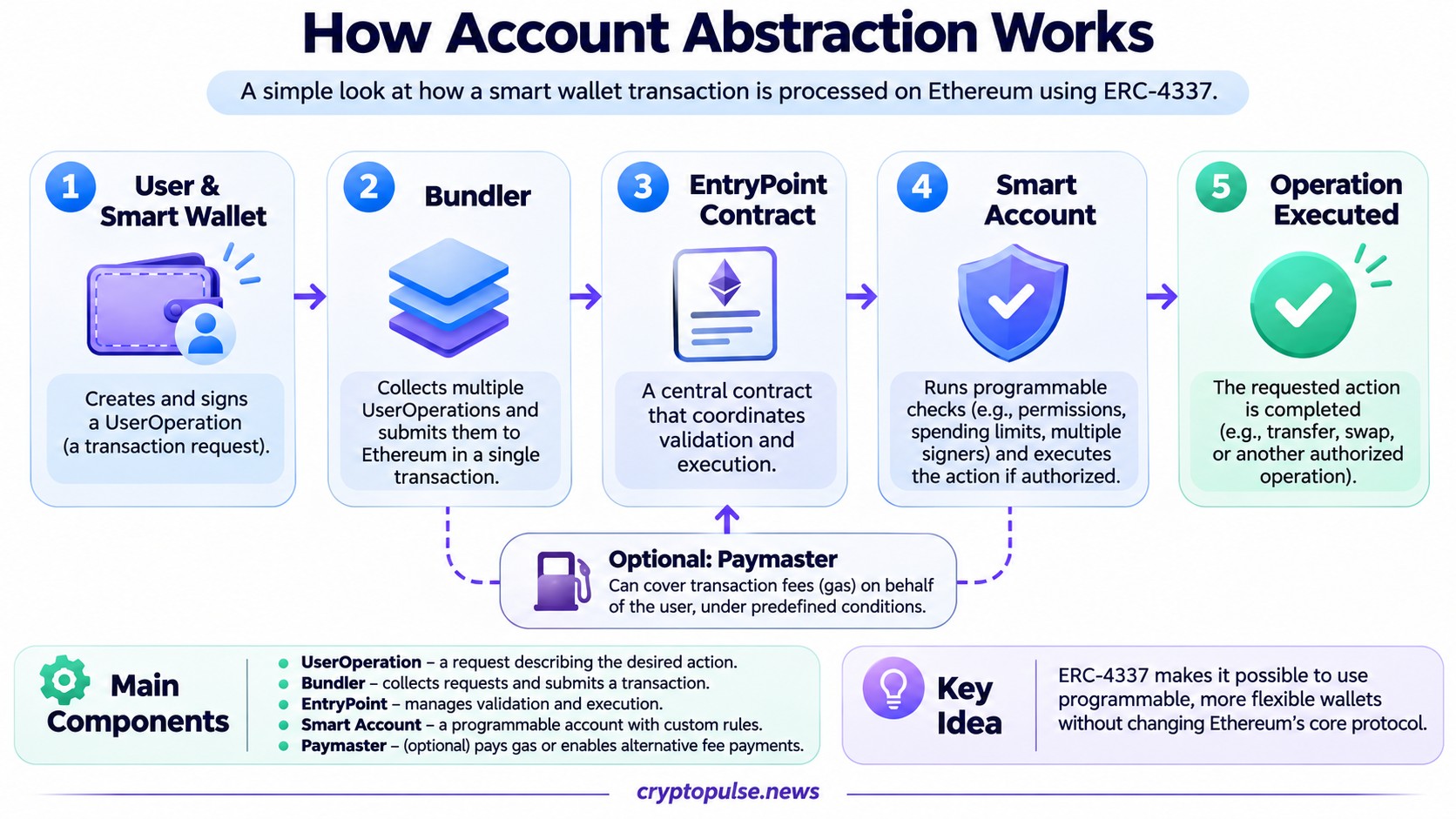
Account abstraction can be implemented through different mechanisms. One widely used approach is ERC-4337, which introduces a transaction-processing system built around programmable accounts without requiring changes to Ethereum’s core consensus rules.
Its operation involves several components working together to validate user requests and execute transactions.
Smart Accounts and Transaction Authorization
A smart account is a blockchain account whose operations are governed by smart contract logic.
Unlike a conventional EOA, which relies on Ethereum’s standard signature verification, a smart account can define its own authorization requirements. For example, it might require approval from two independent keys before transferring a large amount of cryptocurrency.
The contract can also enforce restrictions on transaction destinations, spending amounts, or authorized applications.
When a user requests an action, the smart account checks whether the operation satisfies its programmed conditions before allowing execution.
This programmable validation is central to account abstraction. It enables developers to create different security and access models without requiring every account to follow identical authorization rules.
UserOperations, Bundlers, and EntryPoint
ERC-4337 introduces a transaction request called a UserOperation, which describes an action that a smart account wants to perform.
Rather than submitting a conventional Ethereum transaction directly, the wallet sends this request to specialized infrastructure.
A simplified process involves four steps:
- The user initiates an action, such as transferring tokens.
- A bundler collects UserOperations and submits them to Ethereum through a standard transaction.
- The EntryPoint smart contract coordinates validation and execution.
- The smart account validates the request and, if authorized, executes the intended action.
Bundlers can combine requests from multiple accounts into a single transaction, while EntryPoint provides a standardized interface for processing them.
UserOperations are not ordinary Ethereum transactions. They are requests processed through ERC-4337 infrastructure and ultimately included on-chain through transactions submitted by bundlers.
Paymasters and Transaction Fees
Ethereum transactions require gas, a fee paid for the computational resources used to process operations.
Under ERC-4337, specialized smart contracts called paymasters can cover transaction fees on behalf of users, subject to predefined conditions.
For example, a decentralized application might sponsor the first few transactions for new users, allowing them to interact without initially purchasing ETH.
Paymaster arrangements can also enable users to pay fees with supported tokens rather than the network’s native currency. The underlying infrastructure handles the necessary fee settlement.
However, account abstraction does not eliminate network fees. It changes who pays them and how those costs can be managed.
These arrangements may improve onboarding and simplify payments, but their availability depends on the wallet, application, and supporting infrastructure.
Key Benefits of Account Abstraction
Account abstraction expands the possibilities of wallet design by making account behavior programmable. Its most important advantages concern access management, transaction efficiency, and the ability to customize how users interact with decentralized applications.
Easier Wallet Recovery and Security Controls
Traditional self-custody wallets often depend on securely storing a seed phrase or private key. Losing access to that information can permanently prevent users from controlling their funds.
Smart wallets can introduce alternative recovery mechanisms, reducing dependence on a single backup method.
For example, a wallet might use social recovery, where designated guardians help restore access after the owner loses an authentication device. Guardians may be trusted people, independent devices, or other authorized entities, depending on the implementation.
Programmable security policies can also require additional approvals for sensitive operations or restrict transfers above specified amounts.
These features provide more options for managing access, although they introduce their own risks. Recovery participants, authorization contracts, and backup procedures must remain trustworthy and properly secured.
Transaction Batching and Simpler Payments
Interacting with decentralized finance applications often requires several separate transactions.
For instance, a user exchanging tokens may first need to approve a smart contract’s access to the tokens and then submit a separate swap transaction.
With transaction batching, compatible smart wallets can combine multiple actions into a single operation, reducing the number of approvals and interactions required.
The account can execute these actions sequentially within one transaction, potentially making the complete process easier to manage.
Combined with sponsored gas or alternative fee-payment arrangements, this capability can simplify activities that otherwise require several manual steps.
However, fewer interactions do not necessarily mean lower transaction costs. Actual gas consumption depends on the operations performed, network conditions, and additional smart contract overhead.
Automation and Custom Permissions
Programmable accounts can support controlled automation without requiring users to approve every individual action manually.
One approach involves session keys, which grant temporary or restricted permissions to applications.
For example, a blockchain game could receive permission to perform specific in-game transactions within defined spending limits. The wallet owner would not need to authorize each action separately.
Similarly, smart accounts can implement recurring operations or permissions restricted to particular contracts and transaction types.
These capabilities can improve the experience of applications requiring frequent interactions, particularly gaming platforms and decentralized financial services.
Crucially, automation depends on carefully defined permissions. Users should understand what an application is authorized to do, how long that authorization remains valid, and whether it can be revoked.
Smart wallets make these controls possible, but their availability varies between implementations.
ERC-4337 and EIP-7702 Explained
Ethereum supports multiple approaches to account abstraction, with ERC-4337 and EIP-7702 providing two important paths toward programmable wallet functionality.
Although both enable more flexible account behavior, they differ in how they integrate smart contract logic into Ethereum’s existing account system.
ERC-4337: Smart Accounts Without Protocol Changes
ERC-4337 enables account abstraction through smart contract infrastructure that operates alongside Ethereum’s conventional transaction system.
Instead of requiring modifications to Ethereum’s consensus rules, it introduces a standardized framework for processing UserOperations through bundlers and the EntryPoint contract.
This allows developers to deploy dedicated smart accounts with customizable authorization and execution logic. Depending on their design, these accounts can support multiple signers, recovery mechanisms, transaction batching, and flexible fee arrangements.
ERC-4337 is particularly useful for applications that want to offer programmable wallets without depending on changes to Ethereum’s underlying protocol.
However, its functionality requires supporting infrastructure, and smart accounts may involve additional deployment and execution costs compared with conventional accounts.
EIP-7702: Smart Features for Existing Accounts
EIP-7702 introduces a different approach by allowing existing externally owned accounts to delegate execution to smart contract code.
Through a signed authorization, an EOA can delegate execution to an existing smart contract while retaining its original address. This delegation generally remains active until the account changes or revokes it, rather than automatically ending after one transaction.
This enables capabilities such as transaction batching and programmable execution without requiring users to move their assets into a newly created smart contract wallet.
Unlike ERC-4337, EIP-7702 introduces changes at the Ethereum protocol level. Its delegation mechanism became available through the Pectra network upgrade in May 2025.
Importantly, the original private key retains authority over the account, even after delegation. EIP-7702 does not automatically replace single-key control with stronger authentication.
The two approaches are complementary rather than competing. An EIP-7702 account can also use compatible ERC-4337 infrastructure to process operations through bundlers and paymasters.
Real-World Uses of Smart Wallets
Account abstraction becomes particularly useful when cryptocurrency accounts need more flexible controls than conventional wallets provide. Beyond simplifying individual transactions, programmable accounts can support applications with different security and operational requirements.
Consider several practical scenarios:
- Business treasury management: A company could configure a smart wallet to require multiple approvals for large transfers while allowing smaller operational payments under predefined limits. This provides more granular control over company funds.
- Subscription-style payments: A user could authorize recurring payments within specified limits, allowing compatible applications to collect payments without requesting a new manual approval each time. Such arrangements require carefully restricted permissions.
- Family and shared accounts: A smart wallet could assign different permissions to account participants, allowing limited spending while reserving sensitive operations for designated administrators.
- Automated DeFi strategies: A wallet could authorize selected contracts to execute predefined actions, such as adjusting a position when particular conditions are met. The automation would depend on appropriate permissions and external execution infrastructure.
These scenarios illustrate how account abstraction enables different authorization and transaction models for different users. The underlying features can be combined and customized, although actual capabilities depend on each wallet’s implementation.
Limitations and Security Risks
Despite their advantages, smart wallets introduce additional technical complexity and potential security vulnerabilities. Account abstraction changes how accounts operate, but it does not remove the need for secure authorization and careful wallet management.
One important concern involves smart contract vulnerabilities. Unlike conventional EOAs, programmable accounts depend on contract code that may contain implementation errors. A flaw in transaction validation, access controls, or upgrade mechanisms could expose funds to unauthorized operations. Independent audits help identify risks but cannot guarantee complete security.
Delegated execution introduces another potential attack surface. Under EIP-7702, users can authorize existing accounts to execute code from another contract. Delegating to malicious or compromised code may expose an account’s entire balance, making the selection and verification of delegation targets particularly important.
Recovery mechanisms and automated permissions also require careful configuration. A compromised guardian, unrestricted session key, or poorly designed recovery process could allow an attacker to bypass the intended protections.
Infrastructure dependencies present operational risks as well. Some account abstraction implementations rely on bundlers, paymasters, and supporting services. Unavailable infrastructure, restrictive policies, or insufficient liquidity for fee sponsorship can interrupt transactions even when the underlying network remains operational.
Finally, greater flexibility does not always mean lower costs or better compatibility. Smart contract execution can introduce additional gas overhead, and some applications may not fully support every wallet implementation.
Users should therefore evaluate smart wallets based on their security design, supported features, recovery options, and compatibility rather than assuming that programmable accounts are inherently safer than traditional wallets.
Final Thoughts
Account abstraction represents an important evolution in cryptocurrency wallet design, allowing accounts to operate with greater flexibility than conventional private-key-controlled wallets.
Through approaches such as ERC-4337 and EIP-7702, Ethereum supports programmable transaction authorization, more convenient application interactions, and alternative ways to manage fees and account access.
These capabilities can make decentralized applications easier to use while enabling developers to build more sophisticated security and permission systems.
However, smart wallets introduce trade-offs involving contract security, implementation complexity, and infrastructure dependencies. Their effectiveness depends on how those challenges are addressed.
As decentralized applications become more sophisticated, account abstraction provides a foundation for more adaptable crypto wallets, with greater flexibility in how users authorize transactions, manage access, and retain control over their digital assets.
Frequently Asked Questions
No. Although Ethereum pioneered widely adopted approaches such as ERC-4337, account abstraction is also supported on many Ethereum-compatible networks, including Arbitrum, Optimism, Base, and Polygon. Implementations and available wallet features vary across networks.
Potentially, yes. EIP-7702 allows compatible Ethereum wallets to add smart contract functionality to existing accounts without changing their addresses. However, availability depends on wallet software, network support, and the specific features implemented.
Not necessarily. Some smart wallets offer alternative authentication and recovery methods that reduce reliance on traditional seed phrases, while others still use them. The security model depends on how the wallet manages authorization and recovery.
Not inherently. Blockchain operations still require network fees, but paymasters or applications can cover these costs on behalf of users. This can create a gasless experience for the user without eliminating the underlying transaction expense.
Learn More with CryptoPulse.News
- What Are Smart Contracts and How Do They Work
- What Is Ethereum and Why It Matters in Digital Finance
- What Is Crypto Custody? From Private Keys to Custodians
- How to Store Cryptocurrency Securely: A Beginner’s Guide