What Are Tokenized Deposits and Why They Are Used
Tokenized deposits bring traditional bank money onto digital ledgers, offering new possibilities for payments, financial transactions, and the movement of funds between institutions.
Most money held in bank accounts already exists digitally, but moving it between financial institutions can still involve multiple systems, intermediaries, and settlement procedures. Tokenized deposits offer a different approach by representing commercial bank money on programmable digital infrastructure, where certain transactions can be coordinated and processed more efficiently.
Unlike cryptocurrencies issued independently of banks, tokenized deposits remain connected to the traditional banking system. They are attracting interest from financial institutions seeking to modernize payments, corporate treasury operations, and asset settlement. Understanding their structure, practical applications, and limitations helps explain where this technology fits within the evolving financial system.
Table of Contents
- What Are Tokenized Deposits?
- How Tokenized Deposits Work
- Why Banks and Businesses Use Tokenized Deposits
- Real-World Uses of Tokenized Deposits
- Tokenized Deposits vs. Stablecoins and CBDCs
- Examples of Tokenized Deposit Initiatives
- Risks and Limitations of Tokenized Deposits
- Who Can Access Tokenized Deposits?
- Final Thoughts
- Frequently Asked Questions
What Are Tokenized Deposits?
Tokenized deposits are digital representations of money held at commercial banks, recorded on a distributed ledger or another programmable financial platform. They represent a claim against the issuing bank, much like the balance in a conventional deposit account.
A distributed ledger, such as a blockchain, is a digital record maintained and synchronized across multiple participants. It allows transactions and ownership records to be updated according to agreed rules.
For example, a company holding $10,000 in an eligible bank account might have that amount represented as tokenized deposits on a banking platform. The company still has a claim against the bank, but the digital representation can support additional transaction capabilities.

Tokenization changes how bank money is recorded and transferred, not necessarily its underlying legal nature. The money does not become a decentralized cryptocurrency simply because it appears on a digital ledger.
There are also different models. Some tokenized deposits remain linked to identified bank customers, while transferable deposit tokens can represent claims that pass between holders. This distinction affects how payments operate, who can hold the tokens, and how their value is maintained.
How Tokenized Deposits Work
Tokenized deposit systems combine existing banking relationships with programmable transaction infrastructure. Their operation depends on the issuing bank, the platform’s design, and whether payments remain within one institution or involve several banks.
From Bank Deposits to Digital Tokens
The process begins with a commercial bank that supports tokenized deposits. An eligible customer can have part of an existing deposit balance represented on a digital ledger, subject to the bank’s issuance rules.
For instance, a business with $50,000 in its bank account might allocate $10,000 for use within a tokenized payment platform. The bank records the corresponding amount, ensuring that the tokenized representation is properly reconciled with its deposit obligations.
In some systems, tokens are issued and later redeemed against conventional deposit balances. In others, the ledger directly records account-linked balances.
Tokenization does not necessarily change the customer’s underlying claim against the bank. The exact rights depend on how the deposit arrangement is legally structured.
How Transfers and Settlement Work
When two customers use the same participating bank, a tokenized payment can be processed by updating their balances on the platform.
Suppose Company A pays Company B $5,000. The system reduces Company A’s available balance and credits Company B according to the platform’s rules. Authorized participants can verify the transaction through the shared record.
Payments between customers of different banks are more complicated. One bank cannot simply transfer its deposit liability to another bank in every tokenized deposit model. The sending and receiving banks may need to adjust their respective customer balances and settle the corresponding obligation using central bank money.
Central bank reserves are funds commercial banks hold at their central bank, commonly used to settle obligations between institutions.
A properly coordinated system can link these steps, reducing the need for separate payment messages and manual reconciliation.
Why Banks and Businesses Use Tokenized Deposits
The main attraction of tokenized deposits is the possibility of improving financial processes while retaining commercial banks as regulated providers of money and payment services. Their potential benefits extend beyond simply representing existing deposits in a new digital format.
Faster Payments and Liquidity Management
Traditional payments can involve separate systems for initiating transactions, verifying instructions, transferring funds, and confirming settlement. Cross-border transfers may require additional intermediaries and operate within different banking hours.
Tokenized deposit platforms can bring some of these activities into a more coordinated process. Depending on their infrastructure, payments may settle faster, operate across extended hours, and require fewer reconciliation steps.
For businesses, this can improve access to liquidity, meaning funds available to meet immediate payment obligations.
However, tokenization does not guarantee instant or inexpensive transfers. Actual performance depends on participating institutions, platform availability, compliance procedures, and the settlement arrangements connecting different banks.
Programmable Transactions and Settlement
Another important feature is programmability: the ability to execute financial instructions automatically when predefined conditions are satisfied.
Smart contracts, which are programs that carry out agreed rules, can help coordinate payments with other business activities.
For example, a company purchasing a digital financial asset could arrange for payment to occur only when the asset is successfully delivered. If the required conditions are not met, the transaction would not complete under those rules.
Banks may also automate selected treasury transfers, payment approvals, or settlement procedures.
These capabilities can reduce operational work and certain execution risks. Nevertheless, they require reliable software, appropriate authorization, and controls to prevent mistakes or unauthorized transfers.
Real-World Uses of Tokenized Deposits
Tokenized deposits are particularly relevant to institutions that handle substantial transaction volumes, manage funds across multiple entities, or participate in digital financial markets. Their applications range from corporate payments to the settlement of tokenized securities.
Corporate and Cross-Border Payments
Businesses operating internationally often need to send money across banks, currencies, and jurisdictions. These transfers may involve correspondent banks, which process payments on behalf of other financial institutions.
Tokenized deposit systems can help participating banks coordinate payment instructions and settlement more directly.
For example, a company paying an overseas supplier could use a platform connecting both banks, potentially reducing processing delays and improving transaction visibility.
Cross-border payments still require currency conversion, regulatory compliance, and suitable settlement arrangements. A tokenized platform cannot eliminate these requirements merely by using a shared ledger.
Treasury and Liquidity Management
Corporate treasury teams oversee a company’s cash balances, payment obligations, and short-term funding needs.
A multinational business may hold funds across subsidiaries and banks in several countries. Moving money between these accounts can be operationally complex, especially outside regular banking hours.
With suitable tokenized deposit infrastructure, treasury teams could automate eligible internal transfers and monitor available liquidity through a coordinated platform.
For instance, a company might move funds between participating entities to meet an upcoming payment without relying on several disconnected processes.
These arrangements can improve cash management, although their usefulness depends on which banks, currencies, and corporate accounts the platform supports.
Settlement of Tokenized Assets
Tokenized deposits can also function as a payment mechanism for financial assets represented on digital ledgers, including tokenized bonds and other securities.
A particularly useful mechanism is delivery-versus-payment (DvP), where the transfer of an asset is linked to the corresponding transfer of money.
Consider an investor purchasing a tokenized bond. A coordinated settlement system can arrange for the bond and payment to change hands together, so neither side completes its transfer independently.
This approach can reduce settlement risk, including the possibility that one party delivers an asset without receiving the agreed payment.
Such transactions require compatible infrastructure and enforceable settlement arrangements. Not every tokenized deposit or asset platform currently supports this functionality.
Tokenized Deposits vs. Stablecoins and CBDCs
Tokenized deposits are one of several forms of digital money. Although they share certain technological features with stablecoins and central bank digital currencies (CBDCs), their main differences involve who issues them, what they represent, and how they operate.
Stablecoins are digital assets designed to maintain a relatively stable value, often against the US dollar. Depending on their structure, they may be backed by cash, government securities, or other assets. Their holders generally have claims determined by the issuer’s legal arrangements rather than conventional bank deposit rights.
CBDCs, meanwhile, represent money issued directly by a central bank. They may be designed for public use or for transactions between financial institutions.
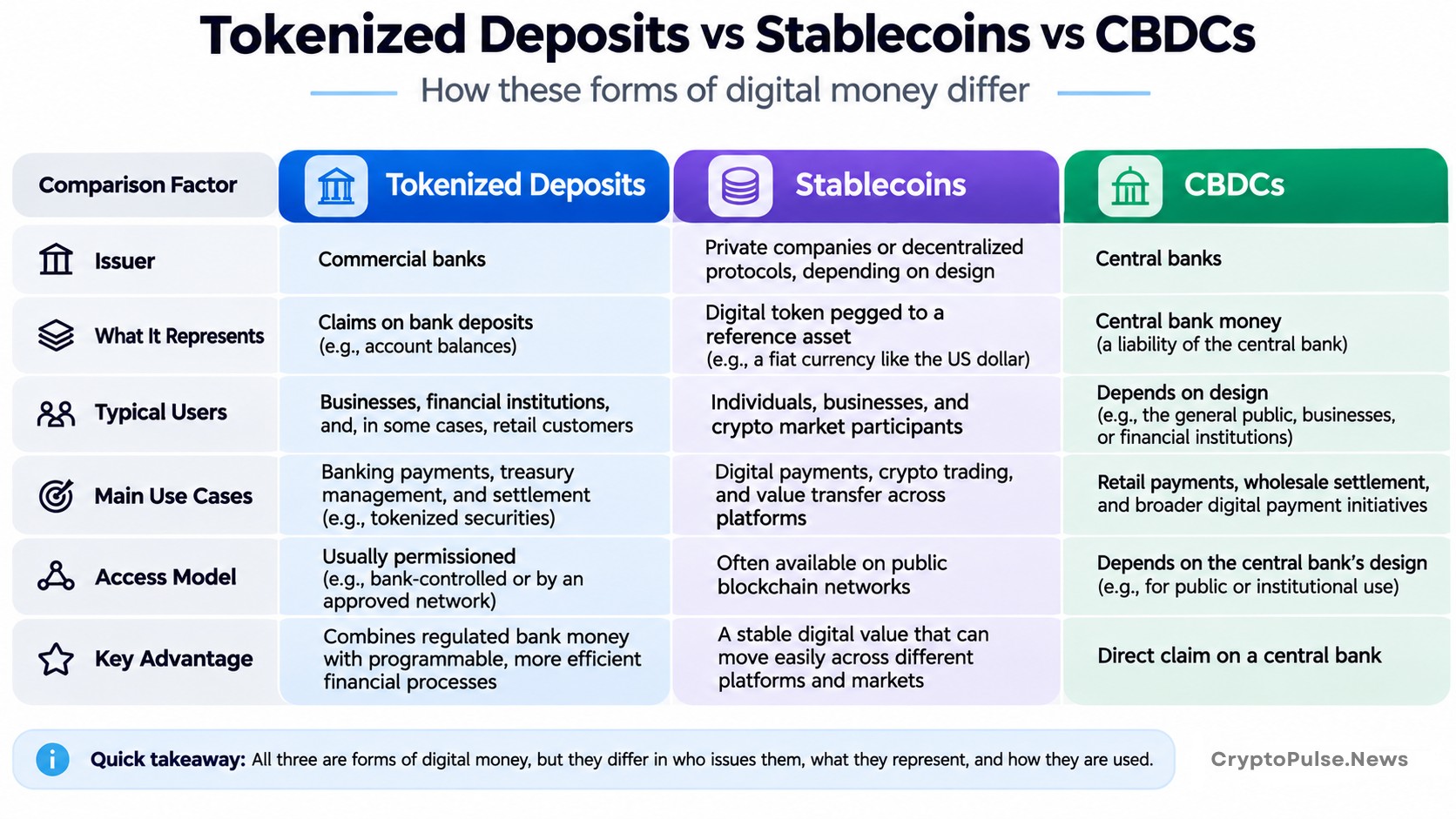
Tokenized deposits retain a direct connection to commercial banking, whereas stablecoins follow their own issuance and reserve arrangements. Eligible deposits may also benefit from deposit insurance, depending on the jurisdiction and legal structure.
These forms of digital money are not necessarily competitors. Each can serve different financial needs.
Examples of Tokenized Deposit Initiatives
Several major financial institutions have developed tokenized deposit services, demonstrating how the technology can be applied within existing banking operations.
J.P. Morgan’s Kinexys platform supports digital payments using commercial bank money. Its JPM Coin deposit token allows eligible institutional clients to transfer dollar-denominated value on supported public blockchain networks, including Base and Ethereum, while remaining within the bank’s controlled framework.
Citi Token Services uses tokenization to facilitate corporate liquidity transfers and cross-border payments between participating Citi accounts. Its infrastructure is designed to support transfers beyond conventional banking hours while retaining the bank’s established account relationships.
DBS Token Services, developed by Singapore-based DBS Bank, combines permissioned blockchain technology with banking services. Its offerings include Treasury Tokens and conditional payment capabilities intended to support institutional cash management.
These initiatives illustrate different implementations of the same broader concept. Tokenized bank money can operate through private networks or permissioned arrangements on public blockchains, depending on the institution’s technical and business requirements.
Risks and Limitations of Tokenized Deposits
Despite their potential advantages, tokenized deposits remain exposed to financial, technological, and operational risks. Their connection to regulated banks provides an established legal and institutional framework, but does not eliminate these challenges.
Banking and Technology Risks
Tokenized deposits remain liabilities of the issuing commercial bank, meaning their holders are exposed to the bank’s financial condition. Tokenization does not remove credit risk or guarantee repayment under every circumstance.
Deposit insurance may apply to eligible balances, but coverage depends on local regulations, account ownership, and the product’s legal classification.
Digital infrastructure introduces additional concerns. Software vulnerabilities, compromised credentials, incorrect transaction instructions, or failures in smart contracts can disrupt operations or lead to financial losses.
A shared ledger may provide transparent transaction records, but accurate recordkeeping does not guarantee that every transaction is legitimate or reversible.
Banks therefore need appropriate cybersecurity measures, transaction controls, recovery procedures, and operational safeguards.
Interoperability and Regulatory Challenges
Many tokenized deposit platforms operate within individual banks or networks of approved institutions. Moving funds between separate systems can require additional technical connections and settlement arrangements.
Interoperability remains a major obstacle to broader adoption, particularly when platforms use different standards or cannot communicate directly.
Regulatory requirements also vary across jurisdictions. Banks must consider customer verification, anti-money-laundering controls, data protection, and the legal treatment of digital deposits.
Cross-border operations create further complexity because participating institutions may face different rules and supervisory expectations.
Finally, introducing tokenized deposits requires investment in technology, operational changes, and coordination with existing banking infrastructure. The potential efficiency gains must justify these implementation costs.
Who Can Access Tokenized Deposits?
Most tokenized deposit services are designed primarily for institutional customers, including corporations, financial institutions, and businesses with specialized payment or treasury needs.
Access generally requires an account with a participating bank, identity verification, and approval to use the relevant platform. Depending on the service, participants may also need compatible technical infrastructure.
Unlike widely available cryptocurrencies, tokenized deposits are not necessarily assets that anyone can purchase, hold in a personal crypto wallet, or transfer to an arbitrary blockchain address.
Some systems use public blockchain networks while restricting participation to approved customers. Others operate entirely within private banking environments.
Retail applications are also possible, but their availability depends on individual banks, regulatory frameworks, and product design.
Using a public blockchain does not automatically make tokenized deposits publicly accessible. The bank issuing the money may still control who can hold, transfer, and redeem it.
Final Thoughts
Tokenized deposits offer a way to modernize commercial bank money without fundamentally changing its relationship to the issuing institution. By combining bank deposits with programmable digital infrastructure, they can support new approaches to payments, treasury management, and financial asset settlement.
Their value lies not simply in creating digital tokens, but in connecting money transfers with more efficient and coordinated financial processes.
However, regulatory requirements, banking risks, interoperability, and technical complexity remain important considerations.
Tokenized deposits are unlikely to serve every purpose currently addressed by traditional bank accounts, stablecoins, or CBDCs. Instead, they represent another form of digital money that can help connect established banking services with emerging financial infrastructure.
Frequently Asked Questions
Yes, tokenized deposits can earn interest, depending on the underlying bank account and the terms offered by the issuing institution. Tokenization itself does not generate interest or guarantee any additional returns.
Tokenized deposits may qualify for deposit insurance if they meet the applicable legal requirements. Coverage depends on the issuing bank, jurisdiction, account ownership, and deposit structure, rather than the use of tokenization itself.
Eligible holders can generally redeem or convert tokenized deposits into conventional bank balances according to the issuing bank’s rules. The process and availability depend on the specific platform, and direct withdrawal of physical cash may require a separate banking transaction.
Yes, some tokenized deposit products operate on public blockchain networks, but participation is typically restricted to approved users. A public blockchain does not automatically make a bank-issued token freely transferable or accessible to everyone.
Learn More with CryptoPulse.News
- What Is Tokenization and How It Transforms Finance
- What Are Stablecoins and Their Role in Modern Finance
- What Is a CBDC? How Governments Are Digitizing Money
- What Are Real-World Assets (RWA) in Crypto