What Is Market Making in Crypto
Crypto market making is the practice of continuously quoting buy and sell prices to provide liquidity while managing inventory, spreads, and market risk.
Market making is an important but often misunderstood part of cryptocurrency trading. When a token has active buy and sell orders near its current price, traders can usually enter or exit positions without waiting for another participant to take the opposite side at exactly the same moment. Market makers help create that continuous availability of liquidity.
The process is more involved than simply placing a few orders on an exchange. Professional market makers use algorithms and trading systems to adjust quotes as prices, trading activity, volatility, and available liquidity change. They also have to manage the inventory they accumulate when trades are not balanced and may hedge their exposure across other markets.
Table of Contents
- What Is a Crypto Market Maker?
- How Market Makers Provide Liquidity
- How Market Makers Manage Inventory and Risk
- How Market Making Influences Prices and Price Impact
- Market Making on Exchanges
- How Crypto Market Makers Make Money
- Common Misconceptions and Risks
- Conclusion
- Frequently Asked Questions
What Is a Crypto Market Maker?
A crypto market maker is a trader or trading firm that continuously quotes buy and sell prices for a cryptocurrency market. These quotes give other participants an opportunity to buy or sell without having to wait for a matching order to appear at exactly the same price.
On a traditional order book, the market maker’s two basic quotes are the bid, which is the price at which it is willing to buy, and the ask, which is the price at which it is willing to sell. The difference between them is the bid-ask spread.
For example, suppose a token is trading around $10.00. A market maker could quote a $9.98 bid and a $10.02 ask. A trader who wants to sell immediately can trade against the bid, while a trader who wants to buy immediately can trade against the ask.

This does not mean the market maker determines that the token is worth $10.00. Its quotes are part of a larger market in which many participants continuously submit and cancel orders. Market making is primarily about supplying tradable liquidity and managing the risks of doing so, rather than predicting where the market should ultimately trade. Market makers and market takers therefore play complementary roles: one supplies liquidity while the other consumes it.
How Market Makers Provide Liquidity
The mechanics of market making become clearer when looking at what happens inside an exchange order book.
Two-Sided Quotes
A professional market maker generally tries to maintain orders on both sides of the market rather than simply buying and holding an asset. These quotes can be adjusted many times as the market moves.
Imagine that ETH is quoted at a $3,500 bid and a $3,502 ask. A trader submitting a market sell order could immediately sell into the $3,500 bid, while a buyer could purchase at $3,502. If the market moves higher, the market maker can move its quotes higher as well.
The goal is not necessarily to keep exactly the same spread throughout the day. Quotes may become wider when volatility or uncertainty increases and narrower when competition and market conditions allow it. A market maker also has to consider how much inventory it already holds and whether incoming orders are becoming heavily one-sided.
This continuous adjustment is one reason professional market making is usually automated. Crypto markets trade around the clock, and responding manually to every change in price and order flow would be impractical at scale.
Order-Book Depth and Spreads
Liquidity is not just about whether a buy or sell order exists. It also depends on how much trading capacity is available near the current market price.
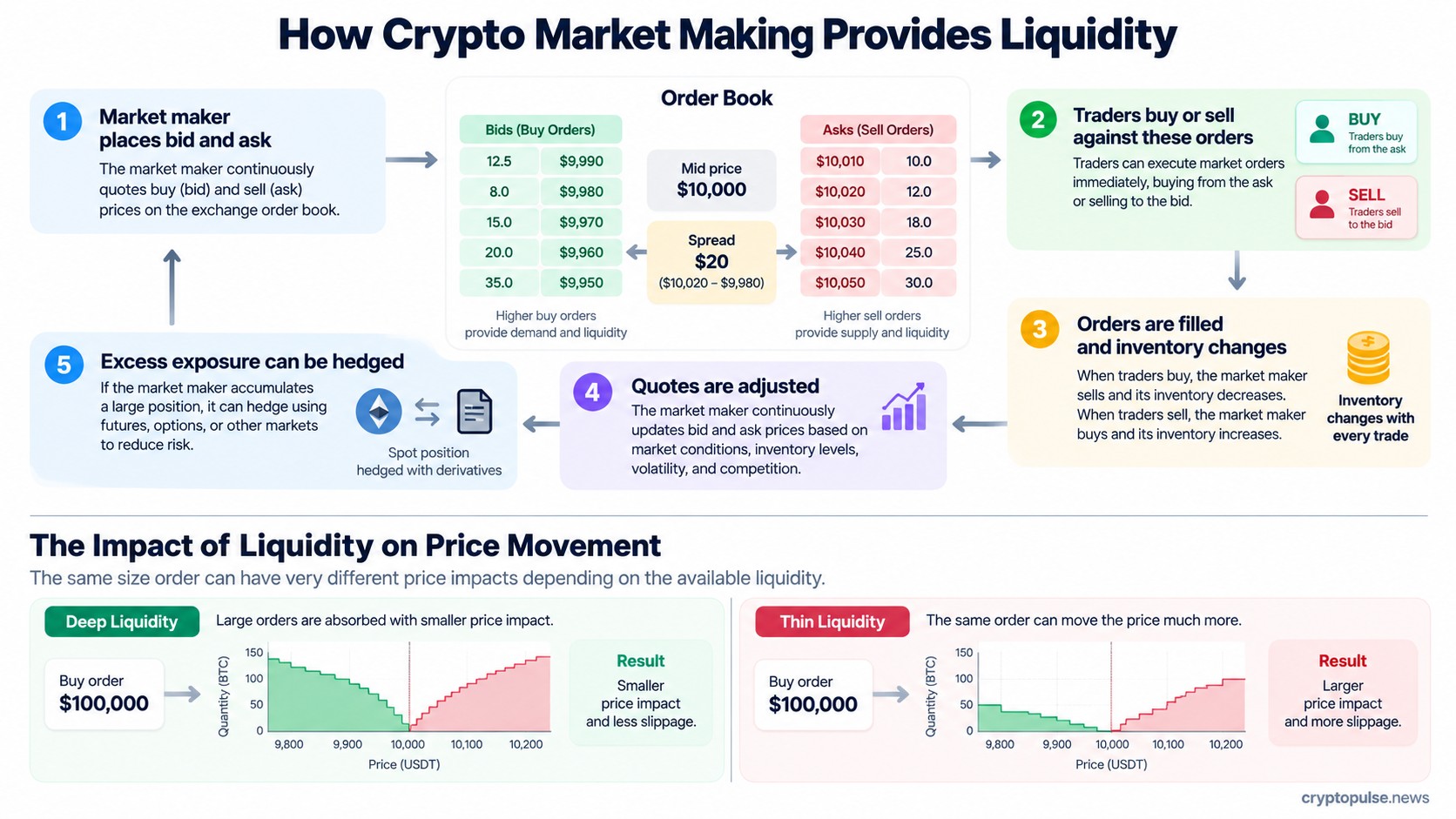
Consider two markets with a token trading at $10. In the first, there may be millions of dollars of buy and sell orders distributed across prices close to $10. In the second, only a small amount of liquidity may be available near the market. A large market order is likely to move through more price levels in the second market, producing greater slippage, meaning the trader receives an average execution price that is less favorable than the price visible before the order was submitted.
The bid-ask spread is another basic measure of trading conditions. A narrower spread generally means the immediate cost of crossing from one side of the market to the other is lower, all else being equal. Deeper order books can also reduce the price impact of larger trades. Coinbase Institutional has demonstrated this relationship in studies of digital-asset execution: flatter slippage curves correspond to more liquid trading venues, while larger orders can produce increasingly significant execution costs in thinner markets.
In practical terms, better liquidity means traders can usually execute larger orders with less slippage.
How Market Makers Manage Inventory and Risk
Providing liquidity creates a problem that is easy to overlook: the market maker does not control which side of its quotes traders will hit.
Inventory Risk
Suppose a market maker posts both bids and asks for a token priced at $10. If traders buy heavily from its ask orders, the market maker sells tokens and its inventory falls. If traders repeatedly sell into its bids, the market maker buys tokens and accumulates a larger position.
Either situation can create unwanted exposure.
Imagine that a market maker accumulates 100,000 tokens at an average price of $10. If the token suddenly falls to $8, the inventory has lost $200,000 in unrealized value. The market maker may have earned money from spreads along the way, but those gains can be overwhelmed by an adverse move in the inventory.
This is known as inventory risk. It is one of the central challenges of market making because the business depends on repeatedly providing liquidity while avoiding an excessive directional position.
Professional market makers therefore monitor inventory continuously and can change their quotes to encourage trades in one direction or the other. For example, a firm holding too much of a token may make its sell quote more attractive or its buy quote less aggressive in an attempt to reduce inventory.
Academic research on cryptocurrency markets supports the importance of this problem. A study covering multiple centralized exchanges from March 2017 through March 2022 found that liquidity-provision returns vary with volatility and liquidity. It also identified inventory risk and adverse selection as important factors affecting market-making economics.
Hedging Market-Making Positions
Market makers do not always have to eliminate an unwanted position simply by trading the same asset in the spot market. They can also use hedging, which means taking another position designed to reduce the effect of an adverse price move.
For example, suppose a market maker has accumulated a large amount of ETH while providing liquidity on a spot exchange. Instead of immediately selling all of that ETH, it could open a short ETH position through a perpetual futures contract. If ETH falls, losses on the spot inventory may be partially offset by gains on the hedge.
The hedge does not make the position risk-free. Funding costs, basis risk, execution costs, liquidity conditions, and the possibility that the hedge does not move perfectly with the underlying position all remain. The purpose is to reduce unwanted market exposure, not to eliminate every source of risk.
Hedging can also be used across venues or related instruments when a market maker operates in several markets. In practice, professional firms combine quoting, inventory management, and hedging rather than treating each activity separately.
It is also useful to distinguish hedging from arbitrage. Arbitrage seeks to exploit price differences between related markets, while hedging is primarily about reducing an existing exposure. A market-making firm may engage in both activities, but they serve different purposes.
How Market Making Influences Prices and Price Impact
Market making does not mean that a trading firm decides where a cryptocurrency should trade. However, the amount and quality of liquidity available around the current price can significantly affect how orders move through the market.
Consider two tokens trading at $10. If one has substantial buy and sell orders close to $10, a $100,000 market order may be absorbed with relatively limited slippage. If the other has a thin order book, the same order can consume several price levels and move the traded price much more. In market microstructure, this relationship is commonly described through price impact: more liquid markets generally experience a smaller price change for a given amount of net order flow.
Market makers can therefore influence the cost and immediate price impact of trading by providing or withdrawing liquidity and adjusting their quotes. Their activity can also contribute to short-term price discovery as they continuously update bids and asks in response to information and order flow.
There is an important distinction, however. Market makers are participants in price formation, not automatic price setters. Broader supply and demand, news, investor expectations, arbitrage, and activity from other traders all contribute to the market price.
Market Making on Exchanges
Market making looks different depending on how a trading venue matches orders. The basic objective remains similar—make it easier for participants to trade by maintaining available liquidity—but the mechanism can be very different on a centralized exchange compared with a decentralized exchange.
Centralized Exchange Market Making
On centralized exchanges, professional market makers commonly interact directly with an electronic order book. Their systems continuously place, cancel, and replace limit orders as prices and market conditions change.
Suppose BTC is trading at $100,000. A market maker might maintain bids below the current market and asks above it, with quantities distributed across several price levels. As BTC moves, volatility changes, or one side of the inventory becomes too large, the system can automatically adjust those quotes.
This activity can provide greater order-book depth, tighter spreads, and more immediate execution, although the exact benefits depend on how much liquidity the market maker actually supplies and how stable that liquidity is. Crypto research covering centralized exchanges has found that liquidity provision is particularly exposed to inventory risk and adverse selection, especially in smaller, more volatile, and less liquid cryptocurrency pairs.
Decentralized Exchanges and AMMs
Decentralized exchanges can use a different model called an automated market maker (AMM). Instead of relying exclusively on a traditional order book, an AMM can use a smart-contract-controlled liquidity pool from which traders swap assets.
In the classic Uniswap v2 design, for example, each liquidity pool follows a constant-product formula, commonly expressed as x × y = k. Traders swap one token for another against the pool, while the formula determines how the pool’s relative token balances change and therefore how the implied price moves.
An AMM is not the same thing as a professional market-making firm. Liquidity can be supplied by individual users, while the pricing mechanism is implemented by the protocol. Professional firms can also participate in decentralized markets using automated strategies, but the underlying structure is different from a CEX order book.
Liquidity providers on AMMs face their own risks, including impermanent loss, which can occur when the relative prices of the assets in a pool change. Research on AMMs shows that these opportunity costs can be substantial, particularly when the assets in a pool are not closely correlated.
How Crypto Market Makers Make Money
Market making is generally designed to earn revenue from providing liquidity while controlling the risks created by that activity. One potential source is the bid-ask spread: if a market maker buys at the bid and later sells at the ask, the difference can contribute to gross trading revenue.
In reality, the economics are more complicated. A market maker pays exchange fees where applicable, faces technology and execution costs, and can lose money when its inventory moves against it. Spread revenue is not the same as guaranteed profit.
Market makers may also receive exchange-specific liquidity incentives, rebates, or other commercial compensation. When working with token issuers, a professional firm may have a separate contractual arrangement covering its liquidity-provision services.
Suppose a market maker repeatedly captures an average spread of $0.02 on a token, but a sharp price decline leaves it holding a large inventory. The losses from inventory exposure can exceed the revenue generated from many individual trades. This is why professional market making depends as much on pricing, inventory management, hedging, and risk controls as on the number of trades completed.
Research on cryptocurrency liquidity provision similarly finds that the expected economics of providing liquidity vary with volatility, trading activity, liquidity, and adverse selection.
Common Misconceptions and Risks
Market making is often surrounded by assumptions that go beyond what liquidity provision actually does.
One common misconception is that market makers control a token’s price. They can influence spreads, available depth, and the price impact of orders, but they operate alongside many other participants and cannot independently determine the market’s long-term valuation.
Another misconception is that market making automatically makes a token’s price rise. Liquidity can make buying and selling more efficient, but it does not create fundamental demand. A token can have substantial liquidity and still fall sharply when sellers dominate the market.
Market making is also not inherently the same as market manipulation. Legitimate market making involves providing buy and sell liquidity and managing resulting risks. Manipulative conduct, by contrast, can involve deceptive trading practices designed to create a false impression of supply, demand, or market activity. The two should not be treated as interchangeable.
The terminology is occasionally confused with marketing, largely because the words sound similar. The activities themselves are completely different: market making concerns trading liquidity and execution, while marketing concerns promotion, awareness, and communicating a project’s value proposition.
Finally, market making does not eliminate risks. Inventory risk, adverse selection, volatility, liquidity shocks, execution risk, and hedging costs can all affect results. Providing liquidity is therefore a risk-management business, not a risk-free way to collect spreads.
Conclusion
Market making plays an important role in keeping crypto markets liquid and tradable. Market makers continuously provide buy and sell quotes, manage the inventory created by executed orders, and use hedging and other risk-management techniques to control their exposure.
For traders, this activity can mean tighter spreads, deeper order books, and less slippage, particularly in actively supported markets. At the same time, market making does not guarantee a stable price or determine an asset’s long-term value. Market makers are one part of the broader price-discovery process, alongside traders, investors, arbitrageurs, exchanges, and changing market conditions.
Understanding how market making works makes it easier to evaluate liquidity and trading conditions across both centralized and decentralized crypto markets.
Frequently Asked Questions
A market maker provides liquidity by placing orders that can rest on an exchange’s order book, while a market taker consumes existing liquidity by executing against those orders. A trader can act as either a maker or taker depending on how an order is placed and executed.
Market making itself is not market manipulation. Legitimate market making provides buy and sell liquidity, while manipulation involves deceptive or abusive trading intended to distort market activity or prices.
When a market maker reduces or removes its quotes, order-book depth can fall and spreads can widen, making larger trades more likely to experience slippage and price impact. During periods of extreme volatility, liquidity providers may reduce their exposure as part of risk management.
Crypto projects may hire market makers to improve trading liquidity, maintain tighter spreads, and provide deeper order books for their tokens across selected exchanges. This is different from marketing: market making supports trading infrastructure, while marketing focuses on promotion and awareness.
Learn More with CryptoPulse.News
- How Crypto Liquidity Moves Prices in the Market
- What Are Crypto Derivatives and Why Traders Use Them
- How to Analyze the Crypto Market Using Key Indicators