How Crypto Prediction Markets Work
Crypto prediction markets let users trade on future events, with contract prices showing how likely traders collectively believe each outcome is.
What will Bitcoin cost at the end of the year? Will a central bank cut interest rates at its next meeting? Will a company launch a particular product before a deadline?
Instead of simply asking people what they expect, a prediction market allows them to put money behind their forecasts by buying and selling contracts tied to an outcome. As traders react to new information, contract prices rise or fall, creating a live estimate of what the market collectively considers more or less likely.
Crypto prediction markets apply this model using digital assets and, in some cases, smart contracts and onchain settlement. Understanding them starts with one simple idea: you are trading the outcome of an event, not the underlying asset itself.
Table of Contents
- What Is a Crypto Prediction Market?
- How Crypto Prediction Markets Work
- Why Prediction Market Prices Look Like Probabilities
- What Makes Crypto Prediction Markets Different?
- What Can Prediction Markets Be Used For?
- Prediction Markets vs. Traditional Betting
- Risks and Limitations of Prediction Markets
- Can Prediction Markets Actually Predict the Future?
- Final Thoughts
- Frequently Asked Questions
What Is a Crypto Prediction Market?
A prediction market is a marketplace where participants trade contracts whose value depends on whether a specified future event occurs. These instruments are often called event contracts.
The subject can be almost anything that can be clearly verified: a cryptocurrency reaching a certain price, an economic data release, an election result, a sports outcome, or whether a company completes a particular action before a deadline. U.S. regulator CFTC similarly describes prediction markets as markets where participants buy and sell contracts based on whether defined events occur.
Crypto prediction markets bring digital-asset infrastructure into that model. Depending on the platform, users may trade using stablecoins, hold outcome tokens in crypto wallets, or rely on smart contracts to handle positions and settlement.

A prediction market is not the same thing as a poll. A poll records what respondents say they believe. A market asks participants to risk capital on those beliefs. Someone who thinks the prevailing market estimate is wrong can take a position and potentially profit if their assessment proves more accurate.
Platforms such as Polymarket have popularized this model in crypto by offering markets across politics, economics, technology, crypto, sports, and other categories.
How Crypto Prediction Markets Work
The interface can look simple — often little more than a question and two prices — but several steps occur between creating a market and paying the winning side.
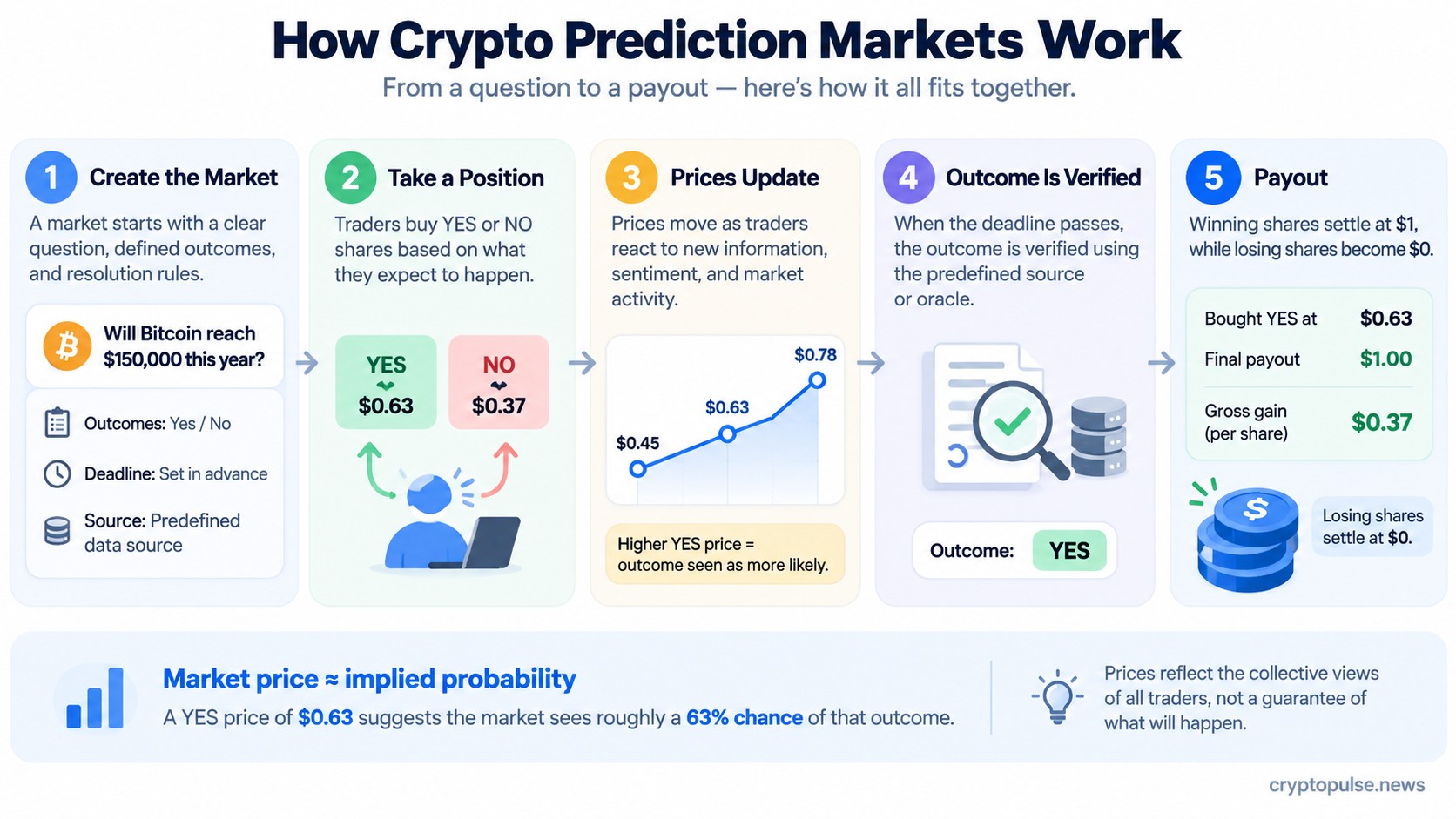
1. A Market Is Created Around an Event
Every prediction market begins with a clearly defined question and resolution rules.
Consider a hypothetical market:
Will Bitcoin close above $150,000 on December 31, 2026?
For that question to work as a tradeable contract, the rules need to define more than the headline. Which price source determines Bitcoin’s closing price? At what exact time is it measured? What happens if the selected exchange experiences an outage? Which timezone applies?
These details matter because traders need to know exactly what they are betting their capital on before entering a position.
Modern platforms therefore publish resolution criteria alongside the market. Polymarket, for example, states that its rules specify the resolution source, end date, and handling of relevant edge cases; the market title summarizes the question, while the detailed rules determine how it ultimately resolves.
A well-designed market minimizes ambiguity before trading begins rather than trying to interpret the result afterward.
2. Traders Buy YES or NO Positions
Many prediction markets use a binary structure with two possible outcomes: YES or NO.
Suppose the Bitcoin market has a YES position trading at $0.63. A trader buying at that price pays $0.63 per share because they believe the event is sufficiently likely — or that the contract itself is underpriced.
If the market ultimately resolves YES, a winning share is typically redeemable for $1. If the event resolves NO, the YES share becomes worth $0.
That means someone buying YES at $0.63 and holding it through a successful resolution would receive $1, generating a $0.37 gross gain per share before applicable fees and other costs.
Crypto prediction markets can differ in their technical design, but an important distinction from a conventional sportsbook is that users may be trading against other market participants rather than a bookmaker setting fixed odds. On Polymarket, for example, opposing YES and NO orders can be matched when their combined prices equal $1, creating fully collateralized outcome shares.
3. Prices Change as Traders React
A prediction-market price is not fixed when the contract is created. It changes as buyers and sellers continuously reassess the event.
Imagine that YES initially trades around $0.45. New information then makes the outcome appear more likely, attracting buyers and pushing the market toward $0.61. Later, another major development moves it to $0.78.
No central authority has necessarily declared that the event is now more probable. Instead, the price changes because market participants are willing to buy and sell at different levels.
This is price discovery — the same broad mechanism through which many financial markets incorporate changing expectations into prices.
On an order-book platform such as Polymarket, traders place bids and offers at prices they are willing to accept. Polymarket currently displays its headline probability using the midpoint between the best bid and ask when the spread is sufficiently narrow; if the spread exceeds $0.10, it uses the most recent traded price instead.
As new information arrives, traders can also sell positions before the event ends rather than waiting for final settlement.
4. The Market Resolves and Pays Out
Eventually, the question must receive a definitive answer.
If our hypothetical Bitcoin contract specifies a particular exchange price at a particular timestamp, that agreed source is checked once the deadline arrives. The market then resolves according to the rules established before trading.
Winning shares settle at their defined payout value, while losing shares become worthless.
Crypto-native platforms can use oracles as part of this process. An oracle is a mechanism that brings information from outside a blockchain — such as an election result, sports score, or financial data point — into a system that smart contracts can use.
Polymarket currently resolves markets through UMA’s Optimistic Oracle. A result can be proposed and challenged before becoming final, and successful market resolution makes winning shares redeemable for $1 while losing shares have no value.
The exact mechanism varies between platforms, which is why resolution rules are as important as the market price itself.
Why Prediction Market Prices Look Like Probabilities
One of the most useful — and most easily misunderstood — features of prediction markets is that prices can be interpreted as implied probabilities.
The connection becomes clearer once the contract’s payout structure is understood.
Reading the Price
Suppose a binary market shows:
YES: $0.72
NO: $0.28
A YES price near $0.72 can be read as roughly a 72% market-implied probability that the event will occur, while $0.28 represents roughly 28% for the opposite outcome.
This interpretation comes from the payoff. If a winning contract becomes worth $1, paying $0.72 for YES makes economic sense only if the buyer believes the likelihood or trading opportunity justifies risking those 72 cents.
If the market resolves YES, someone who purchased at $0.72 and held until settlement receives $1, leaving a $0.28 gross profit per share. And if it resolves NO, the $0.72 position is lost.
This price-probability relationship is central to prediction markets. Academic research has long treated prediction-market prices as market-aggregated forecasts, because participants with different information and expectations interact through trading rather than simply reporting opinions.
Price Is Not the Same as Truth
A 72-cent YES contract should not be interpreted as scientific proof that an event has exactly a 72% objective chance of happening.
It tells us what the market currently implies based on available orders, trades, incentives, and information.
That distinction matters.
A thinly traded market can move sharply after one large order. Participants can share the same bias or react incorrectly to new information. Wide bid-ask spreads can make a single displayed probability less informative. Traders may also disagree about the contract’s resolution rules rather than the underlying event itself.
Liquidity therefore matters when judging the quality of a prediction-market signal. A heavily traded market with many independent participants generally provides more information than an obscure contract with little activity, although high volume alone does not guarantee an accurate forecast.
Prediction-market prices are best viewed as dynamic estimates produced by market participants, not authoritative probabilities. Their real value lies in showing how collective expectations change as information changes.
What Makes Crypto Prediction Markets Different?
Prediction markets existed long before crypto, but digital assets changed how some of these markets can be funded, traded, and settled. The main difference is not the idea of trading on future events; it is the infrastructure used to operate the market.
Stablecoins and Onchain Settlement
Crypto prediction markets often use stablecoins as the trading and settlement asset, avoiding the price volatility that would come from denominating contracts directly in Bitcoin or another fluctuating cryptocurrency.
Polymarket, for example, currently operates on Polygon and denominates transactions in USDC, a dollar-pegged stablecoin. Its YES and NO shares are collateralized by USDC, while winning shares can be redeemed after resolution.
This creates a relatively straightforward accounting model: a contract priced at $0.60 is economically close to a 60-cent position rather than an amount whose value changes with the cryptocurrency used to fund it.
Onchain infrastructure can also make transactions and contract activity publicly verifiable. However, using crypto does not automatically make a prediction market fully decentralized. Platforms can still control interfaces, market listings, user access, compliance procedures, or other parts of the system.
Smart Contracts and Market Resolution
Smart contracts can automate important parts of prediction-market infrastructure, including the creation of outcome shares, collateral management, and payouts after a market resolves.
The more difficult part is determining what actually happened in the real world.
A blockchain cannot independently know who won an election, what an official inflation figure was, or whether a company launched a product before a deadline. That information has to come from an external source.
This is where oracles become important. An oracle provides or verifies offchain information so that an onchain system can act on it.
Different platforms handle this process in different ways. Some rely on decentralized oracle systems, while others use designated data sources, administrators, or regulated exchange procedures to determine the final outcome.
This makes the resolution mechanism a critical part of market design. A perfectly functioning smart contract is still only as useful as the rules and external information used to determine the winner.
Open Market Infrastructure
Crypto can also make prediction-market infrastructure more programmable.
Outcome tokens can exist as digital assets, settlement can occur without traditional banking hours, and market activity can potentially interact with other onchain applications. Public ledgers can provide additional transparency around transactions and collateral.
At the same time, it is important not to treat all prediction markets as one category. Not every prediction market uses crypto, and not every crypto prediction market operates in the same way.
Kalshi, for example, runs a centralized U.S. exchange regulated by the Commodity Futures Trading Commission, while Polymarket uses stablecoins, Polygon, smart contracts, and an oracle-based resolution system. Kalshi describes itself as a Designated Contract Market regulated by the CFTC.
The underlying concept is similar, but the technical architecture and regulatory framework can be very different.
What Can Prediction Markets Be Used For?
Prediction markets can be created around almost any clearly measurable future event for which participants have different expectations.
Common categories include cryptocurrency prices, macroeconomic data, interest-rate decisions, elections, company milestones, technology launches, sports, and entertainment events.
A crypto-focused market might ask whether Ethereum will exceed a certain price before year-end. An economic market could track whether a central bank will change interest rates at its next meeting. Other contracts may focus on product launches, legislation, or corporate actions.
But prediction markets are not used only for directional speculation.
Beyond speculation, prediction markets can also be used for hedging event risk. Someone exposed to a specific economic or business outcome could take a position that gains value if the unwanted event occurs. Kalshi, for example, explicitly identifies both directional traders and hedgers among its market participants, including users managing risks related to inflation, interest rates, or weather.
This distinction matters: the same event contract can be a speculative trade for one participant and a risk-management tool for another.
Prediction Markets vs. Traditional Betting
Prediction markets are frequently compared with sportsbooks because both involve putting money at risk on uncertain future outcomes. There is genuine overlap, but their market structures are not identical.
In a traditional sportsbook, the bookmaker typically publishes the odds and manages its exposure. Those odds may move as new information arrives or as customers place bets, but the operator remains a central counterparty within the betting structure.
An exchange-style prediction market works differently. Participants submit bids and offers, and prices emerge from interaction between traders. Kalshi, for instance, says users trade against other platform members rather than against the exchange itself. One participant posts an offer as a maker, and another can accept it as a taker.
Prediction-market positions can also often be traded before an event resolves. A trader who buys YES at $0.40 may later sell at $0.65 rather than waiting to find out whether the final payout is $1 or $0.
That creates a market whose price can function as a real-time information signal, not simply a quoted payout.
Still, the distinction should not be overstated. Both activities involve financial exposure to uncertain events, and their legal treatment depends on the jurisdiction, contract, and platform.
Risks and Limitations of Prediction Markets
Prediction markets can aggregate useful information, but the price on the screen should never be treated as an infallible forecast. Several factors can weaken the signal or create losses for traders.
Liquidity and Price Distortion
A prediction market needs enough buyers and sellers to produce meaningful price discovery.
In a liquid market, competing orders help narrow the gap between the highest price buyers will pay and the lowest price sellers will accept. In a thin market, even a relatively modest trade can move the displayed price substantially.
This means a market showing an 80% implied probability with very little activity may carry far less informational weight than a deep market with many independent participants.
Bid-ask spreads also matter. A market with YES bids at $0.55 and offers at $0.75 does not have the same precision as one trading tightly around $0.64. The wider spread reflects greater disagreement or insufficient liquidity.
Large traders can temporarily influence prices as well, especially in smaller markets. A visible probability should therefore be considered alongside trading depth and market activity rather than interpreted in isolation.
Resolution and Oracle Risk
Prediction markets also face a risk that conventional financial markets do not encounter in quite the same form: the event itself can be difficult to define or resolve.
A question that initially appears simple may become ambiguous. An election could be delayed or contested. A product may be announced but not publicly released. Two data providers may publish different figures. A price-based contract may depend heavily on the selected exchange and timestamp.
Poorly written rules can therefore create disputes even when everyone knows roughly what happened.
Crypto prediction markets add another layer because some rely on oracles and dispute mechanisms to bring real-world information into smart contracts. If the data source is unreliable, the rules are unclear, or the resolution process fails, traders may face a result they did not anticipate.
Traders should therefore read the resolution criteria, not just the market headline.
Regulation and Access
Prediction markets sit at the intersection of trading, derivatives, gaming rules, and financial regulation, making their legal status highly dependent on jurisdiction.
In the United States, Kalshi operates as a CFTC-regulated Designated Contract Market, and the CFTC has explicitly described event-contract markets as prediction markets within the U.S. derivatives framework.
Regulation remains unsettled and can evolve as authorities determine how different event contracts fit within derivatives, gambling, financial-market, and consumer-protection rules. Legal treatment can therefore differ substantially by contract type and jurisdiction.
Crypto platforms may follow very different models, and availability can vary by country.
Users should never assume that access to a website means every market or trading activity is legally available in their jurisdiction. Rules can also change faster than an evergreen article can reasonably track, making platform-specific eligibility something that should always be checked directly.
Can Prediction Markets Actually Predict the Future?
Prediction markets cannot see the future. Their usefulness comes from something more practical: they can aggregate many separate pieces of information into a single changing price.
The idea is closely related to the wisdom of crowds. Different participants bring different information, models, incentives, and opinions. If someone believes the market is materially wrong, they can trade against the prevailing price rather than merely disagreeing with it.
That financial incentive can help useful information enter the price.
Research into real prediction markets supports the idea that informed, price-sensitive traders can improve market prices. A 2024 study published in the Journal of Financial Markets found evidence that traders identified as information-sensitive had a positive informational impact on prediction-market prices.
But crowd wisdom is not automatic. Research also emphasizes that aggregated judgments can fail when participants share the same mistaken assumptions or lack useful information.
Prediction quality therefore depends on factors such as:
- diverse participation
- sufficient liquidity
- access to relevant information
- incentives to correct mispricing
- clearly defined contracts
- reliable resolution mechanisms
The best way to view a prediction-market price is therefore as a live, market-generated forecast rather than a promise about what will happen.
Final Thoughts
Crypto prediction markets turn uncertain future events into tradeable contracts. A market is defined, traders buy competing outcomes, prices change as new information arrives, and the winning side receives the final payout after resolution.
Their most interesting feature is not simply the ability to speculate. By translating competing expectations into prices, prediction markets can provide a continuously updated view of how participants assess future outcomes.
Crypto adds stablecoins, smart contracts, transparent settlement infrastructure, and oracle-based resolution to that model. It also introduces additional technical and regulatory considerations.
Ultimately, prediction-market prices are signals, not certainties. Their usefulness depends on liquidity, market design, informed participation, and clear resolution rules — the same factors that determine whether a market is genuinely discovering information or merely displaying a number.
Frequently Asked Questions
The answer depends on the platform, contract type, and jurisdiction. Some prediction markets operate under financial-market regulation, while others may face restrictions or different legal treatment, so users should always check local rules and platform eligibility.
Yes, but profits are not guaranteed. A trader needs to identify situations where they believe the market-implied probability is mispriced, while also accounting for fees, liquidity, and the possibility of losing the full amount committed to a contract.
Prediction markets can produce useful forecasts by aggregating information from many participants, but their accuracy varies by market. Liquidity, participant diversity, available information, and well-defined resolution rules all affect how reliable the resulting probability signal is.
Not always. Crypto-native platforms may use stablecoins or crypto wallets, while regulated prediction exchanges can allow users to fund accounts through conventional payment methods without directly handling cryptocurrency.
Learn More with CryptoPulse.News
- How Crypto Liquidity Moves Prices in the Market
- What Are Smart Contracts and How Do They Work
- How to Manage Risk When Investing in Cryptocurrency
- How to Read Crypto News and Understand Market Impact