What Is Blockchain Technology and How It Works
This guide explains how blockchain technology works, why it was created, and where it delivers real value as a trust and coordination system beyond cryptocurrencies.
Blockchain technology has become one of the most discussed concepts in digital finance and beyond, yet its purpose is often misunderstood. It is frequently associated with cryptocurrencies or dismissed as a passing trend, which obscures what the technology is actually designed to do.
At its core, blockchain addresses a specific problem: how independent participants can share and verify information without relying on a central authority. This has implications for how systems record ownership, validate transactions, and coordinate activity across networks.
To understand how this works in practice, it is essential to start with the fundamentals. This guide explains what blockchain is, how it works, and where it delivers real-world value.
Table of Contents
Use the navigation below to quickly explore key sections of this guide.
- What Is Blockchain Technology?
- How Blockchain Works
- Key Components of a Blockchain
- Decentralization Explained
- Blockchain Consensus Mechanisms
- Types of Blockchain Networks
- Blockchain vs Traditional Databases
- Real-World Use Cases of Blockchain
- Benefits of Blockchain Technology
- Limitations and Challenges of Blockchain
- Blockchain, Bitcoin, and Ethereum: The Difference
- Blockchain and the Future of Web3
- Is Blockchain Still Relevant Today?
- Frequently Asked Questions
What Is Blockchain Technology?
To understand blockchain, it helps to start with a clear definition and then build toward the structure and principles behind the system.
Simple Definition
A blockchain is a shared record of information maintained by a network of independent participants rather than a single controlling entity. Once data is recorded, it becomes extremely difficult to change without agreement from the network.
At its core, blockchain replaces centralized control with shared verification, allowing participants to rely on the system rather than on each other.
Technical Definition
From a technical perspective, blockchain is a distributed ledger composed of sequential data blocks, each cryptographically linked to the previous one and updated through a consensus process.
The ledger is replicated across many computers, ensuring that all participants operate from the same version of truth.
What makes blockchain distinct is the combination of cryptographic linkage, decentralized validation, and consensus-based updates.
Blockchain as a Distributed Ledger
A ledger is simply a record of transactions or events. Traditionally, this role is handled by trusted intermediaries such as banks or institutions.
In a blockchain, the ledger is distributed — identical copies exist across many nodes. This removes the need for a central authority and shifts trust toward transparent rules and verifiable data.

Why Decentralization Matters
Decentralization is not just a philosophical idea — it is a practical design choice. Centralized systems create single points of control and failure, while blockchain distributes these risks across many participants.
The key innovation is decentralized agreement on data, enabling coordination in environments where trust is limited or intermediaries are inefficient.
How Blockchain Works
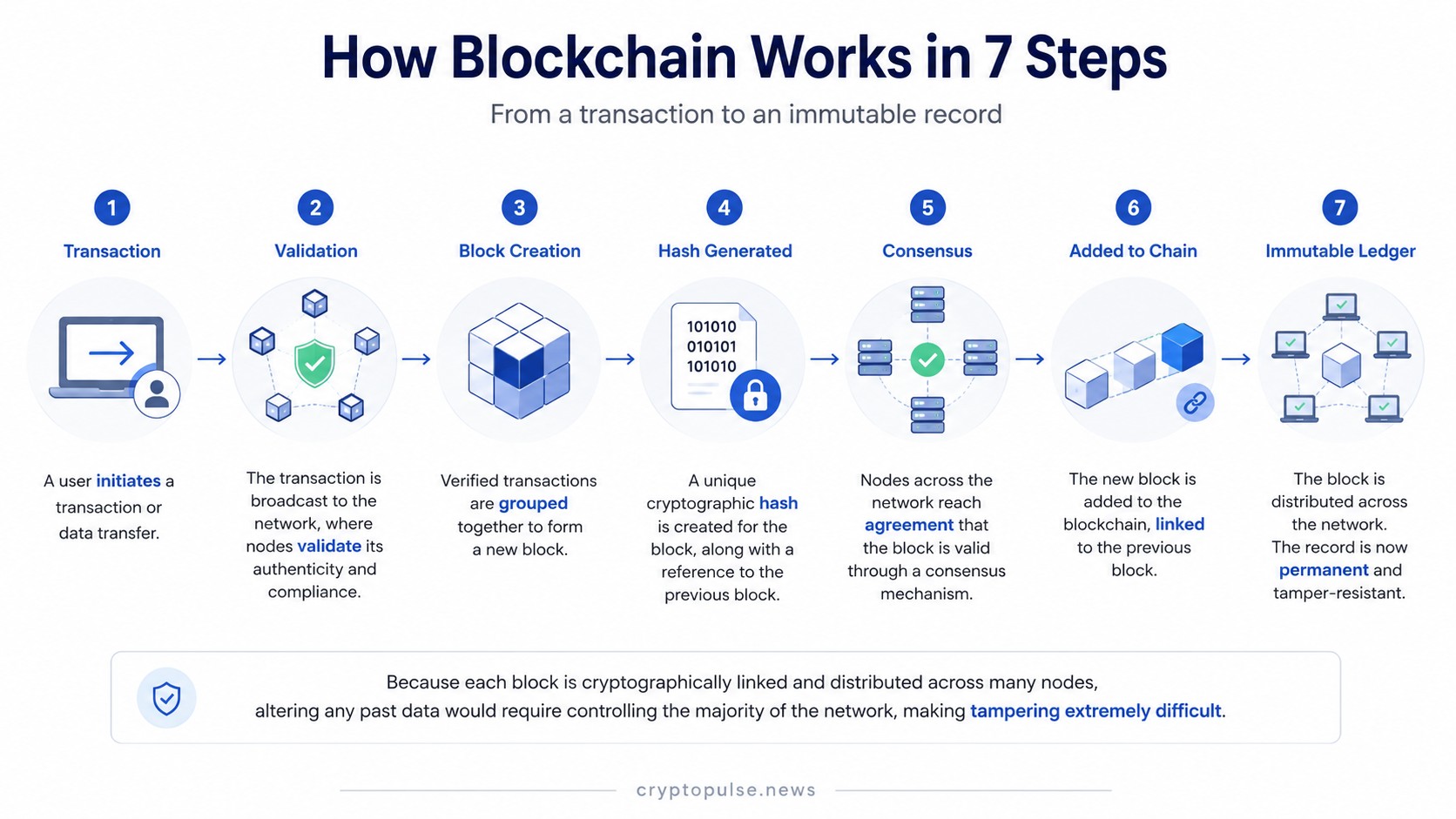
To understand blockchain in practice, it helps to break the system into a sequence of steps — from how transactions are created to how they become a permanent part of the ledger.
Blocks and Transactions
Blockchain activity begins with transactions — individual actions such as transferring value, recording ownership, or updating data. These transactions are collected over time and grouped into blocks.
Each block contains a set of verified transactions, a reference to the previous block, and additional data required for validation. Once completed, blocks are added in sequence, forming a continuous chain of records.
Hashing and Cryptographic Links
Each block is connected to the previous one through a cryptographic hash — a fixed-length output generated from its data. Even the smallest change produces a completely different hash.
This creates a secure link between blocks. If any past record is altered, all subsequent hashes break, making tampering immediately visible and increasingly difficult to execute.
Block Creation and Validation
Before a block is added, it must be validated according to the network’s rules. This process ensures that transactions are legitimate, properly authorized, and consistent with the current state of the system.
While different blockchains use different validation methods, the objective remains the same: only valid data is added to the shared ledger.
Why Past Data Cannot Be Easily Changed
Because blocks are linked and distributed across many participants, altering past data would require controlling a large portion of the network at the same time.
This property is known as immutability. It does not mean data is impossible to change, but that doing so is technically complex and economically impractical in well-designed systems.
Key Components of a Blockchain
A blockchain is not a single technology, but a combination of elements that work together to maintain a secure and consistent system.
Blocks
Blocks are data containers that group and organize transactions. Their size and creation frequency influence the network’s performance, scalability, and security.
Nodes
Nodes are the computers that run the network. They store copies of the ledger, validate transactions, and share information with other participants.
A blockchain becomes more secure as the number and diversity of nodes increase, reducing reliance on any single point of control.
Distributed Ledger
The ledger exists simultaneously across many nodes. This redundancy ensures resilience and makes unilateral changes extremely difficult.
Instead of relying on a central authority, the system maintains consistency through shared data and predefined rules.
Cryptographic Hashes
Hashes protect the integrity of blockchain data. They allow participants to verify information quickly and ensure that any modification is immediately detectable.
Smart Contracts
Some blockchains support smart contracts — self-executing programs stored on the network. These automatically enforce rules once predefined conditions are met.
This extends blockchain beyond record-keeping, enabling automated coordination between participants without intermediaries.
Decentralization Explained
While blockchain is often described as “decentralized,” the concept becomes clearer when compared directly to traditional systems.
Centralized vs Decentralized Systems
In centralized systems, a single authority controls data and decision-making. In decentralized systems, control is distributed among participants according to predefined rules.
Centralization offers efficiency and simplicity, while decentralization prioritizes resilience, neutrality, and reduced reliance on trust.
Why Decentralization Matters
Decentralization becomes important in environments where participants do not fully trust each other, where censorship is a risk, or where coordination must happen across borders without a shared authority.
It is not always necessary — but in the right context, it enables systems that would otherwise be difficult or impossible to maintain.
Trust Minimization
Blockchain systems are designed to minimize the need for trust, not eliminate it entirely.
Instead of relying on institutions, participants rely on transparent rules and verifiable data. Trust shifts from people to the system itself.
Censorship Resistance
Decentralized networks are inherently harder to censor because no single entity controls what gets included or excluded.
This makes blockchain particularly relevant for global systems where access and neutrality are important.
Network Resilience
Because data is replicated across many nodes, decentralized systems can continue operating even if some participants fail or act maliciously.
This distributed structure improves fault tolerance and reduces the risk of system-wide failure.
Blockchain Consensus Mechanisms
For a decentralized system to function, it must still reach agreement. Consensus is the process that allows a blockchain network to maintain a single, consistent version of the ledger.
What Consensus Means and Why It Exists
In any shared system, participants must agree on what is true. In blockchain, this agreement is achieved through consensus mechanisms.
Unlike centralized systems — where a single authority defines the state of the database — blockchain networks must coordinate across many independent participants. Without consensus, the ledger would split into conflicting versions and lose its usefulness.
Consensus solves three critical problems: preventing double-spending, resisting malicious behavior, and maintaining a unified history.
Proof of Work Explained
Proof of Work (PoW) requires participants to perform computational work to propose new blocks. This work involves solving complex cryptographic puzzles that are difficult to compute but easy to verify.
Its purpose is not efficiency, but economic security. By tying validation to real-world resource costs, Proof of Work makes attacks extremely expensive.
This model is particularly effective in open networks, where anyone can participate without prior trust.
Proof of Stake Explained
Proof of Stake (PoS) replaces computational work with economic commitment. Participants lock up assets as collateral, and validators are selected based on their stake and protocol rules.
If they act dishonestly, they risk losing their funds. This creates strong incentives for honest behavior without requiring high energy consumption.
Proof of Stake is designed to improve efficiency and scalability, while maintaining security through aligned incentives. In Proof of Stake networks, this process is commonly known as staking, allowing participants to earn rewards for helping secure the network.
Why Consensus Is Critical for Security
Consensus mechanisms define how a blockchain defends itself. They determine who can add data, how conflicts are resolved, and how attacks are discouraged.
Blockchain security depends not on secrecy, but on transparent and enforceable rules applied consistently across the network.
Trade-Offs: Security, Scalability, and Energy
No consensus mechanism is perfect. Each design involves trade-offs between security, scalability, and resource efficiency.
Proof of Work prioritizes robustness and decentralization but requires significant energy. Proof of Stake improves efficiency and scalability, but introduces new considerations around governance and concentration.
Understanding these trade-offs is essential when evaluating different blockchain systems.
Types of Blockchain Networks
Not all blockchains are designed the same way. The structure of a network depends on who can participate, who controls validation, and how trust is distributed.
Public Blockchains
Public blockchains are open networks where anyone can participate without permission. Transactions are transparent, validation is decentralized, and governance is driven by protocol rules rather than institutions.
They are designed to function as neutral, global infrastructure, independent of borders or centralized control. This makes them particularly valuable in environments where participants do not share trust or legal frameworks.
However, openness introduces trade-offs. Public networks must balance accessibility with performance, which can limit throughput and increase system complexity.
Private Blockchains
Private blockchains restrict participation to approved entities. Control over validation, access, and governance is managed by a single organization or a defined authority.
These systems apply blockchain principles — such as shared ledgers and cryptographic integrity — in environments where trust already exists but coordination is inefficient.
While efficient, private blockchains sacrifice many benefits of decentralization. In practice, they are closer to distributed databases with cryptographic guarantees than fully trust-minimized systems.
Consortium and Hybrid Blockchains
Consortium blockchains distribute control among a group of organizations rather than a single entity. Validation and governance are shared between selected participants.
This model aims to balance efficiency with reduced trust assumptions, making it suitable for industries where multiple parties require a shared system but no single participant should dominate control.
Permissionless vs Permissioned Networks
Another important distinction is whether a network is permissionless or permissioned.
Permissionless systems allow anyone to participate and rely on economic incentives for security. Permissioned systems restrict access and depend on identity, rules, and governance structures.
This distinction defines who the system is designed to trust — and under what conditions.
Blockchain vs Traditional Databases
Blockchain is often compared to traditional databases, but the two serve fundamentally different purposes.
Control and Ownership
Traditional databases are controlled by a single organization. In contrast, blockchain ledgers are collectively maintained by multiple participants.
This changes how decisions are made, how data is governed, and who has authority over the system.
Transparency and Auditability
Blockchain records are inherently transparent and verifiable. Transactions follow a consistent structure that allows independent validation without requiring privileged access.
This enables continuous auditability, reducing reliance on periodic external audits.
Immutability
Traditional databases prioritize flexibility and allow data to be modified or deleted. Blockchain prioritizes historical integrity.
Instead of rewriting data, changes are recorded as new entries, creating a clear and traceable history over time.
Performance and Scalability
Centralized databases are significantly faster and more efficient than blockchain systems. This is not a limitation, but a direct result of decentralization.
Blockchain trades performance for trust, resilience, and verifiability, making it suitable for specific use cases rather than universal replacement.
When Blockchain Is Not the Right Solution
Blockchain is not always necessary. It adds complexity and overhead when a simpler system would suffice.
It is generally not suitable when:
- a single trusted authority already exists
- data must remain private and easily editable
- high performance and low latency are critical
In these cases, traditional databases remain the more practical choice.
Real-World Use Cases of Blockchain
Blockchain is not a universal solution, but it delivers clear value in areas where multiple parties need to coordinate without relying on a central authority.
Cryptocurrencies
Cryptocurrencies demonstrate that digital value can exist without centralized issuers. They solve the problem of digital scarcity, enabling peer-to-peer transfers without intermediaries.
Payments and Remittances
Blockchain-based payment systems reduce reliance on correspondent banking networks and enable faster cross-border settlement.
In practice, many of these systems use stablecoins to minimize volatility while maintaining global transferability and near-instant settlement.
Supply Chain Tracking
Shared ledgers allow participants to record production, shipment, and custody changes in a tamper-resistant format.
This improves traceability and accountability, reducing disputes over origin, authenticity, and handling.
Tokenization of Assets
Tokenization represents real-world or digital assets as blockchain-based units, enabling fractional ownership and programmable transfer rules.
This is especially valuable for assets that are traditionally illiquid or difficult to divide.
DeFi
Decentralized finance uses smart contracts to enable lending, trading, and settlement without centralized intermediaries.
Its core value lies in automation, transparency, and composability, allowing financial services to operate as open systems.
Digital Identity
Blockchain-based identity systems allow individuals to control their credentials without relying on a single issuing authority.
Verification becomes selective and user-controlled, rather than dependent on centralized databases.
Healthcare
In healthcare, blockchain is used primarily as a coordination layer rather than a storage system.
It can manage data integrity, access permissions, and audit trails, while sensitive information remains off-chain.
For a deeper look at how blockchain is applied across industries, see our guide on real-world blockchain use cases.
Benefits of Blockchain Technology
The benefits of blockchain arise from its underlying design. By changing how systems handle trust, coordination, and data integrity, it introduces advantages that are most visible in multi-party and cross-border environments.
Transparency
Blockchain systems operate on verifiable and consistent rules, allowing participants to independently confirm transactions and system state.
This reduces reliance on privileged access and minimizes the need for post-hoc reconciliation.
Security
Security in blockchain comes from a combination of cryptography, decentralization, and economic incentives.
Instead of protecting a single database, responsibility is distributed across many nodes, making coordinated attacks significantly more difficult.
Reduced Reliance on Intermediaries
Blockchain enables coordination without centralized operators. Rules are embedded directly into the system, allowing processes to execute without brokers, clearinghouses, or administrators.
This reduces operational complexity and friction, especially in systems involving multiple parties.
Global Trustless Coordination
Blockchain allows participants to interact without needing to trust each other or share a legal framework.
Trust is placed in the protocol itself — ensuring that rules are applied consistently regardless of geography or jurisdiction.
Limitations and Challenges of Blockchain
Despite its strengths, blockchain introduces real constraints that limit where and how it can be applied. These are structural trade-offs, not temporary shortcomings, and understanding them is essential for realistic evaluation.
Scalability
Scalability remains a core challenge. Because blockchain networks replicate data and require consensus among distributed participants, they process transactions more slowly than centralized systems.
Various scaling approaches exist, but they introduce trade-offs in complexity, latency, or decentralization.
Transaction Costs
Transaction fees reflect competition for limited network capacity. When demand rises, users must pay more to prioritize their transactions.
This mechanism helps secure the network, but can make certain use cases economically impractical during periods of congestion.
Energy Consumption
Energy usage is often associated with specific consensus mechanisms. In these systems, it is not waste, but a deliberate feature tied to security.
Alternative approaches reduce consumption, but introduce different assumptions and trade-offs rather than eliminating them entirely.
Regulation and Compliance
Blockchain systems operate across borders, while regulatory frameworks are typically jurisdiction-based and intermediary-driven.
Aligning decentralized networks with existing legal structures remains an ongoing challenge.
User Experience
User experience is one of the most significant barriers to adoption. Managing private keys, handling irreversible transactions, and navigating unfamiliar interfaces place greater responsibility on users.
These challenges are not purely technical — they are also usability and education problems.
Blockchain, Bitcoin, and Ethereum: The Difference
Blockchain, Bitcoin, and Ethereum are closely related, but they represent different layers of the same technological stack. Understanding this distinction helps clarify what the technology actually enables.
Blockchain
Blockchain is the underlying model — a distributed ledger system maintained through cryptography and consensus.
It defines how data is recorded, verified, and shared without centralized control. On its own, blockchain is infrastructure, not an application.
Bitcoin
Bitcoin is the first large-scale implementation of blockchain. It was designed as a decentralized monetary system that operates without a central issuer or intermediary.
Its architecture prioritizes security, predictability, and resistance to change, making it highly reliable but intentionally limited in functionality.
Ethereum
Ethereum extends blockchain by introducing programmability. Through smart contracts, it allows developers to execute logic directly on the network.
This transforms blockchain from a value-transfer system into a platform for decentralized applications and programmable finance.
Key Difference
The distinction can be summarized simply:
- Blockchain — the underlying technology
- Bitcoin — a specific monetary application
- Ethereum — a programmable blockchain platform
Understanding this separation helps avoid common misconceptions and provides a clearer view of how different systems build on the same foundation.
Blockchain and the Future of Web3
Blockchain plays a foundational role in what is often called Web3 — not as a replacement for the internet, but as a shift in how digital systems handle trust and ownership.
In this model, blockchain acts as a shared infrastructure layer. It provides a neutral foundation for recording ownership, enforcing rules, and coordinating activity without relying on centralized platforms. This shifts control away from intermediaries and toward protocols and users.
One of the most important implications is digital ownership. Blockchain allows individuals to directly control assets, identities, and credentials without custodial services. Ownership is enforced at the protocol level, rather than defined by platform policies.
Blockchain also enables coordination without intermediaries. Applications can operate through transparent, rule-based systems, allowing participants to interact under shared conditions without centralized oversight.
Importantly, blockchain’s role in Web3 is infrastructural, not speculative. Its value lies in enabling durable digital rights, shared state, and verifiable coordination — concepts that remain relevant regardless of market cycles.
Is Blockchain Still Relevant Today?
Blockchain’s relevance is best evaluated through real-world usage, not market sentiment. While public attention has fluctuated, the underlying systems have continued to operate, evolve, and expand.
Adoption remains selective. Blockchain has not replaced traditional systems — nor is it meant to. Instead, it is gaining traction in areas where trust, coordination, and cross-border interaction are persistent challenges.
Examples include payments, settlement layers, digital asset issuance, and shared registries — areas where blockchain delivers measurable advantages over conventional approaches.
Hype cycles have often overstated short-term impact. As expectations reset, the technology continues to mature in the background — a pattern common to many foundational infrastructure technologies.
Blockchain remains relevant where:
- centralized intermediaries introduce friction
- independent verification is critical
- participants cannot rely on shared institutional trust
Its long-term value is not tied to speculation, but to its ability to enable reliable coordination in complex digital environments.
Conclusion
Blockchain is best understood not as a trend, but as a new model for organizing trust and coordination in digital systems.
Its core contribution is the ability to establish shared truth without centralized control — a capability that becomes increasingly important in global, multi-party environments.
At the same time, blockchain is not a universal solution. Its value depends on context, and applying it effectively requires understanding both its strengths and its limitations.
As digital systems continue to expand across borders and institutions, the principles behind blockchain — transparency, verifiability, and decentralized coordination — will remain central to how data, value, and authority are managed.
Frequently Asked Questions
Blockchain is a digital system for recording information in a way that is shared, secure, and difficult to change. Instead of being controlled by a single entity, the data is maintained by a network of participants who agree on its validity.
No. Blockchain is the underlying technology, while Bitcoin is a specific application of it. Bitcoin uses blockchain to enable decentralized digital money, but blockchain can be applied to many other use cases beyond payments.
Blockchain networks are highly secure, but they are not impossible to attack. Large, well-established blockchains are extremely difficult to compromise because doing so requires significant resources and coordination. Most security incidents occur in applications, smart contracts, or smaller networks rather than in the blockchain itself.
The main benefits include transparency, security, decentralization, and reduced reliance on intermediaries. These advantages are most relevant in systems involving multiple parties that need to share and verify data.
Blockchain is most useful when multiple participants need to coordinate without trusting a central authority, when data must be verifiable, and when transparency or immutability is important. It is not necessary for systems where a single trusted entity can efficiently manage data.
Learn More with CryptoPulse.News
- Beginner’s Guide to Cryptocurrency
- What Is Crypto Staking and How Does It Work
- Blockchain Use Cases Across Industries
- What Is DeFi? A Simple Guide to Decentralized Finance
- What Is Layer 2 and Its Role in the Future of Blockchain