What Are Smart Contracts and How Do They Work
Smart contracts have become a fundamental part of the crypto industry, powering much of DeFi, tokenization, NFTs, DAOs, and other blockchain applications.
Blockchain technology has evolved far beyond its original use as a way to record cryptocurrency transactions. Today, blockchain networks can support financial services, digital assets, governance systems, marketplaces, and other applications that operate through programmable rules.
Smart contracts are at the center of this evolution. They provide the programmable infrastructure that allows blockchain applications to perform actions according to predefined rules rather than relying on a central operator to handle every step. Ethereum, for example, describes smart contracts as the fundamental building blocks of its application layer.
This article explains what smart contracts are, how they work, what they can do, where they are used, and what benefits and risks they introduce. It also looks at how they differ from traditional contracts and why understanding them is essential for understanding modern blockchain technology.
Table of Contents
- What Is a Smart Contract?
- How Smart Contracts Work
- What Can Smart Contracts Do?
- Real-World Examples of Smart Contracts
- Benefits of Smart Contracts
- Risks and Limitations of Smart Contracts
- Smart Contracts vs. Traditional Contracts
- Why Smart Contracts Matter for Crypto and Blockchain
- Final Thoughts
- Frequently Asked Questions About Smart Contracts
What Is a Smart Contract?
There are two useful ways to understand a smart contract: a technical definition and a simpler explanation for beginners.
In technical terms, a smart contract is a computer program deployed on a blockchain that contains code and data and can execute predefined functions when users or other contracts interact with it. On Ethereum, smart contracts reside at specific blockchain addresses and are executed by the Ethereum Virtual Machine (EVM).
In simple terms, a smart contract is software that follows predetermined rules and can execute a programmed action when it is triggered and the required conditions are met.
A useful analogy is a digital vending machine. If you provide the required payment and select a product, the machine follows its programmed instructions and delivers the product. A smart contract works on a similar principle: the correct input triggers predefined logic and produces the programmed result. Ethereum itself uses this vending-machine analogy when introducing smart contracts.

The terminology can be misleading, however. “Smart” does not mean the contract uses artificial intelligence, and a smart contract is not necessarily a legal contract. Fundamentally, it is code running within blockchain infrastructure.
Once deployed, a smart contract can also hold assets, maintain data, enforce rules, and interact with other contracts. This programmability is what allows developers to build much more complex applications on top of blockchains.
How Smart Contracts Work
At a high level, the process involves writing the code, deploying it to a blockchain, triggering its functions, and recording the resulting state. The EVM provides the environment in which this code is executed consistently across network nodes.
Writing and Deploying the Code
Smart contracts are written in programming languages designed for blockchain environments. On Ethereum, Solidity is one of the main smart-contract languages, while Vyper is another actively maintained option.
The developer first writes the contract and then compiles the source code into bytecode that the EVM can execute. The compiled contract is deployed through a blockchain transaction, which requires a network fee. On Ethereum, deployment requires ETH to pay for gas, because storing the contract on the blockchain consumes network resources.
After deployment, the contract has its own blockchain address. Users and other contracts can interact with it by sending transactions that call specific functions defined in its code.
A Simple Smart Contract Example
A smart contract does not have to contain complicated financial logic. At its most basic level, it can store information and provide functions that change or retrieve that information.
For example, this simplified Solidity contract stores a number and allows a user to change it:
contract SimpleStorage {
    uint256 public value;

    function setValue(uint256 newValue) public {
        value = newValue;
    }
}
Here, value is a state variable that stores data associated with the contract, while setValue() is a function that changes that data. Solidity documentation uses similar storage examples to demonstrate how state variables and functions form the basic structure of a contract.
The example is intentionally simple. Real-world smart contracts can contain much more sophisticated logic, including rules for transferring tokens, calculating interest, managing collateral, processing trades, or conducting governance votes.
Triggering and Executing a Contract
Once a smart contract exists on the blockchain, a user can interact with it through a wallet, decentralized application (dApp), or another smart contract. The interaction normally involves a blockchain transaction containing the information needed to call a particular function.
The network processes the transaction and, if it is valid, the relevant code is executed by the blockchain’s virtual machine. On Ethereum, gas measures the computational work required to execute operations and helps allocate network resources.
Consider a simplified token swap. A user submits a transaction to a decentralized exchange’s smart contract. The contract checks the relevant conditions, performs the programmed calculations and token transfers, and updates the blockchain state if execution succeeds.
The important point is that the contract does not make its own decisions. It follows the logic written into its code. If the required conditions are not satisfied, the programmed operation may fail or revert rather than producing a different outcome based on human judgment.
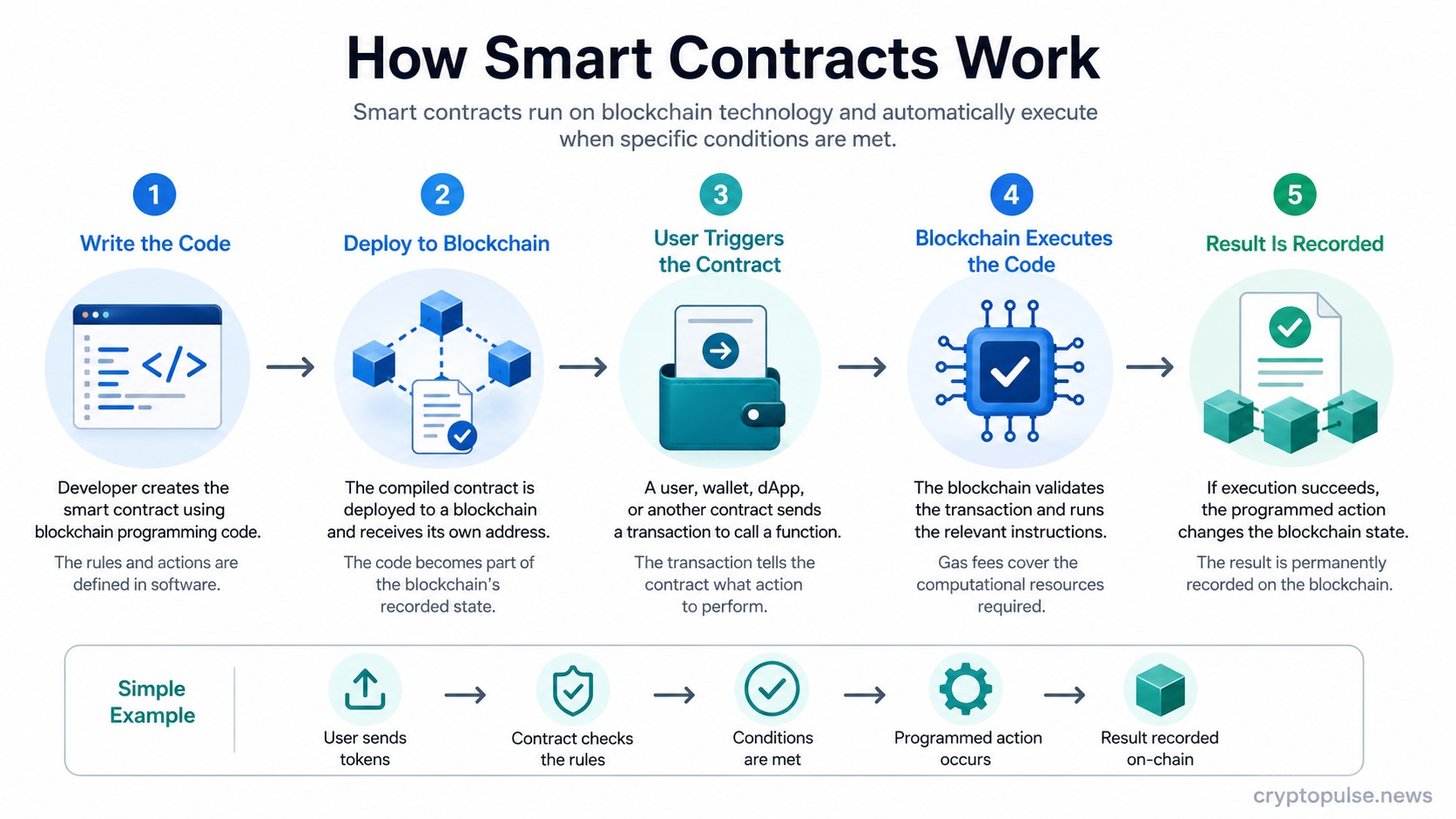
This execution model is what makes smart contracts useful for applications that require predictable, programmable interactions between users, assets, and blockchain-based systems.
What Can Smart Contracts Do?
The flexibility of smart contracts allows developers to build applications that go well beyond simple cryptocurrency transfers. A smart contract can hold assets, maintain records, apply rules, and interact with other contracts, creating programmable systems that operate on blockchain networks.
One of their most important uses is decentralized finance (DeFi). Smart contracts can facilitate token swaps, lending, borrowing, collateral management, and other financial operations without requiring a traditional financial institution to process every transaction. Ethereum’s DeFi ecosystem, for example, includes applications for trading, lending, saving, and investing.
Smart contracts also provide the infrastructure for token creation and management. Standards such as ERC-20 define common functions for fungible tokens, while ERC-721 provides a standard for NFTs. These standards help tokens remain compatible with wallets, exchanges, and other applications.
Other applications include DAO governance, NFT marketplaces, automated payments, staking systems, and tokenized real-world assets. In each case, the contract provides programmable rules that determine what users can do and how the application responds.
The broader significance is that smart contracts turn a blockchain from a simple transaction ledger into programmable infrastructure for digital applications.
Real-World Examples of Smart Contracts
Smart contracts are easier to understand when viewed through applications that people can actually use.
Ethereum
Ethereum was designed to extend the capabilities of blockchain beyond sending and receiving cryptocurrency. Its smart-contract platform allows developers to publish programs that run on the Ethereum network and build applications on top of them.
This model supports decentralized exchanges, lending protocols, stablecoins, NFTs, games, governance systems, and other applications. A decentralized application, or dApp, generally combines smart-contract code running on a blockchain with a user-facing interface that allows people to interact with it.
Ethereum therefore provides a useful example of the broader role of smart contracts: the blockchain supplies the execution environment, while smart contracts provide much of the application’s programmable logic.
Uniswap
Uniswap demonstrates how smart contracts can replace parts of the traditional exchange process. Instead of relying on a centralized exchange operator to match every buyer and seller, users can interact with smart contracts that manage token swaps and liquidity.
From the user’s perspective, the process can be as simple as connecting a wallet, selecting two tokens, reviewing the transaction, and confirming it. Behind that interface, smart-contract code handles the programmed rules governing the transaction.
This illustrates an important principle: users do not normally interact with raw blockchain code directly. A dApp provides a more familiar interface, while smart contracts operate as its blockchain-based backend.
Stablecoins and Tokenized Assets
Smart contracts are also central to many blockchain-based representations of assets. Token standards define how digital assets behave and interact with other applications, making tokens more interoperable across wallets, exchanges, and DeFi protocols.
For example, a token contract can maintain balances and enforce rules governing transfers. More sophisticated contracts can support systems for stablecoins, tokenized securities, funds, or other real-world assets.
This is one reason smart contracts are increasingly important beyond speculative cryptocurrency trading: they provide programmable infrastructure for representing and managing digital versions of assets and financial instruments.
Benefits of Smart Contracts
Smart contracts offer several characteristics that make them useful for blockchain applications.
Automation is one of the most obvious. Once the required conditions are satisfied, a contract can execute its programmed logic without someone manually processing the transaction. This can reduce operational steps in processes such as token swaps, payments, lending, and asset transfers.
Transparency is another important advantage. On public blockchains, contract code and transaction activity can often be inspected, allowing users and developers to see how an application operates and verify its activity.
Smart contracts also provide programmability. Developers can combine basic operations into increasingly sophisticated applications rather than building every process from scratch.
Another important property is composability. Smart contracts can interact with other contracts, allowing developers to build new applications using existing blockchain infrastructure. A token contract, for example, can be designed to work with wallets, exchanges, lending applications, and other protocols that recognize the same standards.
Finally, smart contracts can reduce reliance on certain intermediaries. The goal is not to eliminate every intermediary from every process, but to move some rules and execution from organizations or manual procedures into software running on shared infrastructure.
Risks and Limitations of Smart Contracts
The same properties that make smart contracts powerful can also create significant risks. Code can automate an error just as efficiently as it can automate a correct instruction, and blockchain transactions can be difficult to reverse once executed.
Code Bugs and Exploits
Smart contracts can contain programming errors or vulnerabilities that attackers may exploit. This is particularly serious when contracts control large amounts of digital assets.
Ethereum’s developer documentation notes that smart-contract code is generally immutable after deployment and that vulnerabilities can therefore be difficult to correct. High-profile exploits have resulted in substantial financial losses, demonstrating that auditing and testing reduce risk but cannot guarantee that a contract is completely secure.
A vulnerability can also arise from poorly designed permissions. For example, a contract might accidentally allow an unauthorized account to perform an operation that should be restricted.
For users, this means that interacting with a smart contract involves more than trusting the blockchain itself. The quality and security of the contract’s code matter as well.
Oracles and External Data
Smart contracts cannot automatically access arbitrary information from the outside world. If an application needs data such as an asset price, interest rate, or other external information, it may rely on an oracle.
An oracle is a system that supplies external data to a blockchain application. The challenge is ensuring that the information is accurate, timely, and resistant to manipulation. Ethereum’s documentation refers to this as the oracle problem.
This matters particularly in DeFi. A lending protocol, for example, may need an accurate market price to determine how much a user can borrow against collateral. If the supplied price is incorrect or manipulated, the smart contract can execute perfectly while still producing a harmful outcome.
The code can be trustworthy while the information fed into it is not.
Immutability and User Errors
Smart contracts are often designed to be immutable, meaning their core code cannot simply be edited after deployment. This supports predictable execution and reduces the ability of a central party to secretly change the rules. However, it also means that fixing a serious programming error can be difficult.
Some projects use upgrade mechanisms that allow contract logic to be changed, but these introduce additional technical and governance considerations.
Users also face their own risks. Sending assets to the wrong address, approving a malicious contract, or interacting with a fraudulent application can result in losses. These are among the common cryptocurrency mistakes beginners should avoid, particularly when interacting with unfamiliar applications or contracts.
Smart contracts remove some forms of human intervention, but they do not remove the need for human judgment.
Smart Contracts vs. Traditional Contracts
Despite their similar name, smart contracts and traditional contracts operate in fundamentally different ways.
A traditional contract is generally a legal agreement written in natural language that establishes obligations between parties. Its terms may be enforced through courts, regulators, arbitration, or other legal mechanisms.
A smart contract, by contrast, is software deployed on a blockchain. Its rules are expressed as code, and the blockchain provides the environment in which that code executes.
This creates an important distinction. Traditional agreements can contain terms that require interpretation, negotiation, or human judgment, while smart contracts execute according to their programmed logic. This can make their behavior predictable, but it also means they cannot independently interpret circumstances that were not encoded into the software.
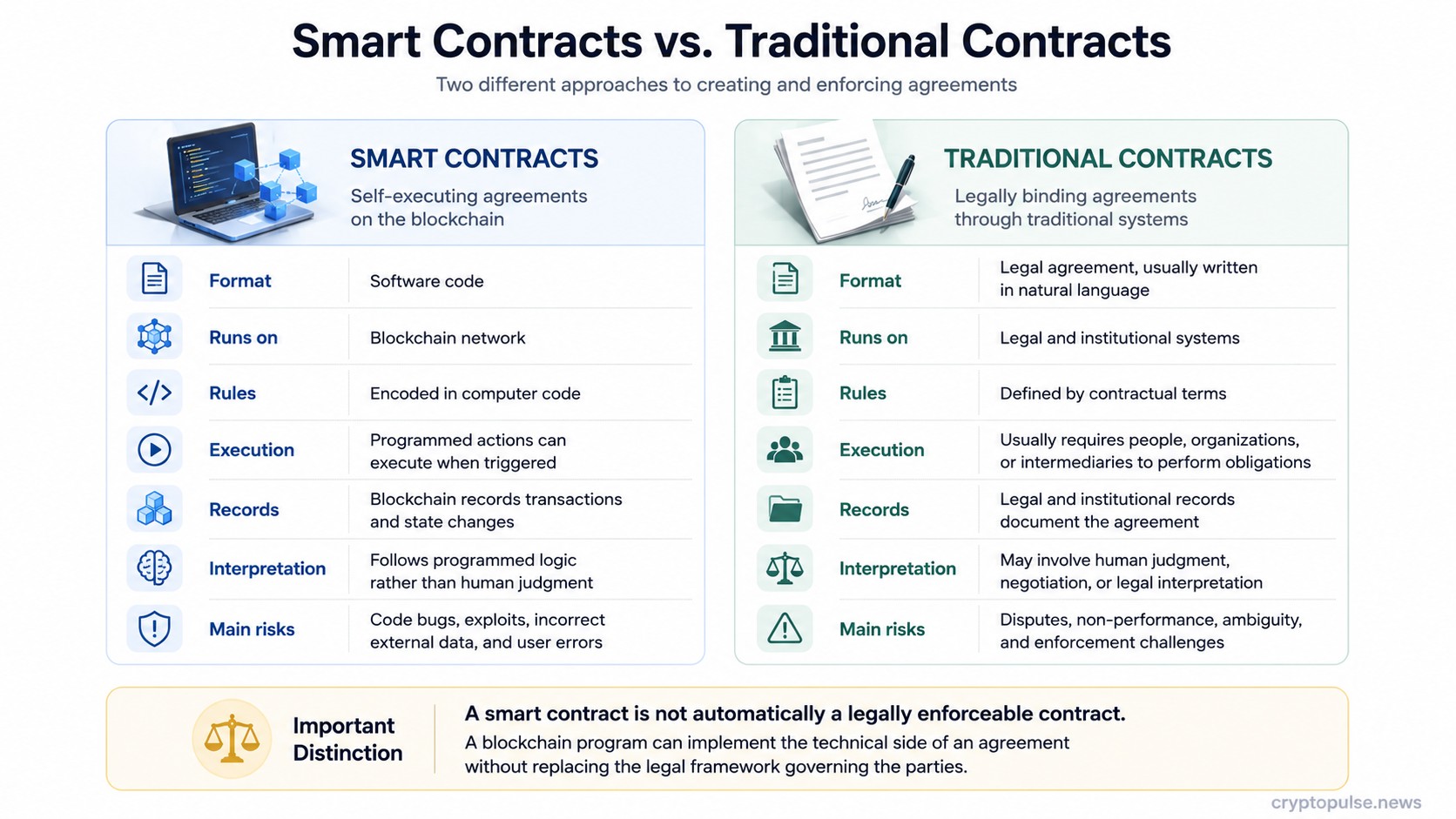
Most importantly, a smart contract is not automatically a legally enforceable contract. A blockchain program can implement the technical side of an agreement without replacing the legal framework that may govern the parties involved.
Why Smart Contracts Matter for Crypto and Blockchain
Smart contracts are important because they changed what blockchain networks can be used for. A blockchain no longer has to function only as a record of who owns or transferred an asset; it can also execute programmable logic around those assets.
This created a fundamental shift from blockchain as a transaction ledger to blockchain as a programmable execution layer. Instead of building every application around a centralized database and server, developers can place part of an application’s rules and state on a shared blockchain and allow users, wallets, and other contracts to interact with them.
Their composability allows smart contracts to interact with one another, enabling developers to combine existing components into more complex applications. A token contract, for example, can interact with a decentralized exchange, a lending protocol, or another application without each system having to operate in isolation. Ethereum describes smart contracts as open APIs that can call other contracts, which is a key part of this composability.
This is why smart contracts matter beyond any single crypto use case. They provide a common programmable layer on which financial, ownership, governance, and other blockchain applications can be built.
Final Thoughts
Smart contracts are one of the core building blocks of programmable blockchain technology. They allow predefined rules to be encoded into software and executed on shared networks, supporting applications that range from decentralized exchanges and lending platforms to NFTs, stablecoins, governance, and tokenized assets.
Their advantages come with important trade-offs. Automation does not guarantee safety, immutable code can contain bugs, and reliable external data remains a challenge. Users therefore need to consider both the underlying blockchain and the specific smart contracts they interact with.
For anyone trying to understand how modern crypto applications actually work, understanding smart contracts is a foundational step. They provide much of the infrastructure connecting blockchain networks with the programmable financial and digital applications built on top of them.
Frequently Asked Questions About Smart Contracts
Using a smart contract usually requires a blockchain transaction fee, often called a gas fee, to pay for the network resources needed to process the transaction. The cost varies by blockchain, network demand, and the complexity of the operation.
Usually, a deployed smart contract cannot simply be edited, because its code is recorded on the blockchain. Some contracts use upgrade mechanisms that allow their logic to be changed, but these introduce additional technical and governance considerations.
Yes. Smart contracts can contain vulnerabilities that attackers exploit, potentially resulting in the loss or theft of digital assets. Audits and testing can reduce these risks, but they cannot guarantee that contract code is completely secure.
On blockchain networks such as Ethereum, smart contracts are deployed to the blockchain and associated with specific blockchain addresses. Their code and stored data become part of the network’s state, allowing users and other contracts to interact with them.
Learn More with CryptoPulse.News
- What Is Ethereum and Why It Matters in Digital Finance
- What Is DeFi? A Simple Guide to Decentralized Finance
- What Is Tokenization and How It Transforms Finance
- What Is Layer 2 and Its Role in the Future of Blockchain