What Are Zero-Knowledge Proofs and Why They Matter
Zero-knowledge proofs allow information or computation to be verified without revealing the underlying data, improving privacy and efficiency across crypto networks.
Most digital systems work on a simple assumption: if you want to prove something, you must reveal the information that proves it. Logging into an account means submitting a password, while verifying your identity may require sharing personal details. Zero-knowledge proofs (ZKPs) challenge that model by separating verification from disclosure.
Originally developed as a cryptographic concept, ZKPs have become increasingly relevant to cryptocurrency and blockchain infrastructure. They can help protect sensitive information, verify computations performed outside a blockchain, and support scaling systems that process large numbers of transactions more efficiently. Understanding how they work helps explain why “ZK” has become an important part of modern crypto technology.
Table of Contents
- What Is a Zero-Knowledge Proof?
- How Do Zero-Knowledge Proofs Work?
- Why Zero-Knowledge Proofs Matter in Crypto
- ZK-SNARKs vs. ZK-STARKs
- How Zero-Knowledge Proofs Are Used in Blockchain
- Benefits and Limitations of Zero-Knowledge Proofs
- The Future of Zero-Knowledge Technology
- Final Thoughts
- Frequently Asked Questions
What Is a Zero-Knowledge Proof?
A zero-knowledge proof is a cryptographic method that allows one party to prove that a statement is true without revealing the secret information used to prove it.
The party making the claim is called the prover, while the party checking it is the verifier. Imagine that Alice wants to demonstrate that she knows a password. In a conventional system, she might send the password to a server, which compares it with stored information. A zero-knowledge system can instead let Alice produce mathematical evidence that she possesses the required secret without exposing the secret itself.
A valid zero-knowledge proof is generally expected to satisfy three core properties:
- Completeness: if the statement is true and both parties follow the protocol, the verifier should accept the proof.
- Soundness: a dishonest prover should not be able to convince the verifier that a false statement is true, except with a negligible probability.
- Zero knowledge: the verifier should learn nothing beyond the fact that the claim being tested is valid.
The key idea is therefore not secrecy alone. ZKPs make information verifiable while minimizing how much of that information needs to be disclosed.
How Do Zero-Knowledge Proofs Work?
The mathematics behind modern zero-knowledge systems can be highly complex, involving cryptographic commitments, hashes, polynomial calculations, and specialized proof systems. The underlying concept, however, is easier to understand: the prover demonstrates knowledge or correct computation by producing evidence that the verifier can check without receiving the hidden information itself.
Different zero-knowledge protocols achieve this in different ways. One useful distinction is between systems that require interaction between the two parties and systems that produce a proof that can later be checked independently.

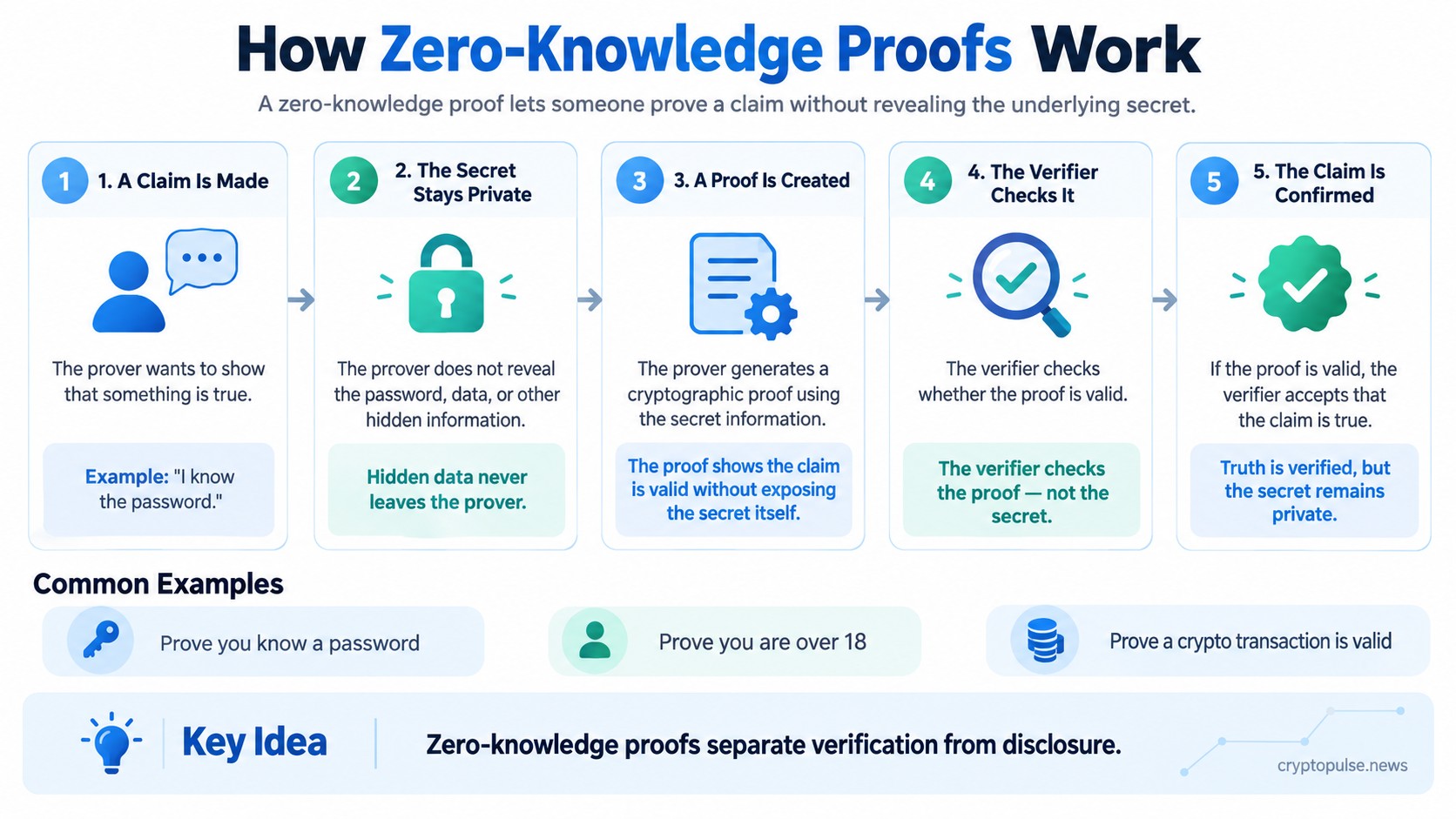
The Prover and Verifier
A classic way to illustrate zero knowledge is with a hypothetical cave containing two paths connected by a secret door. Suppose Alice knows the password that opens the door and wants to prove this to Bob without revealing the password.
Alice enters the cave and randomly chooses one path. Bob, who cannot see which direction she chose, then asks her to return through a particular path. If Alice knows the secret, she can always use the hidden door when necessary and emerge from the requested side. If she does not know it, she can only guess correctly.
Repeating the challenge makes cheating increasingly unlikely.
Real cryptographic systems replace caves and doors with mathematical problems, but the principle is similar: the verifier gains confidence that the prover possesses the required knowledge without learning the knowledge itself.
Interactive and Non-Interactive Proofs
Early zero-knowledge protocols often relied on interactive proofs, where the prover and verifier exchanged multiple challenges and responses. Each successful round increased the verifier’s confidence that the prover’s claim was genuine.
Modern crypto applications frequently use non-interactive zero-knowledge proofs, where the prover generates a cryptographic proof that can be checked later without an ongoing exchange with a particular verifier. zk-SNARKs, which we will examine later, are a prominent example.
This property is especially useful for decentralized networks. A blockchain cannot depend on every validator holding a private conversation with whoever generated a proof. Instead, a prover can perform a computation, generate a compact proof of its validity, and publish that proof for independent verification.
This creates an important distinction between doing the computation and checking that the computation was done correctly. In systems designed around validity proofs, verification can require far less work than repeating the original computation. Ethereum’s scaling documentation, for example, describes how zero-knowledge rollups execute transactions outside Ethereum Mainnet and submit cryptographic validity proofs that Ethereum can verify rather than re-executing the entire batch.
Why Zero-Knowledge Proofs Matter in Crypto
Public blockchains are designed to make activity independently verifiable. That transparency is valuable, but it creates practical trade-offs. Users may not want every piece of information exposed publicly, while blockchain networks cannot efficiently perform unlimited computation or store unlimited data.
Zero-knowledge proofs offer tools for addressing several of these problems without abandoning cryptographic verification.
One application is privacy. A ZKP can confirm that a transaction follows predefined rules without necessarily revealing all of the information involved. Zcash provides an established example: its shielded transactions can keep transaction information encrypted while zero-knowledge proofs demonstrate that the transaction complies with the network’s consensus rules.
Another increasingly important application is scalability and verifiable computation. ZK-rollups can execute batches of transactions outside Ethereum’s base layer and then submit a validity proof showing that the resulting state change is correct. Ethereum verifies the proof instead of independently repeating every computation in the batch.
The concept may eventually extend even further. Ethereum researchers are also exploring ZK proofs for Layer 1 block verification, where validators could verify proof of correct block execution rather than re-executing every transaction themselves.
Describing ZKPs simply as privacy technology therefore misses much of their significance. Their broader value lies in making claims and computations independently verifiable while reducing the information or computational work required for that verification.
ZK-SNARKs vs. ZK-STARKs
Zero-knowledge proofs are not a single technology. Several proof systems have been developed with different approaches to proof generation, verification, security, and computational efficiency. Two terms that appear frequently in crypto are zk-SNARKs and zk-STARKs.
Both can allow complex computations to be verified without repeating the full computation, but their underlying designs involve different trade-offs.
ZK-SNARKs
ZK-SNARK stands for Zero-Knowledge Succinct Non-Interactive Argument of Knowledge. “Succinct” refers to the ability to produce relatively small proofs that can be verified efficiently, while “non-interactive” means the prover and verifier do not need an ongoing exchange after the proof has been created.
SNARKs have become one of the best-known forms of zero-knowledge technology in crypto. Zcash is an important real-world example: the privacy-focused cryptocurrency has used multiple zk-SNARK proving systems throughout its development to validate shielded transactions without exposing their protected transaction data.
Some SNARK constructions require a trusted setup, a procedure for generating cryptographic parameters that must be performed securely. This is not a universal property of SNARKs, however. Zcash’s Orchard shielded protocol uses Halo 2, a proving system introduced without the trusted setup requirement associated with earlier Zcash systems.
ZK-STARKs
ZK-STARK stands for Zero-Knowledge Scalable Transparent Argument of Knowledge. STARK systems were designed to provide efficient verification of large computations while avoiding the trusted setup used by some earlier proof systems.
The word transparent refers to this absence of secret setup parameters. STARKs instead rely on publicly verifiable cryptographic techniques, including hash functions. This can simplify assumptions around the initial creation of the system. Their trade-offs can include larger proof sizes than some SNARK constructions, meaning neither approach is automatically superior for every application.
Starknet provides a practical example. The Ethereum Layer 2 network uses STARK proofs to prove the validity of computations performed outside Ethereum, allowing the resulting state to be settled on Ethereum after cryptographic verification.
For users, the names matter less than the broader distinction: different proof systems optimize for different combinations of proof size, proving cost, verification efficiency, transparency, and security assumptions.
How Zero-Knowledge Proofs Are Used in Blockchain
The theoretical value of ZKPs becomes clearer through their practical applications. Crypto projects now use zero-knowledge technology for purposes ranging from confidential transfers to Layer 2 scaling, while other applications explore ways to verify credentials and sensitive data without exposing them.
Private Transactions
Public blockchain ledgers normally make transaction information visible to anyone who examines the network. Zero-knowledge proofs can allow a protocol to verify that a transaction obeys its rules while keeping selected information private.
Zcash is one of the longest-running examples. In its shielded system, cryptographic proofs can demonstrate that a transaction is valid—for example, that the spender has authority over the funds and that value is not being created improperly—without publicly revealing all of the protected transaction details.
This illustrates an important distinction. Privacy does not mean bypassing verification. The network still needs mathematical evidence that its rules have been followed; the ZKP changes how much underlying information must become public to establish that fact.
ZK-Rollups and Blockchain Scaling
Zero-knowledge proofs also address a different problem: the limited amount of computation that a Layer 1 blockchain can economically process itself.
A ZK-rollup processes transactions outside the base network and combines them into batches. It then generates a validity proof showing that the resulting blockchain state was calculated correctly. The proof can then be verified on the Layer 1 instead of requiring it to repeat every calculation individually.
This model is used by Ethereum scaling systems including Starknet and ZKsync. Starknet describes itself as a Layer 2 validity rollup using STARK proofs, while ZKsync uses cryptographic validity proofs for its Ethereum scaling architecture.
The advantage is not that computation disappears. Expensive work is moved to the prover, while the blockchain receives a more efficient way to verify its correctness. This separation between execution and verification is one of the main reasons ZK technology has become important to Layer 2 development.
Identity and Data Verification
The same principle can apply beyond financial transactions. A user might need to prove a fact about personal information without disclosing the complete underlying record.
For example, an application could theoretically use a zero-knowledge credential to confirm that a person is above a required age without revealing their exact date of birth. Similar approaches can be applied to membership, authorization, account balances, or other attributes where the verifier needs a yes-or-no answer rather than the source data itself.
This concept is often called selective disclosure: revealing only what is necessary for a particular interaction.
Such systems still depend on trustworthy credential issuance and careful implementation. A ZKP can prove a claim according to the rules encoded into a system, but it cannot by itself guarantee that the original information supplied to that system was accurate.
Benefits and Limitations of Zero-Knowledge Proofs
ZKPs solve useful cryptographic problems, but using them involves trade-offs. Their value depends on the proof system, application design, hardware requirements, and the type of computation being proven.
Key Benefits
One major advantage is data minimization. Instead of automatically exposing the information behind a claim, a system can sometimes reveal only what a verifier actually needs to know.
ZKPs can also improve computational efficiency at the verification layer. A prover may perform substantial work elsewhere and produce a proof that is cheaper to verify than re-executing the original computation. This property is particularly valuable on blockchains, where onchain computation is scarce and expensive.
With appropriate architecture, these characteristics can support:
- private or selectively disclosed information;
- Layer 2 scalability through validity proofs;
- verifiable offchain computation;
- privacy-preserving identity and credential systems;
- verification of complex processes without reproducing every underlying step.
The common thread is efficient trust through cryptographic verification rather than unnecessary disclosure or repeated computation.
Current Limitations
Generating a zero-knowledge proof can require significant computational resources, even when verifying the finished proof is comparatively efficient. Prover performance therefore remains an important engineering concern, particularly for large or complex workloads.
The technology is also difficult to implement correctly. Proof systems rely on specialized cryptography, circuits, software infrastructure, and careful auditing. A mathematically secure proof system does not automatically make the application built around it secure. Bugs in circuits, smart contracts, bridges, wallets, or application logic can introduce separate risks.
Different systems also make different compromises. Some require setup procedures, others produce larger proofs, and proving time and hardware requirements can vary substantially.
Finally, “zero knowledge” should not be interpreted as automatic anonymity. A system may use ZKPs for one part of its operation while still exposing addresses, metadata, deposits, withdrawals, or other information elsewhere. Privacy depends on the design of the entire application, not merely the presence of a ZK proof.
The Future of Zero-Knowledge Technology
Zero-knowledge technology is gradually expanding from a specialized privacy tool into general infrastructure for proving that computation was performed correctly.
Ethereum scaling is currently one of its most visible applications. Networks such as Starknet and ZKsync already use validity proofs to move substantial computation away from Ethereum while retaining cryptographic verification on the settlement layer.
Research and development also extend beyond rollups. Potential uses include cross-chain verification, digital identity, privacy-preserving applications, and verifiable computation performed by external systems. In each case, ZKPs can provide cryptographic evidence that an external computation was performed correctly instead of requiring users or networks to simply trust its operator.
Progress will depend partly on making proof generation faster, reducing infrastructure requirements, improving developer tooling, and minimizing implementation risks. Different proving systems are therefore likely to coexist rather than converge immediately around one universal design.
The long-term significance of ZKPs may be less about making everything private and more about making verification possible with less disclosure, less duplicated computation, and fewer trust assumptions.
Final Thoughts
Zero-knowledge proofs introduce a powerful idea: proving that something is true does not always require revealing everything that makes it true.
For crypto networks, that principle has applications well beyond confidential transactions. ZKPs can help verify offchain computation, support Layer 2 scaling, protect selected information, and enable new approaches to digital credentials and data verification.
The technology remains technically demanding, and its benefits depend heavily on how each system is designed and implemented. Still, as blockchains seek to process more activity while limiting unnecessary data exposure and computation, zero-knowledge proofs provide an increasingly important bridge between privacy, efficiency, and verifiability.
Frequently Asked Questions
No. While ZKPs are widely associated with privacy, they are also used for blockchain scaling, verifiable computation, identity systems, and validating offchain activity.
Encryption hides data so only authorized parties can read it, while a zero-knowledge proof lets someone prove a statement is true without revealing the underlying data at all.
ZKPs are built on strong cryptographic assumptions, but the surrounding software, circuits, smart contracts, or implementation can still contain vulnerabilities. Security depends on both the proof system and how it is deployed.
Not automatically. A ZKP can hide selected transaction details, but addresses, metadata, deposits, withdrawals, or other activity may still remain visible depending on the protocol.
Learn More with CryptoPulse.News
- What Is Layer 2 and Its Role in the Future of Blockchain
- What Is Blockchain Technology and How It Works
- What Are Smart Contracts and How Do They Work
- What Is Ethereum and Why It Matters in Digital Finance