What Is Crypto Custody? From Private Keys to Custodians
Crypto custody defines how digital assets are secured and who has the authority to move them, from individual holders to institutional custodians.
Owning cryptocurrency introduces a question that traditional bank accounts largely answer for their customers: who is responsible for keeping access to the assets secure? With crypto, the answer can range from an individual protecting their own private keys to a regulated institution operating sophisticated custody infrastructure.
This distinction matters because cryptocurrencies are not physically stored in wallets, on exchanges, or inside hardware devices. They remain recorded on their respective blockchains. What custody systems protect is the ability to authorize transactions involving those assets. Understanding that relationship between blockchain ownership, private keys, wallets, and custodians is essential to understanding how crypto is held securely.
Table of Contents
- What Is Crypto Custody?
- Why Private Keys Define Crypto Ownership and Control
- Self-Custody vs. Third-Party Custody
- Hot, Cold, and Hybrid Crypto Custody
- Multisig, MPC, and Modern Custody Technology
- What Is Institutional Crypto Custody?
- Crypto Custody Risks
- How to Choose a Crypto Custody Model
- Final Thoughts
- Frequently Asked Questions
What Is Crypto Custody?
Crypto custody refers to the methods and services used to safeguard the cryptographic keys and signing authority that control access to digital assets. Depending on the custody model, those credentials may be managed directly by the asset owner, shared between several parties, or entrusted to a specialized provider.
This differs from the way people commonly think about traditional financial custody. A bank can maintain an account balance in its own records, while a securities custodian can hold assets on behalf of investors within established financial infrastructure. With cryptocurrency, the authoritative record of assets and transactions is maintained by the blockchain itself.
For example, Bitcoin remains recorded on the Bitcoin blockchain whether access is managed through a hardware wallet, an exchange, or an institutional custodian. What changes is who controls the authority to move it.

Custody therefore concerns much more than where a wallet is located. It includes key generation and storage, transaction authorization, backup and recovery, access controls, and operational security. The appropriate setup can differ substantially between an individual holding a small amount of crypto and an institution responsible for assets belonging to clients or investors.
Why Private Keys Define Crypto Ownership and Control
To understand custody, it helps to separate the digital assets recorded on a blockchain from the cryptographic credentials used to control them. A wallet manages the keys needed to interact with blockchain assets; it does not literally contain the coins or tokens themselves.
Two concepts are particularly important for individual users: public/private-key cryptography and wallet recovery mechanisms.
Public and Private Keys
Public-key cryptography allows a blockchain user to prove authority over assets without revealing the secret information used to authorize transactions.
A private key is a secret cryptographic value used to generate signatures, while a corresponding public key can be used to verify those signatures. Blockchain addresses are generally derived from or associated with public-key information and provide destinations to which assets can be sent, although the exact mechanism differs between blockchain networks.
When an owner sends crypto, wallet software uses the relevant private key to sign the transaction. The network can then verify that signature according to its protocol rules without learning the private key itself.
This is why private keys are central to custody. Anyone who obtains sufficient signing authority may be able to authorize transactions, while losing the only available key can make the associated assets permanently inaccessible.
Seed Phrases and Key Recovery
Modern wallets often make key management easier through a seed phrase, also called a recovery or mnemonic phrase. Instead of separately backing up every private key generated by a wallet, a sequence of human-readable words can serve as the root from which a compatible wallet derives many keys and addresses.
That convenience also creates a critical security responsibility. A seed phrase capable of restoring a wallet can effectively provide access to all assets controlled through the keys derived from it. It should therefore never be treated like an ordinary password or shared with someone claiming to provide wallet support.
Recovery mechanisms vary between wallets and custody technologies, so not every crypto account relies on a seed phrase. The broader principle remains the same: a custody arrangement needs a secure method for maintaining signing authority while also accounting for device failure, lost credentials, or other recovery scenarios.
Self-Custody vs. Third-Party Custody
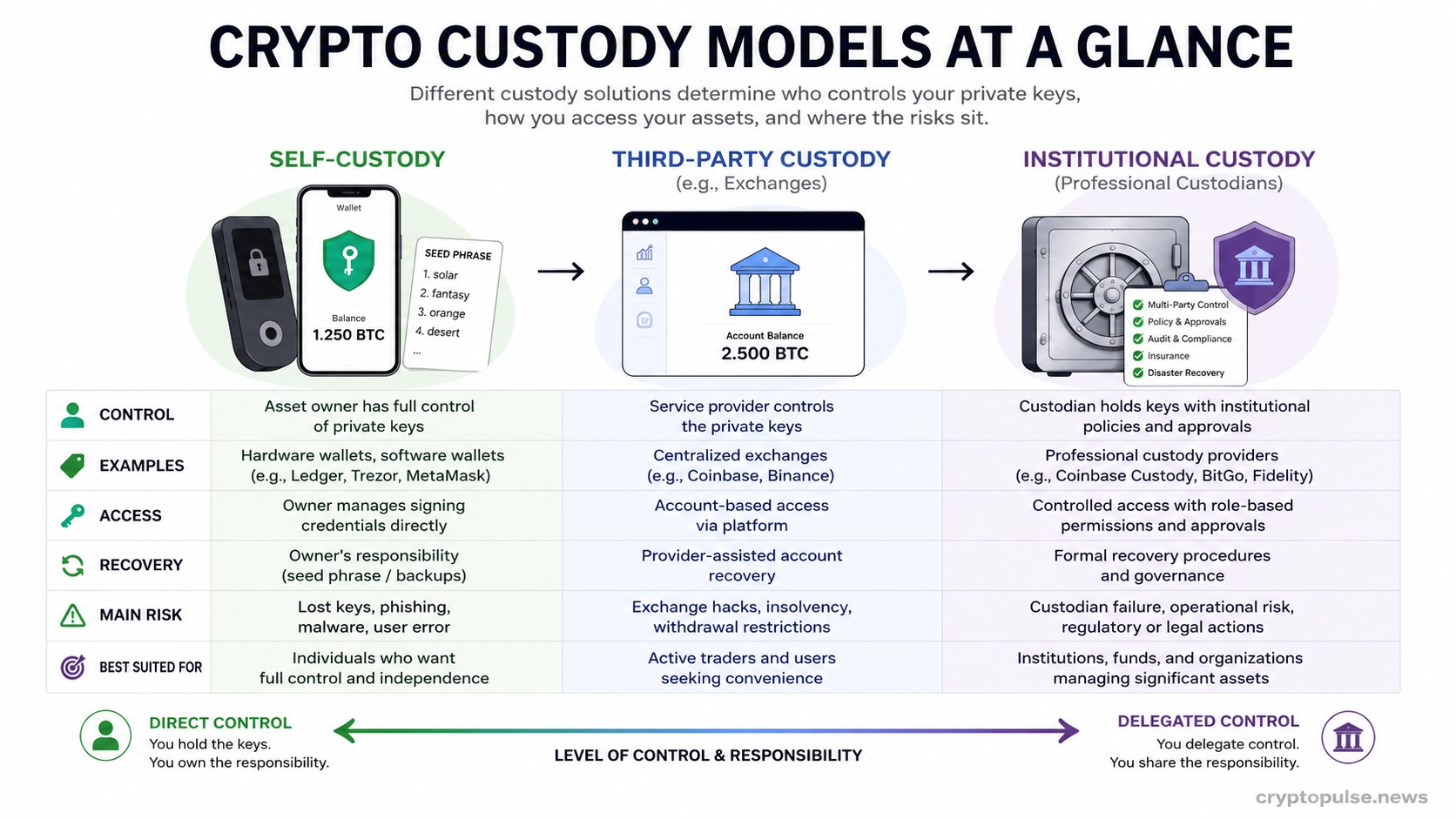
The most fundamental custody decision is who ultimately controls the ability to authorize transactions. At a high level, crypto custody can be divided into self-custody and third-party custody, although some modern arrangements distribute control between multiple participants.
Neither model removes risk. Instead, they place security responsibilities and potential points of failure in different places.
Self-Custody
With self-custody, the owner retains control over the cryptographic credentials needed to access and transfer their assets rather than entrusting that authority to an exchange or dedicated custodian.
This can be done through a software wallet such as MetaMask or Trust Wallet, or through a hardware wallet such as Ledger or Trezor. Hardware wallets are designed to keep sensitive signing material isolated from the general-purpose computer or smartphone used to prepare transactions.
Self-custody provides direct control and removes dependence on a custodian for withdrawals, but that independence comes with responsibility. The user must protect keys or recovery credentials, verify transactions, maintain suitable backups, and plan for loss or device failure.
A compromised recovery phrase can allow an attacker to take control of the wallet. Conversely, permanently losing all usable recovery methods can leave legitimate owners unable to access their own assets. There is generally no central administrator that can simply reset a blockchain private key.
Third-Party Custody
With third-party custody, an external organization takes responsibility for some or all of the infrastructure used to secure and authorize access to crypto.
The most familiar example is a centralized crypto exchange. When users buy assets and leave them in a standard custodial account at an exchange such as Coinbase or Binance, they typically interact through account credentials rather than directly controlling the blockchain private keys associated with the platform’s wallets.
Dedicated crypto custodians extend this model with infrastructure designed specifically for safeguarding assets. Their systems may combine offline storage, distributed signing, approval policies, transaction monitoring, physical security, audits, and institutional access controls.
This arrangement can make recovery and operational management easier, but it introduces counterparty risk: access partly depends on another organization remaining secure, solvent, operational, and able to process withdrawals.
Importantly, self-custody is not inherently safe simply because the user controls the keys, and custodial storage is not inherently unsafe because a third party does. The quality of the security architecture and the way it is operated are ultimately what matter.
Hot, Cold, and Hybrid Crypto Custody
Who controls the assets is only one part of custody. Another question is how accessible the signing infrastructure should be. Crypto custody systems commonly use hot, cold, or hybrid approaches depending on how frequently assets need to move and what level of isolation is required.
The distinction is particularly important for exchanges and institutions, which need to balance security against the ability to process transactions efficiently.
Hot Storage
Hot storage keeps the infrastructure required for signing transactions connected to, or readily accessible through, online systems. This allows transactions to be processed quickly and can support automated operations.
For an individual, a mobile or browser wallet used regularly for transactions is a common example. Exchanges also need readily available systems to process customer deposits and withdrawals.
The trade-off is exposure. Internet-connected environments face threats such as malware, compromised credentials, software vulnerabilities, and unauthorized remote access. Hot storage is therefore particularly useful for assets that require frequent movement, but concentrating large long-term holdings in readily accessible signing environments can increase security risk.
Cold Storage
Cold storage isolates private keys or signing systems from internet-connected environments, reducing their exposure to remote attacks.
A hardware wallet kept offline when not in use is a familiar form of cold storage for individuals. Institutional implementations can be considerably more elaborate, combining isolated signing devices with physical security, multiple approvals, controlled facilities, and documented procedures.
Cold storage does not make assets impossible to steal or lose. Physical compromise, flawed backup procedures, insider threats, and human error can still create vulnerabilities. It also adds operational friction because moving assets may require additional verification or manual steps.
Its main advantage is therefore a smaller online attack surface, making cold storage particularly suited to assets that do not need to move frequently.
Hybrid Custody Approaches
Large crypto operations rarely need to choose exclusively between hot and cold storage. Instead, hybrid custody separates assets according to their operational purpose.
An exchange, for example, may keep enough assets accessible to meet expected customer withdrawals while maintaining a larger portion under more restrictive storage controls. Institutional custody platforms can similarly combine highly protected long-term storage with systems that permit authorized assets to be moved when trading, staking, settlement, or other activities require it.
This illustrates an important point: hot and cold describe how signing authority is secured and accessed, while custodial and self-custodial describe who controls it. They are related but separate concepts. A user can operate a self-custodied cold wallet, while a professional custodian can maintain cold-storage infrastructure on behalf of clients.
Modern custody goes further by distributing signing authority itself rather than relying on a single private key or operator. That is where technologies such as multisignature wallets and multi-party computation become important.
Multisig MPC and Modern Custody Technology
Relying on one person, device, or private key can create a single point of failure. Modern custody systems address this problem by distributing the authority needed to approve transactions. Two important approaches are multisignature wallets and multi-party computation (MPC).
Although both can prevent a single compromised credential from being sufficient to move assets, multisig and MPC achieve this in fundamentally different ways.
Multisignature Wallets
A multisignature, or multisig, wallet requires more than one private key to authorize a transaction. Instead of one key having complete control, the wallet follows predefined signing rules.
A common example is a 2-of-3 arrangement, where three separate keys exist but any two must approve a transaction. A company could give those keys to different executives or keep them in separate locations. Losing one key would not necessarily make the assets inaccessible, while stealing a single key would not be enough to move them.
Multisig can therefore reduce dependence on one person or device and provide useful governance for organizations. However, its implementation varies between blockchains, and the wallet’s authorization structure may be visible onchain depending on the network and design.
Multi-Party Computation
Multi-party computation (MPC) takes a different approach. Instead of requiring several conventional blockchain signatures, cryptographic computation can be distributed among multiple participants so that they collectively produce a valid signature without one participant needing to reconstruct and hold the complete signing secret during the process.
In custody applications, this can allow signing authority to be distributed across devices, people, or locations. A transaction may require several independent parties or systems to participate before it can be authorized.
This architecture can reduce the risk that compromising one component gives an attacker complete control. It can also support flexible approval policies without requiring a blockchain to natively support a particular multisig arrangement.
MPC should not be treated simply as another name for multisig. Multisig generally uses multiple blockchain-level signatures or keys, while MPC distributes the cryptographic process used to create a signature.
What Is Institutional Crypto Custody?
Managing personal crypto and safeguarding assets for a fund, corporation, asset manager, or thousands of clients are very different operational tasks. Institutional custody combines key security with governance, compliance, reporting, access controls, and business continuity.
This has created a specialized custody sector that includes crypto-native companies as well as established financial institutions.
Why Institutions Need Custodians
An institution holding significant digital assets usually cannot rely on one employee keeping a recovery phrase or hardware wallet in a safe. It needs processes that continue working when employees leave, devices fail, responsibilities change, or transactions require approval from multiple departments.
Institutional systems can therefore include role-based permissions, multiple approval levels, audit trails, geographically separated infrastructure, transaction policies, and disaster-recovery procedures. Some providers also integrate trading, settlement, staking, or collateral services while maintaining custody controls.
For example, Fidelity Digital Assets says its institutional custody infrastructure uses offline cold-vaulted storage, multi-tiered approvals, multi-site storage, and audited operational controls. BitGo similarly offers institutional custody using cold storage alongside multisig and MPC key-management options.
The goal is not simply to make a private key harder to steal. It is to create a controlled system for managing assets throughout an organization’s operations.
Qualified and Regulated Custodians
The term qualified custodian has a specific regulatory meaning rather than simply describing a custodian with strong security. In the United States, custody requirements can depend on the type of institution, asset, regulator, and applicable securities or banking rules. Other jurisdictions use their own licensing and custody frameworks.
Professional providers may operate through regulated trust companies, banks, or other authorized entities. For example, Fidelity Digital Assets, National Association operates as a national trust bank after receiving an OCC charter in 2025. BitGo also provides regulated custody through different entities across multiple jurisdictions.
This distinction is particularly important for investment funds and financial firms that may have legal obligations governing how client assets are held.
Regulated custody does not mean that crypto becomes risk-free or that every custodian provides identical protections. Institutions still need to evaluate asset segregation, security architecture, insurance terms, operational controls, regulatory status, and what would happen to client assets if the provider failed.
Crypto Custody Risks
Every custody model introduces trade-offs. The central question is not whether custody creates risk, but where that risk is concentrated and who is responsible for managing it.
With self-custody, users can lose access through destroyed devices, missing backups, forgotten credentials, or improperly stored recovery phrases. Phishing and malware can expose keys, while signing a malicious transaction can result in assets being transferred even if the underlying wallet technology remains secure. Physical security and inheritance can also become important for long-term holdings.
Third-party custody transfers many technical responsibilities to another organization but introduces counterparty and operational risk. A provider can suffer a security breach, become insolvent, restrict withdrawals, experience technical failures, or face legal action that affects customer access.
The collapse of FTX in 2022 became a prominent reminder of the distinction between owning a crypto balance displayed by an intermediary and directly controlling assets onchain. However, an exchange account and a dedicated regulated custody arrangement are not equivalent and should not be treated as such.
Ultimately, custody redistributes responsibility rather than eliminating it. Self-custody places more responsibility on the owner; third-party custody makes the provider’s security, governance, and financial condition part of the risk assessment.
How to Choose a Crypto Custody Model
There is no custody method that is optimal for every crypto holder. The appropriate model depends on what assets are being held, how they will be used, who needs access, and what risks the owner is capable of managing.
For an individual, relevant considerations include the value and purpose of the holdings, transaction frequency, technical experience, backup strategy, and ability to protect recovery credentials. Someone who regularly trades may have different requirements from someone storing Bitcoin for years.
Organizations have additional concerns, including governance, regulatory requirements, asset segregation, recovery procedures, and business continuity. Using an external custodian also requires due diligence into its legal status, security practices, and treatment of client assets.
The choice does not have to be absolute. A crypto holder might keep long-term assets in self-custody while maintaining a smaller balance on an exchange for trading. Institutions can similarly divide assets among custody arrangements according to operational needs.
What matters is understanding who can authorize transactions, how that authority is protected, and what happens when something goes wrong.
Final Thoughts
Crypto custody ultimately comes down to control. The assets themselves remain recorded on a blockchain, while wallets, keys, signing systems, and custodians determine who has the authority to move them and under what conditions.
Self-custody gives individuals direct control but also makes them responsible for security and recovery. Third-party and institutional custody delegate some of that responsibility to specialized infrastructure, introducing different operational and counterparty considerations. Technologies such as cold storage, multisig, and MPC can further reduce specific points of failure.
There is therefore no universally superior way to hold crypto. A sound custody strategy matches the level of control, security, accessibility, and oversight to the needs of the asset owner.
Frequently Asked Questions
Yes. Coinbase provides custodial services, meaning customers can hold crypto without directly managing the underlying private keys. It also offers dedicated institutional custody services through Coinbase Custody.
Yes. Custodians can face hacks, operational failures, insolvency, or other events that affect customer assets or access to them. Regulation and security controls can reduce certain risks but cannot eliminate custody risk entirely.
Yes. Spot crypto ETFs generally use specialized custodians to safeguard the underlying cryptocurrency held by the fund. For example, U.S. spot Bitcoin ETFs hold actual Bitcoin through designated custodians rather than requiring ETF investors to manage private keys themselves.
No. A crypto wallet is software or hardware used to manage blockchain keys and transactions, while a custodian is a third party that safeguards assets or signing authority on behalf of clients. A wallet can be self-custodial or operated as part of a custodial service.
Learn More with CryptoPulse.News
- How to Store Cryptocurrency Securely: A Beginner’s Guide
- Best Cryptocurrency Wallets for Beginners
- What Is a Crypto ETF and How It Impacts the Market
- What Is a Crypto Treasury Strategy and Why Companies Use It