What Is Tokenomics and How to Read It
Learn how crypto tokenomics work, what determines a token’s supply and utility, and how to interpret the economic model behind a cryptocurrency project.
Every cryptocurrency operates within an economic framework that influences how its tokens are created, distributed, used, and valued. Some cryptocurrencies have a limited supply, while others continuously introduce new units. Certain tokens serve essential functions within their ecosystems, while others depend largely on speculative interest.
These differences are central to understanding tokenomics, a concept that extends beyond token prices or market capitalization. A project’s economic design can shape participant incentives, long-term sustainability, and potential risks.
Understanding tokenomics helps users look beyond market trends and examine the mechanisms that support a cryptocurrency’s operation and economic value.
Table of Contents
- What Is Tokenomics in Crypto?
- The Key Components of Tokenomics
- How Tokenomics Influences Crypto Prices
- How to Read a Crypto Project’s Tokenomics
- A Practical Example of Reading Tokenomics
- What Good Tokenomics Looks Like
- Common Tokenomics Red Flags
- Final Thoughts
- Frequently Asked Questions About Tokenomics
What Is Tokenomics in Crypto?
Tokenomics combines the words token and economics and refers to the economic structure governing a cryptocurrency or digital token. It describes how tokens enter circulation, who receives them, what they are used for, and which mechanisms influence their supply and demand.
Tokenomics establishes the rules and incentives that shape interactions between a project, its users, developers, validators, and investors. Depending on the cryptocurrency, these rules may be enforced through blockchain protocols, smart contracts, or decisions made by a project’s governing organization.
For example, Bitcoin follows a predetermined issuance schedule with a fixed maximum supply, while other cryptocurrencies may have flexible supply models, ongoing token emissions, or mechanisms that permanently remove tokens from circulation.

Tokenomics should not be confused with token utility. Utility describes what a token can do, while tokenomics encompasses the broader economic system surrounding it, including distribution, ownership, incentives, and monetary policy.
A cryptocurrency can have useful technology but an unfavorable economic structure. Understanding both is essential when analyzing crypto projects and assessing whether their economic models can remain sustainable.
The Key Components of Tokenomics
Tokenomics consists of several interconnected elements that determine how a cryptocurrency functions economically. Understanding these components individually provides the foundation for interpreting a project’s overall design.
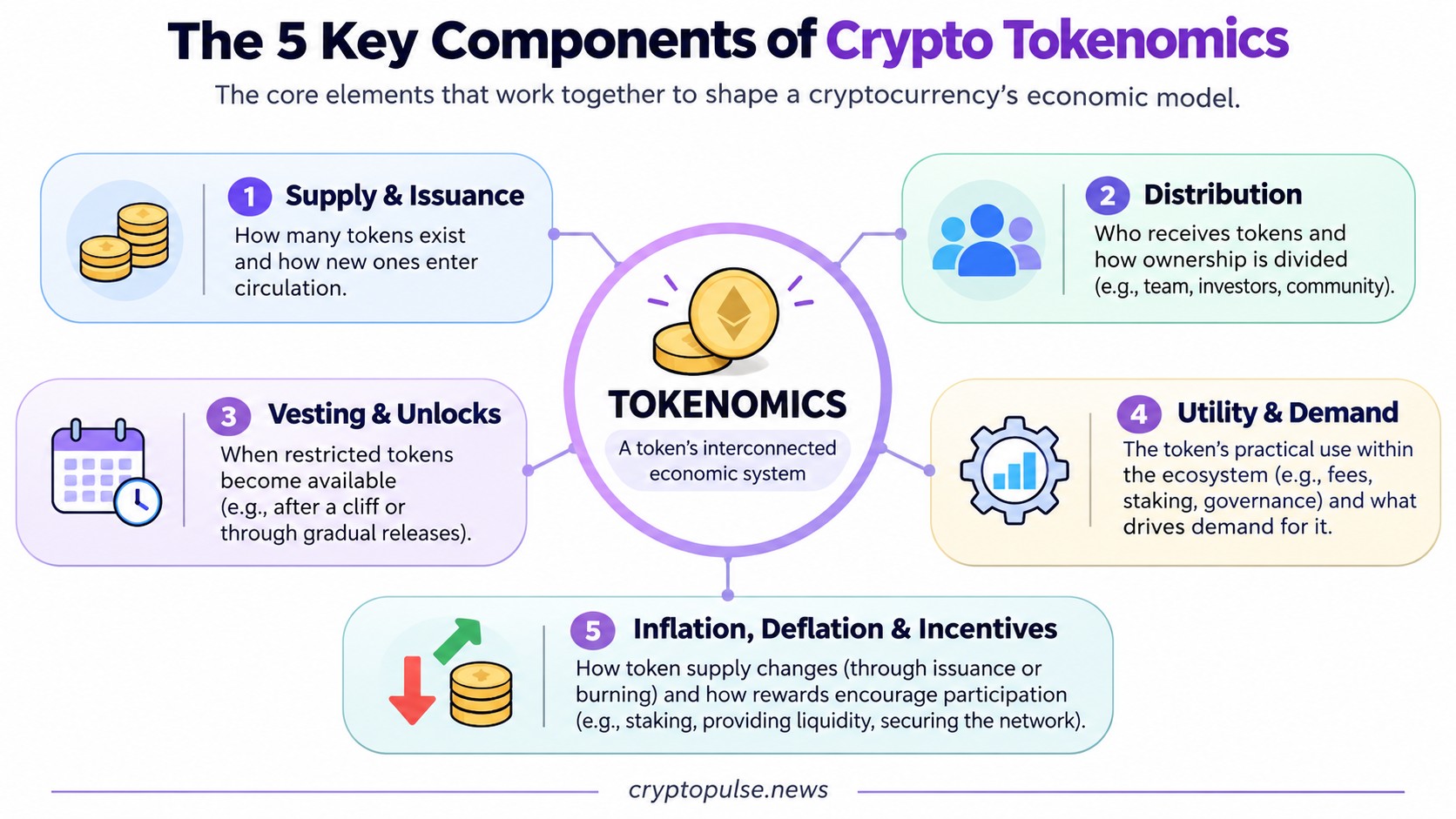
Token Supply and Issuance
Token supply describes how many units of a cryptocurrency exist or may exist in the future. Three common supply metrics are:
- Circulating supply: Tokens considered available in the public market.
- Total supply: Existing tokens, including locked or reserved units, excluding permanently burned tokens.
- Maximum supply: The upper limit of tokens that can ever exist, if one is defined.
These figures can differ substantially, and circulating supply estimates may vary between data providers depending on their methodology.
Another important distinction concerns fixed versus uncapped supply. Bitcoin has a programmed supply ceiling of approximately 21 million BTC, with new coins issued through mining rewards that decrease through periodic halvings.
Other networks may continuously issue new tokens to reward participants or support operations. Their future supply depends on the specific emission rules and whether those rules can be modified.
Token Distribution and Allocation
Token distribution determines who receives tokens and how ownership is divided among different groups.
Projects may allocate tokens to founding teams, early investors, community members, ecosystem development funds, public participants, or treasury reserves.
For example, a hypothetical project could distribute 40% of its supply to the community, 25% to ecosystem incentives, 20% to investors, and 15% to the founding team.
These percentages reveal important aspects of the project’s economic structure. A large allocation to insiders may concentrate ownership and influence, particularly when those tokens also carry governance rights.
However, allocation percentages alone cannot establish how decentralized a cryptocurrency is. The actual distribution of tokens across wallets, control over treasury holdings, and voting mechanisms also matter.
Transparent allocation data helps readers identify who benefits from the token economy and how incentives are distributed.
Vesting and Token Unlocks
Not every allocated token becomes available for trading immediately. Many projects use vesting schedules, which determine when restricted tokens can be released to their recipients.
A vesting arrangement may include a cliff, meaning an initial period during which no tokens are released, followed by gradual or scheduled unlocks.
For instance, team members might receive tokens after a one-year cliff, with the remaining allocation becoming available monthly over the following three years.
Such arrangements can encourage longer-term participation while preventing all allocated tokens from entering circulation simultaneously.
However, token unlocks may introduce additional selling pressure if recipients decide to sell their newly available holdings. An unlock increases potential market supply but does not automatically cause a price decline.
The size of upcoming releases, recipients’ incentives, and existing market liquidity influence their possible impact.
A project’s unlock schedule is therefore an important part of understanding its future circulating supply.
Token Utility and Demand
Token utility refers to the practical functions a cryptocurrency performs within its ecosystem.
Depending on the project, tokens may be required for transaction fees, accessing services, participating in governance, providing collateral, or securing a network through staking.
For example, ETH is used to pay transaction fees on Ethereum and can be staked to help secure the network.
These functions can generate demand because participants need the asset to perform particular activities. However, the strength of this relationship depends on how the system works.
A token used for payments does not necessarily accumulate value simply because transaction activity increases. Users may acquire and immediately spend it, limiting their need to hold substantial balances.
Similarly, governance rights may have limited economic significance if participation is low or voting power is heavily concentrated.
The essential question is whether the token performs a necessary economic function and how ecosystem activity translates into demand for it.
Inflation, Deflation, and Incentives
Cryptocurrency supply can change through token issuance and burning.
Inflation occurs when the number of tokens in circulation increases, potentially through mining, staking rewards, or other emissions. Token burning permanently removes units from supply, often by sending them to an inaccessible address or destroying them through protocol rules.
Ethereum illustrates how these mechanisms can interact. Its proof-of-stake system issues ETH as validator rewards, while its transaction fee mechanism burns a portion of fees. Depending on network activity and issuance, its total supply can increase or decrease.
Token rewards also serve as economic incentives, encouraging participants to secure networks, provide liquidity, or contribute resources.
However, rewards funded primarily through continuous token issuance may become difficult to sustain without sufficient economic demand.
Neither inflation nor deflation automatically makes tokenomics good or bad. What matters is whether supply changes and participant incentives support the network’s intended function over time.
How Tokenomics Influences Crypto Prices
Tokenomics affects cryptocurrency prices through its influence on available supply, demand, and market expectations.
When demand grows faster than the supply available for sale, upward price pressure may develop. Conversely, increased token issuance or large unlocks can create downward pressure if additional holders decide to sell and buyers cannot absorb that supply.
However, the relationship is not purely mechanical. A token unlock does not guarantee selling, and increasing supply does not necessarily reduce prices when demand is growing sufficiently.
Token utility also influences demand, but the connection varies between projects. Greater adoption can increase the need for a cryptocurrency, although transaction frequency, token circulation, and alternative payment mechanisms affect how much demand translates into sustained holding.
Scarcity alone does not create economic value. A cryptocurrency with an extremely limited supply can still have little demand, while a token with ongoing issuance may support substantial economic activity.
Prices also respond to market liquidity, investor sentiment, broader economic conditions, competition, and technological developments.
Therefore, well-designed tokenomics can support a cryptocurrency’s economic sustainability, but it cannot guarantee price appreciation or protect against market volatility.
How to Read a Crypto Project’s Tokenomics
Understanding tokenomics becomes more useful when applying these concepts to an actual cryptocurrency project. A structured review involves examining official documentation, interpreting financial metrics, and identifying the economic incentives behind the token.
Find Reliable Tokenomics Data
Start with the project’s official website, whitepaper, or technical documentation. These sources should describe the token’s purpose, supply model, initial allocation, issuance rules, and vesting schedules.
Market data platforms such as CoinMarketCap and CoinGecko provide supply estimates, market capitalization, and trading information. Blockchain explorers can help verify token contracts, transaction histories, and wallet balances.
For future supply changes, consult official vesting disclosures or dedicated token unlock trackers. Where possible, compare published schedules with observable on-chain activity.
Always check when information was published or updated. Tokenomics can change through protocol upgrades, governance decisions, or revised distribution arrangements.
A project’s published allocation chart may describe its original plans rather than its current supply structure. Reliable analysis requires distinguishing historical commitments from mechanisms that remain active.
Interpret Supply and Valuation Metrics
Two essential valuation metrics are market capitalization and fully diluted valuation (FDV).
Market capitalization is generally calculated by multiplying the token’s current price by its circulating supply. FDV estimates a token’s market value using its current price and a broader supply figure, typically the maximum supply when one is defined. Data providers may use different methodologies, so their FDV estimates are not always directly comparable.
For example, consider a token trading at $2 with 50 million tokens circulating and a maximum supply of 200 million:
- Market capitalization: $100 million.
- Fully diluted valuation: $400 million.
- Circulating supply share: 25%.
- Market cap-to-FDV ratio: 0.25, or 25%.
The difference indicates that a substantial portion of the potential supply is not yet circulating.
A low market cap-to-FDV ratio can signal significant future dilution exposure, particularly when additional tokens are scheduled for release.
However, FDV is not a prediction of future market capitalization. It assumes the current token price remains unchanged despite a different supply level, which may not happen.
The timing of emissions, potential burns, and actual demand matter more than any single valuation ratio.
Evaluate Distribution, Demand, and Incentives
After reviewing supply metrics, examine who controls the tokens and what motivates participants to hold or use them.
Start by comparing token allocations with the release schedule. If a project reserves a large share for early investors while only a small portion of its supply is circulating, examine when those holdings become transferable. A gradual release over several years presents a different supply profile from a concentrated unlock within a few months.
Next, connect token utility with actual demand. For example, a token required to pay network fees may benefit from increased activity, but the economic impact depends on how frequently users acquire, spend, or retain it. A governance token, meanwhile, may derive much of its relevance from the decisions holders can influence.
Finally, examine the source of rewards. Staking or liquidity incentives funded through ongoing emissions may attract participants, but their long-term sustainability depends on the underlying economics.
The strongest assessment connects supply, ownership, utility, and incentives rather than treating each metric independently. A token with broad distribution may still lack demand, while a useful token may face substantial dilution from future issuance.
A Practical Example of Reading Tokenomics
Consider two hypothetical cryptocurrencies, Token A and Token B. Both trade at $1 and have a maximum supply of 100 million tokens, but their circulating supply and allocation structures differ.
| Metric | Token A | Token B |
|---|---|---|
| Token price | $1 | $1 |
| Maximum supply | 100 million | 100 million |
| Circulating supply | 80 million | 10 million |
| Market capitalization | $80 million | $10 million |
| Fully diluted valuation | $100 million | $100 million |
| Circulating supply share | 80% | 10% |
| Initial team and investor allocation | 15% | 50% |
At first glance, Token B might appear cheaper because its market capitalization is eight times lower. However, both projects have the same $100 million FDV at their current prices.
Token A already has 80% of its maximum supply circulating. Token B has only 10%, leaving a considerably larger quantity of tokens outside circulation.
If Token B releases its remaining tokens without a corresponding increase in demand, existing holders could face substantial dilution and potential selling pressure.
Token B initially allocated half its supply to team members and investors. This raises questions about ownership concentration, vesting schedules, and whether those recipients still control their allocations.
Nevertheless, these figures do not prove Token A is a better investment. The projects may differ in utility, adoption, liquidity, and future demand.
The example demonstrates why token price and market capitalization alone provide an incomplete picture of a cryptocurrency’s economic structure.
What Good Tokenomics Looks Like
There is no universal formula for successful tokenomics. A payment-focused cryptocurrency, a governance token, and a network security asset may require different economic models.
Nevertheless, several characteristics can indicate a transparent and potentially sustainable token economy.
Predictable issuance rules make future supply easier to evaluate. Clear allocation disclosures help participants understand ownership concentration, while reasonable vesting arrangements can align long-term incentives between developers, investors, and users.
Meaningful utility is another important consideration. A token should perform a clearly identifiable function within its ecosystem rather than rely exclusively on speculative interest.
Economic rewards also need a sustainable foundation. Incentive programs funded through continuous emissions may support early adoption, but their effectiveness depends on whether the ecosystem develops sufficient lasting demand or other economic support.
Importantly, good tokenomics does not necessarily mean a fixed supply, frequent burning, or exceptionally high staking yields. Each mechanism involves trade-offs.
The most relevant question is whether the token’s economic design supports the project’s purpose while balancing incentives among different participants.
Common Tokenomics Red Flags
Certain tokenomics characteristics deserve additional scrutiny because they can introduce economic risks or create incentives that disadvantage some participants.
One warning sign is low circulating supply combined with a high fully diluted valuation. This structure may expose existing holders to substantial future supply expansion, especially when large unlocks are concentrated within a short period.
Other potential concerns include:
- Excessive insider allocations: Large holdings controlled by teams or early investors may concentrate economic influence.
- Aggressive unlock schedules: Significant token releases may increase potential selling pressure.
- Unsustainable rewards: Exceptionally high yields funded primarily through new token issuance can dilute existing holders.
- Weak token utility: Limited practical demand may leave a token heavily dependent on speculation.
- Unclear supply rules: Undisclosed issuance mechanisms or discretionary minting privileges can introduce unexpected supply changes.
- Limited transparency: Missing allocation records or inconsistent tokenomics disclosures make independent verification difficult.
These characteristics are risk indicators, not automatic evidence of fraud or poor project quality. Some may have reasonable explanations depending on a cryptocurrency’s development stage and economic purpose.
Their significance depends on the combination of risks, available safeguards, and the project’s broader fundamentals.
Final Thoughts
Tokenomics provides a framework for understanding the economic forces behind a cryptocurrency. By examining supply, distribution, utility, incentives, and valuation metrics, readers can better interpret how a token functions and what risks may emerge over time.
The most useful approach is to evaluate these elements together, rather than relying on isolated figures such as token price, maximum supply, or staking yield.
Tokenomics also needs to be considered alongside technology, adoption, governance, security, and market conditions. Even a carefully designed economic model cannot guarantee long-term success.
Ultimately, learning how to read tokenomics helps distinguish a cryptocurrency’s underlying economic structure from short-term market expectations, supporting more informed and independent analysis.
Frequently Asked Questions About Tokenomics
Yes. Tokenomics applies to both native cryptocurrencies, such as Bitcoin and Ethereum, and tokens issued on existing networks. Their economic models may differ in supply mechanisms, distribution, utility, and participant incentives.
Yes. Some cryptocurrencies can modify their issuance schedules, transaction fees, burning mechanisms, or incentive structures through protocol upgrades or governance decisions. However, the ability to make changes depends on the project’s technical design and governance rules.
Tokenomics is typically designed by a project’s founding team, developers, or economic advisors. After launch, certain parameters may be controlled by protocol rules, governance participants, or designated administrators, depending on the project’s structure.
No. Tokenomics describes an entire economic system rather than a single measurable value. However, metrics such as circulating supply, market capitalization, fully diluted valuation (FDV), and inflation rates help quantify specific aspects of a token’s economic model.
Learn More with CryptoPulse.News
- How to Analyze Crypto Projects Before Investing
- What Are Token Unlocks and Why They Affect Crypto Prices
- What Is Crypto Staking and How Does It Work
- How Crypto Liquidity Moves Prices in the Market