What Is Crypto Staking and How Does It Work
Crypto staking allows cryptocurrency holders to help secure Proof-of-Stake blockchains while earning rewards, making it one of the most popular ways to participate in today’s digital asset ecosystem.
Cryptocurrency investing is no longer limited to simply buying and holding digital assets. As blockchain technology has evolved, many networks have introduced mechanisms that allow users to actively participate in maintaining the network while receiving rewards in return. This process, known as crypto staking, has become a fundamental feature of many of the world’s largest blockchain ecosystems.
Whether you own Ethereum, Solana, Cardano, Polkadot, or other Proof-of-Stake cryptocurrencies, understanding how staking works can help you make more informed investment decisions. In this guide, you’ll learn what crypto staking is, how staking rewards are generated, the different ways to stake, the potential risks involved, and whether staking is the right strategy for your long-term goals.
Table of Contents
- What Is Crypto Staking
- How Crypto Staking Works
- Different Ways to Stake Cryptocurrency
- Benefits of Crypto Staking
- Risks of Crypto Staking
- Which Cryptocurrencies Can Be Staked
- Is Crypto Staking Worth It
- Frequently Asked Questions
What Is Crypto Staking
Crypto staking is the process of locking or delegating cryptocurrency to help validate transactions and secure a blockchain network that uses a Proof-of-Stake (PoS) consensus mechanism. In return for contributing to the network’s operation, participants may receive staking rewards, typically paid in the same cryptocurrency they stake.
Unlike Bitcoin, which relies on Proof of Work (PoW) and energy-intensive mining, Proof-of-Stake networks select validators based largely on the amount of cryptocurrency they have committed to the network. This approach significantly reduces electricity consumption while enabling blockchains to remain decentralized and secure.
When users stake their assets, they are not simply depositing funds into a savings account. Instead, they are participating in the blockchain’s consensus process, helping verify transactions, produce new blocks, and maintain the integrity of the distributed ledger. Because validators have their own funds at stake, they are financially incentivized to act honestly and follow the network’s rules.

Today, staking plays a central role in some of the industry’s largest blockchain ecosystems, including Ethereum, Solana, Cardano, Avalanche, Polkadot, Cosmos, and Tezos. Each network has its own staking model, reward structure, and validator requirements, but the underlying principle remains the same: participants contribute to network security in exchange for rewards.
How Crypto Staking Works
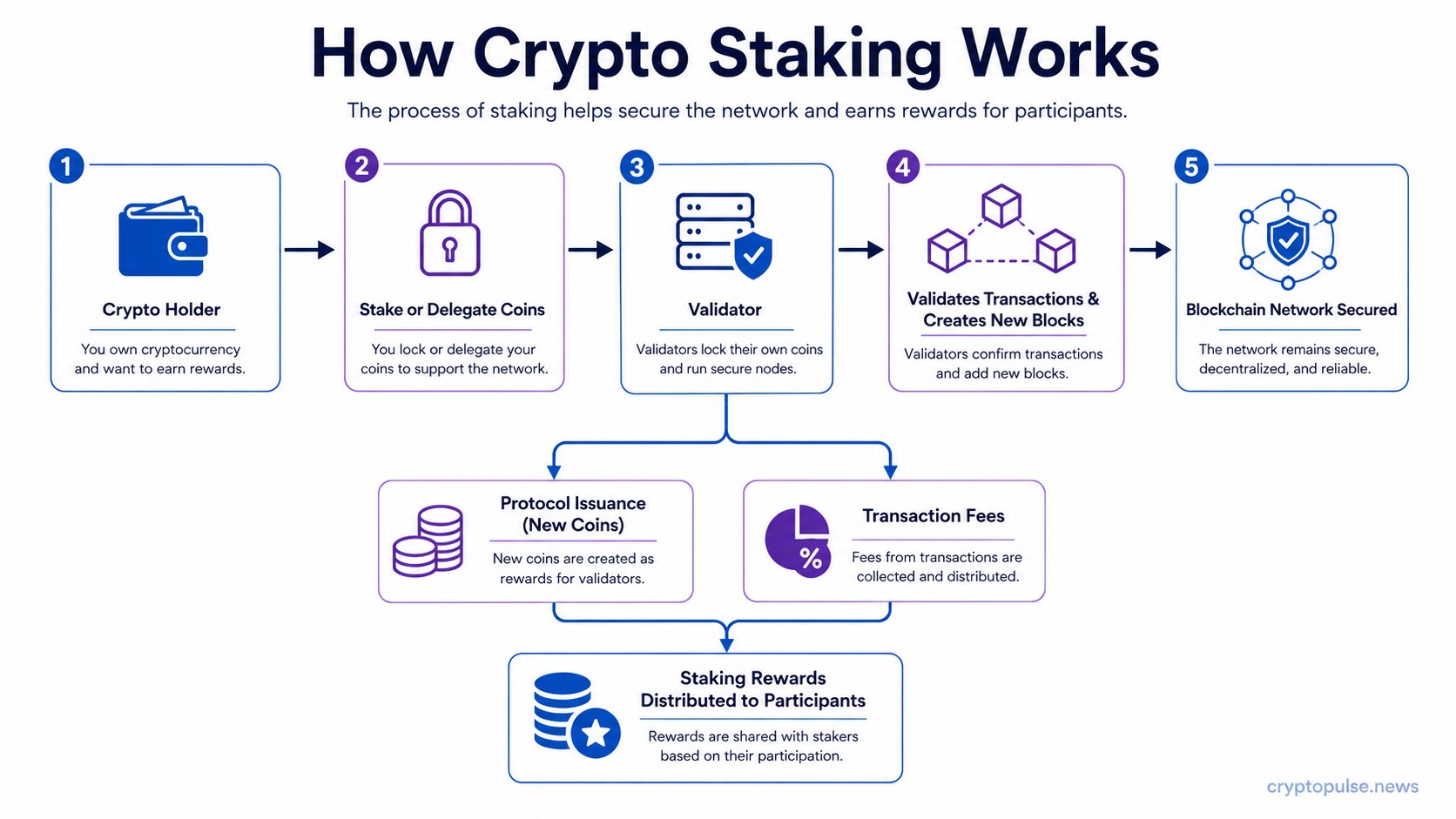
Although staking may seem complicated at first, the underlying concept is relatively straightforward. Proof-of-Stake blockchains rely on validators rather than miners to confirm transactions and create new blocks. The network selects validators according to its own consensus rules, and staking helps determine which participants are eligible to perform this role.
The following sections explain the two core components of the staking process.
Validators and Network Security
Validators are specialized participants responsible for verifying transactions, proposing new blocks, and maintaining consensus across the blockchain network. To become a validator, individuals or organizations must stake a specified amount of cryptocurrency as collateral, demonstrating their commitment to acting honestly.
Whenever users send cryptocurrency or interact with decentralized applications, validators verify these transactions before they are permanently recorded on the blockchain. Multiple validators independently confirm the validity of each block, making it extremely difficult for malicious actors to manipulate the network.
Many Proof-of-Stake systems also include a mechanism known as slashing. If a validator intentionally behaves maliciously, attempts fraud, or repeatedly fails to perform its duties, a portion of its staked assets may be confiscated as a penalty. This economic incentive encourages validators to maintain reliable infrastructure and follow the network’s rules.
Most cryptocurrency holders, however, do not need to operate their own validator. Instead, they can delegate their tokens to existing validators or stake through exchanges and staking providers, allowing them to earn a share of staking rewards without managing complex infrastructure.
Where Staking Rewards Come From
One of the most common questions beginners ask is where staking rewards actually come from. Unlike traditional bank interest, staking rewards are generated by the blockchain protocol itself rather than by lending deposited funds to borrowers.
The exact reward mechanism varies by blockchain, but rewards typically come from one or more of the following sources:
- Newly issued cryptocurrency created according to the network’s monetary policy.
- Transaction fees paid by users whenever they transfer assets or execute smart contracts.
- Protocol incentive mechanisms designed to encourage long-term participation and strengthen network security.
For example, Ethereum validators receive rewards based on several factors, including their participation in validating blocks and the transaction fees generated by network activity. Other blockchains use similar incentive structures but adjust reward rates depending on factors such as the total amount of cryptocurrency currently staked.
It’s important to understand that staking rewards are not guaranteed profits.
While rewards may increase your holdings of a particular cryptocurrency, the market value of those coins can rise or fall over time. As a result, the overall return on staking depends not only on the reward rate but also on the future price of the underlying asset.
Different Ways to Stake Cryptocurrency
Crypto staking is accessible to both beginners and experienced investors. Depending on your technical knowledge, investment size, and desired level of control, there are several ways to participate in staking.
Each option offers different advantages, costs, and responsibilities.
Solo Staking
Solo staking involves running your own validator node and staking cryptocurrency directly on the blockchain without relying on third-party services. This approach provides the highest level of independence because you maintain full control over your validator and private keys.
However, solo staking also requires the greatest commitment. Validators must typically operate dedicated hardware with reliable internet connectivity, maintain high uptime, and regularly update their software. Some networks also impose minimum staking requirements.
For example, running an independent Ethereum validator requires 32 ETH, although smaller holders can also participate through staking pools, exchanges, or liquid staking services.
Despite these barriers, solo staking appeals to experienced users who prioritize decentralization, technical control, and direct participation in network governance.
Staking Pools, Exchanges, and Liquid Staking
Most cryptocurrency holders choose more convenient alternatives that eliminate the need to operate their own validator.
Staking pools allow multiple users to combine their assets so they can collectively participate in staking. Rewards are distributed proportionally based on each participant’s contribution, making staking accessible even with relatively small holdings.
Many centralized cryptocurrency exchanges, including Coinbase, Binance, Kraken, and OKX, also offer integrated staking services. Users simply choose an eligible asset, confirm the staking request, and the platform manages the technical process on their behalf. While this approach is highly convenient, users must trust the exchange to safeguard their assets, making platform security an important consideration.
Another increasingly popular option is liquid staking. Instead of locking assets without flexibility, liquid staking protocols issue a tokenized representation of the staked assets that can continue to be traded or used in decentralized finance (DeFi) applications while the original assets remain staked. Platforms such as Lido have helped expand this model, particularly within the Ethereum ecosystem.
Each staking method involves different trade-offs between convenience, decentralization, liquidity, and risk, so investors should carefully evaluate which option best matches their goals.
Benefits of Crypto Staking
Crypto staking has become increasingly popular because it offers advantages beyond simply earning additional cryptocurrency. While individual results vary by network and market conditions, staking provides several meaningful benefits for both blockchain ecosystems and long-term investors.
One of the most obvious advantages is the opportunity to earn staking rewards while holding digital assets that might otherwise remain idle. Instead of leaving eligible coins unused in a wallet, investors can potentially increase their holdings through ongoing participation in network validation.
Staking also plays a vital role in strengthening blockchain security. The more participants commit assets to a Proof-of-Stake network, the more difficult and expensive it becomes for attackers to compromise the system. This alignment of financial incentives helps maintain decentralized consensus while encouraging responsible validator behavior.
Compared with Proof-of-Work mining, Proof-of-Stake consumes dramatically less energy, making it a more environmentally efficient approach to blockchain security. This improved energy efficiency has become one of the defining characteristics of modern blockchain infrastructure.
Finally, staking often complements long-term investment strategies. Investors who already intend to hold assets for months or years may view staking as a way to participate more actively in the ecosystem while supporting network growth. Some blockchain projects also grant governance rights to stakers, allowing them to vote on protocol upgrades and ecosystem proposals.
Risks of Crypto Staking
Like any investment strategy, crypto staking involves risks that investors should understand before committing their assets. While staking can generate additional cryptocurrency over time, it does not eliminate market risk or guarantee positive returns.
The level of risk depends on the blockchain, staking method, and the service provider you choose. Understanding these factors can help you avoid common mistakes and make more informed decisions.
Price Volatility and Lock-Up Periods
Perhaps the biggest risk associated with staking has nothing to do with the staking process itself—it is the price of the underlying cryptocurrency.
For example, imagine an investor earns 5% annual staking rewards, but the cryptocurrency loses 30% of its market value during the same period. Despite receiving additional coins, the overall investment may still decline significantly in value. Staking rewards should therefore be viewed as an additional yield, not protection against market downturns.
Another consideration is the lock-up or unbonding period. Some Proof-of-Stake networks temporarily restrict access to staked assets after an investor decides to unstake them. Depending on the blockchain, this waiting period may range from a few days to several weeks.
These restrictions can reduce flexibility during periods of high market volatility. Investors who suddenly want to sell their assets may need to wait until the unstaking process is complete before they can transfer or trade their tokens.
For this reason, many experienced investors only stake assets they plan to hold over the long term, rather than funds they may need on short notice.
Slashing, Platform Risk, and Taxes
Beyond market fluctuations, staking introduces several operational risks.
One of the most widely discussed is slashing, a penalty mechanism used by many Proof-of-Stake blockchains. If a validator intentionally violates network rules or repeatedly fails to perform its responsibilities, part of the validator’s staked cryptocurrency may be forfeited. Investors who delegate their assets to third-party validators may also be indirectly affected, depending on the network’s design.
Another important consideration is custodial risk. Investors who stake through centralized exchanges rely on those companies to securely store their assets and operate validators responsibly. While reputable exchanges typically maintain strong security practices, no centralized platform is completely immune to technical failures, insolvency, or cyberattacks.
Liquid staking protocols introduce additional smart contract risk. Although many leading protocols undergo independent security audits, vulnerabilities can never be entirely ruled out in decentralized applications.
Finally, investors should remember that staking rewards may be taxable depending on their country’s laws. Tax treatment varies significantly between jurisdictions, and regulations continue to evolve. Keeping accurate records of staking rewards and consulting a qualified tax professional can help ensure compliance with local requirements.
Which Cryptocurrencies Can Be Staked
Not every cryptocurrency supports staking. Only blockchains that use Proof-of-Stake or related consensus mechanisms allow users to participate in staking.
Some of the most widely staked cryptocurrencies include:
- Ethereum (ETH) — the world’s largest Proof-of-Stake blockchain following its transition from Proof of Work in 2022.
- Solana (SOL) — known for high transaction throughput and relatively low fees.
- Cardano (ADA) — designed with a research-driven approach and a delegated staking model.
- Avalanche (AVAX) — supports staking through validators and delegators while emphasizing scalability.
- Polkadot (DOT) — enables staking as part of its shared security model for interconnected blockchains.
- Cosmos (ATOM) — allows token holders to delegate assets to validators across its expanding ecosystem.
- Tezos (XTZ) — one of the earliest major Proof-of-Stake networks, using a staking process known as “baking.”
In contrast, Bitcoin cannot be staked because it uses the Proof-of-Work consensus mechanism, where miners compete to solve cryptographic puzzles instead of validators staking cryptocurrency. While some platforms advertise “Bitcoin staking,” these products generally involve wrapped Bitcoin, lending services, or third-party financial products rather than native Bitcoin staking.
Understanding this distinction helps investors avoid confusion when comparing different cryptocurrencies and investment opportunities.
Is Crypto Staking Worth It
Whether crypto staking is worthwhile depends largely on your investment strategy, risk tolerance, and time horizon.
For long-term investors, staking can provide an opportunity to increase their cryptocurrency holdings while supporting the security and decentralization of blockchain networks. Investors who already intend to hold eligible assets for several years may find staking a natural extension of their investment approach.
However, staking may be less suitable for short-term traders or investors who require immediate liquidity. Lock-up periods, market volatility, and platform risks can reduce flexibility, particularly during periods of rapid price movement.
It’s also important to maintain realistic expectations. Higher advertised staking yields do not necessarily translate into higher overall returns, especially if the underlying cryptocurrency experiences significant price declines. Likewise, unusually high reward rates offered by lesser-known projects may indicate elevated risk rather than better investment opportunities.
Ultimately, crypto staking should be viewed as one component of a diversified investment strategy, rather than a guaranteed source of passive income. Understanding the blockchain, evaluating validator reliability, and considering your own financial goals are all essential steps before deciding to stake digital assets.
Conclusion
Crypto staking has become one of the defining features of modern blockchain networks, allowing cryptocurrency holders to help secure Proof-of-Stake ecosystems while earning rewards for their participation. Although the process is generally more energy-efficient than traditional mining, successful staking still requires an understanding of validator selection, lock-up periods, market volatility, and platform risks.
By learning how staking works and choosing reputable staking methods, investors can make more informed decisions about whether staking aligns with their long-term financial objectives and overall cryptocurrency strategy.
Frequently Asked Questions
Staking rewards vary depending on the blockchain, validator, and network participation. Annual percentage yields (APYs) typically range from around 2% to over 10%, although higher rewards often come with greater risk. Actual returns also depend on the market price of the staked cryptocurrency.
Yes. While staking itself generates rewards, the value of the underlying cryptocurrency can decline, potentially outweighing those rewards. Investors may also face risks such as slashing, platform failures, or smart contract vulnerabilities, depending on how they stake.
No. Although running your own validator on some networks requires a substantial amount of cryptocurrency (such as 32 ETH for an independent Ethereum validator), many staking pools and exchanges allow users to start with much smaller amounts, making staking accessible to most investors.
In most cases, staked cryptocurrency cannot be sold until it has been unstaked, and some networks require an additional waiting period before the assets become available. However, liquid staking solutions issue tradable tokens that can provide access to liquidity while the original assets remain staked.
Learn More with CryptoPulse.News
- How to Store Cryptocurrency Securely: A Beginner’s Guide
- How to Manage Risk When Investing in Cryptocurrency
- What Is Ethereum and Why It Matters in Digital Finance
- How to Analyze Crypto Projects Before Investing