Top Crypto Exchanges for Beginners
Choosing the right crypto exchange is one of the most important first steps for any investor, as it affects security, costs, ease of use, and the overall experience of buying and managing digital assets.
Buying cryptocurrency has become significantly easier over the past decade, with hundreds of exchanges now serving millions of users worldwide. However, not all platforms offer the same level of security, transparency, fees, or user experience, making it essential for beginners to understand what separates a trustworthy exchange from one that may not meet their needs.
Whether you want to buy your first Bitcoin, diversify into altcoins, or simply explore the cryptocurrency market, selecting the right platform can save money, reduce risks, and make your investment journey far more enjoyable. This guide explains how crypto exchanges work, what features beginners should prioritize, and introduces several well-known centralized exchanges that are widely recognized across the industry.
Table of Contents
- What Is a Crypto Exchange?
- How to Choose the Right Crypto Exchange
- Popular Crypto Exchanges for Beginners
- Common Mistakes Beginners Make When Choosing an Exchange
- Conclusion
- Frequently Asked Questions
What Is a Crypto Exchange?
A cryptocurrency exchange is an online platform that allows users to buy, sell, trade, and sometimes store digital assets such as Bitcoin (BTC), Ethereum (ETH), and thousands of other cryptocurrencies. Similar to a traditional stock brokerage, an exchange connects buyers and sellers while facilitating transactions at market prices.
Most people begin their crypto journey by purchasing digital assets with fiat currencies such as the US dollar, euro, or British pound. Many exchanges support payments through bank transfers, debit cards, credit cards, and third-party payment providers, making it relatively simple for newcomers to enter the market.

Before choosing a platform, it is helpful to understand the two primary types of crypto exchanges.
Centralized Exchanges (CEXs)
Centralized exchanges (CEXs) are operated by companies that manage customer accounts, process trades, and hold users’ assets while they remain on the platform. They typically require users to create an account and complete Know Your Customer (KYC) identity verification before accessing all features.
For beginners, centralized exchanges offer several important advantages:
- Simple and intuitive interfaces
- Customer support
- Fiat currency deposits and withdrawals
- Advanced security features such as two-factor authentication (2FA)
- Educational resources and mobile applications
Because of their convenience, centralized exchanges remain the most common entry point into the cryptocurrency market for first-time investors.
Decentralized Exchanges (DEXs)
Decentralized exchanges (DEXs) operate differently. Instead of relying on a company to hold customer funds, they allow users to trade cryptocurrencies directly from their own wallets using smart contracts.
While DEXs provide greater control over digital assets and enhanced privacy, they generally require users to already own cryptocurrency, understand wallet management, and pay blockchain network fees. For these reasons, decentralized exchanges are often considered more suitable for intermediate and experienced users rather than complete beginners.
How to Choose the Right Crypto Exchange
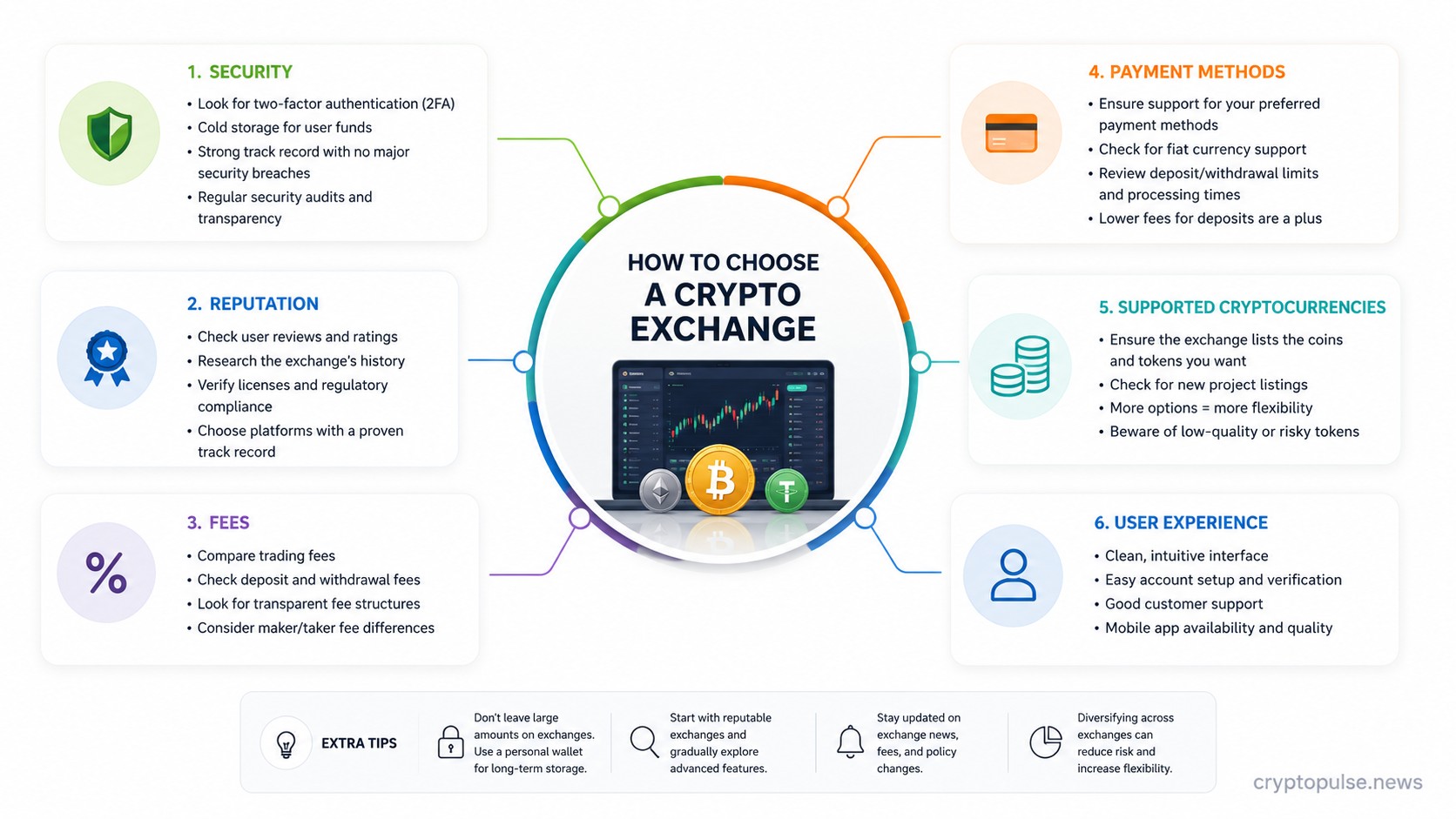
With hundreds of cryptocurrency exchanges available worldwide, choosing the right platform can feel overwhelming. Rather than focusing only on the number of listed coins or the lowest trading fees, beginners should evaluate several important factors that influence both security and long-term usability.
Security and Reputation
Security should always be your highest priority when selecting a crypto exchange. While no online platform can eliminate every possible risk, reputable exchanges invest heavily in protecting customer accounts and digital assets.
Look for platforms that offer:
- Two-factor authentication (2FA) for account protection
- Cold storage for storing most customer assets offline
- Withdrawal security controls, including address whitelisting where available
- Transparent security practices and regular infrastructure improvements
Reputation also matters. Consider how long an exchange has operated, whether it has maintained a strong record of protecting customer funds, and how openly it communicates with users during technical incidents or market volatility.
It is also worth checking whether an exchange publishes Proof of Reserves (PoR) reports. These reports are designed to improve transparency by demonstrating that a platform holds sufficient assets to cover customer balances. While Proof of Reserves does not replace a full financial audit, it has become an important trust indicator following several high-profile exchange failures.
Fees and Payment Options
Exchange fees can vary considerably, especially depending on how you purchase cryptocurrency.
Common costs include:
- Trading fees
- Deposit fees
- Withdrawal fees
- Blockchain network fees for transferring crypto
Many exchanges reduce trading fees for users with higher trading volumes or for those using the platform’s native utility token. However, beginners should avoid choosing an exchange based solely on the lowest advertised fees. A slightly higher fee may be worthwhile if the platform offers stronger security, better customer support, or a more intuitive interface.
Payment flexibility is equally important. Many leading exchanges support:
- Bank transfers
- Debit and credit cards
- Apple Pay or Google Pay in supported regions
- Peer-to-peer (P2P) marketplaces
- Third-party payment providers
Before registering, verify that your preferred payment method is available in your country.
User Experience and Supported Assets
A beginner-friendly exchange should make buying cryptocurrency straightforward rather than confusing.
Look for features such as:
- Clear navigation
- Beginner-friendly mobile applications
- Educational articles and tutorials
- Responsive customer support
- Easy portfolio tracking
Supported cryptocurrencies also deserve attention. While most exchanges offer major assets such as Bitcoin and Ethereum, the number of available cryptocurrencies varies widely between platforms.
For most beginners, access to well-established cryptocurrencies is far more valuable than thousands of obscure tokens. As your knowledge grows, you can always expand to exchanges that specialize in smaller or emerging digital assets.
Finally, remember that availability differs by jurisdiction. Because cryptocurrency regulations vary around the world, some exchanges may restrict services or certain products depending on where you live. Always confirm that a platform legally operates in your country before creating an account.
Popular Crypto Exchanges for Beginners
The following exchanges are well-established centralized platforms that have earned widespread recognition within the cryptocurrency industry. Each offers a slightly different combination of features, supported assets, and trading tools, making them suitable for different types of users. Rather than viewing them as a ranking, consider them as examples of reputable exchanges that beginners can evaluate based on their own priorities.
Binance
Founded in 2017, Binance has grown into one of the world’s largest cryptocurrency exchanges by trading volume. It supports hundreds of cryptocurrencies, offers competitive trading fees, and provides a broad ecosystem that includes spot trading, recurring purchases, staking, Earn products, and a peer-to-peer (P2P) marketplace in many regions.
For beginners, Binance offers a simplified buying experience alongside more advanced trading features that users can explore as they gain confidence. Its extensive educational platform, Binance Academy, also provides free learning resources covering blockchain technology, security, and investing basics.
Because Binance operates globally, available products and services vary depending on local regulations, so users should verify which features are accessible in their country.
Coinbase
Coinbase, established in 2012, is widely recognized for its clean interface and beginner-friendly design. It allows users to purchase cryptocurrency using several payment methods while providing a straightforward experience that minimizes unnecessary complexity.
One of Coinbase’s biggest strengths is its emphasis on ease of use, regulatory compliance, and educational content. The platform also offers secure custody solutions and supports many of the largest cryptocurrencies by market capitalization.
While Coinbase’s convenience makes it attractive for newcomers, its fees can be higher than those of some competitors, particularly when purchasing cryptocurrency through instant payment methods.
Kraken
Founded in 2011, Kraken is one of the oldest continuously operating cryptocurrency exchanges. Over the years, it has built a strong reputation for security, reliability, and transparent operations.
Kraken supports a wide range of cryptocurrencies while offering beginner-friendly purchasing options alongside more advanced trading features for experienced investors. The platform is also known for maintaining a conservative approach to security and regularly publishing information about its proof of reserves process.
Although Kraken’s interface has become more accessible over time, some advanced trading tools may initially appear more technical than those offered by exchanges focused primarily on beginners.
Bitstamp
Launched in 2011, Bitstamp is another long-established cryptocurrency exchange that focuses on providing a reliable and straightforward trading experience. Rather than offering hundreds of niche cryptocurrencies, Bitstamp concentrates on many of the market’s largest and most established digital assets.
This simpler asset selection can actually benefit beginners by reducing unnecessary complexity and encouraging a focus on widely adopted cryptocurrencies. Bitstamp also supports several fiat currencies and has built a reputation for dependable service over many years.
Investors looking for newly launched tokens or a very large selection of altcoins, however, may find its listings more limited than those of larger global exchanges.
MEXC
Founded in 2018, MEXC has become popular for offering a very broad selection of cryptocurrencies, including many smaller and emerging projects that may not yet be available on larger exchanges.
The platform combines relatively competitive trading fees with an easy account setup process and supports both beginner and advanced trading features. For users interested in exploring the broader cryptocurrency ecosystem beyond Bitcoin and Ethereum, MEXC provides extensive market coverage.
Because newly listed cryptocurrencies often carry higher volatility and investment risk, beginners should research unfamiliar projects carefully before making any purchases.
KuCoin
Established in 2017, KuCoin is well known for its diverse range of listed cryptocurrencies and accessible trading platform. In addition to spot trading, it offers features such as recurring purchases, staking opportunities, and various tools designed for users with different levels of experience.
KuCoin has attracted many investors seeking access to projects that may not yet appear on every major exchange. Its intuitive interface makes navigation relatively straightforward despite the platform’s extensive range of services.
As with any exchange supporting numerous digital assets, beginners should prioritize understanding the risks of individual cryptocurrencies rather than investing solely because a token is newly listed or rapidly gaining attention.
Common Mistakes Beginners Make When Choosing an Exchange
Selecting a reputable exchange is only the first step. Many new investors unintentionally expose themselves to unnecessary risks by overlooking basic security practices or making decisions based solely on marketing claims.
One common mistake is choosing an exchange exclusively because it advertises the lowest trading fees. While costs certainly matter, factors such as security, reputation, customer support, and regulatory compliance often have a much greater impact on the overall experience.
Another frequent error is keeping all cryptocurrency on an exchange indefinitely. Although centralized exchanges employ sophisticated security measures, they remain custodial services. Many experienced investors eventually transfer long-term holdings to self-custody wallets, where they control their own private keys.
Beginners should also avoid creating accounts on unknown or poorly established exchanges simply because they promise unusually high rewards, exclusive token listings, or unrealistic investment opportunities. If an offer appears too good to be true, it deserves careful scrutiny.
Finally, never overlook basic account security. Enabling two-factor authentication (2FA), using a strong unique password, and remaining alert to phishing emails or fake websites can significantly reduce the risk of unauthorized account access.
Conclusion
Choosing your first cryptocurrency exchange is about much more than finding the lowest fees or the largest number of listed coins. Security, reputation, ease of use, payment options, and regulatory availability all play important roles in creating a positive experience for new investors.
There is no single exchange that is ideal for everyone. Some users value simplicity, while others prioritize low trading costs or access to a wider range of cryptocurrencies. By understanding how exchanges work and evaluating platforms based on objective criteria rather than marketing claims, beginners can make more informed decisions and build a stronger foundation for their cryptocurrency journey.
As your knowledge and confidence grow, you may decide to explore additional exchanges or even decentralized platforms. Regardless of where you begin, taking time to research before depositing funds is one of the smartest investments you can make.
Frequently Asked Questions
There is no single safest crypto exchange, but beginners should choose platforms with a strong security record, two-factor authentication (2FA), transparent operations, and a long history of serving users. Well-established exchanges such as Binance, Coinbase, Kraken, Bitstamp, MEXC, and KuCoin all offer multiple security features, though availability and services vary by region.
Not necessarily. Most centralized exchanges provide a built-in custodial wallet that allows you to buy, sell, and store cryptocurrencies. However, many long-term investors eventually move their assets to a personal wallet, where they control the private keys and have full ownership of their cryptocurrency.
It depends on the exchange and your location. Most reputable centralized exchanges require Know Your Customer (KYC) verification before users can access full trading features or purchase cryptocurrency with fiat currencies. Some platforms may allow limited services without verification, subject to local regulations.
Yes. Many investors maintain accounts with multiple exchanges to access different cryptocurrencies, payment methods, or features. Using more than one reputable exchange can also provide greater flexibility if certain services or trading pairs are unavailable on a single platform.
Learn More with CryptoPulse.News
- How to Buy Your First Cryptocurrency
- How to Store Cryptocurrency Securely: A Beginner’s Guide
- 10 Common Cryptocurrency Mistakes Beginners Should Avoid
- How to Manage Risk When Investing in Cryptocurrency