What Is DePIN? How Decentralized Infrastructure Works
DePIN connects crypto-economic incentives with real-world infrastructure, allowing distributed participants to provide resources such as wireless connectivity, storage, computing power, and physical data.
Traditional infrastructure is usually built around centralized ownership: telecommunications companies operate networks, cloud providers run data centers, and mapping companies control the equipment and data behind their services.
DePIN introduces a different approach by coordinating physical resources supplied by multiple independent participants. The model can be applied to wireless connectivity, data storage, computing power, mapping, sensors, and other real-world infrastructure.
Some DePIN networks are already operating at significant scale, while others are still developing their commercial use cases. Their economics can also differ substantially from those of traditional infrastructure businesses.
This guide explains how DePIN works, examines major infrastructure categories and real-world networks, and explores its benefits, challenges, and current direction.
Table of Contents
- What Is DePIN?
- How Does DePIN Work?
- What Types of Infrastructure Can DePIN Support?
- Real-World Examples of DePIN Networks
- What Are the Benefits of DePIN?
- What Are the Risks and Challenges of DePIN?
- DePIN vs. Traditional Infrastructure
- Why Does DePIN Matter for Crypto and Web3?
- What Is the Future of DePIN?
- Final Thoughts
- Frequently Asked Questions
What Is DePIN?
DePIN stands for Decentralized Physical Infrastructure Networks. It describes networks that use decentralized protocols and crypto-economic incentives to coordinate physical infrastructure or real-world resources supplied by distributed participants.
A typical DePIN network combines three elements:
- Physical resources: Hardware or other real-world assets supplied by participants. These can include wireless hotspots, storage capacity, GPUs, cameras, sensors, or other equipment.
- A decentralized protocol: Software and blockchain infrastructure that records activity, coordinates participants, verifies contributions, and manages network rules.
- Economic incentives: Participants can receive cryptocurrency tokens or other forms of compensation for providing useful resources or services to the network.
This creates a different approach to infrastructure deployment. Instead of a single company financing, installing, and operating every piece of equipment, many independent providers can contribute resources to a shared network.
The blockchain does not replace the physical infrastructure. A GPU still needs electricity, a wireless hotspot still needs a physical location, and a storage provider still needs actual disk capacity. Instead, blockchain provides the coordination and incentive layer around those resources.
DePIN is not a single technology or blockchain, but a model that can be applied across different infrastructure markets. What connects these networks is the attempt to use decentralized coordination and economic incentives to organize real-world resources at scale.

How Does DePIN Work?
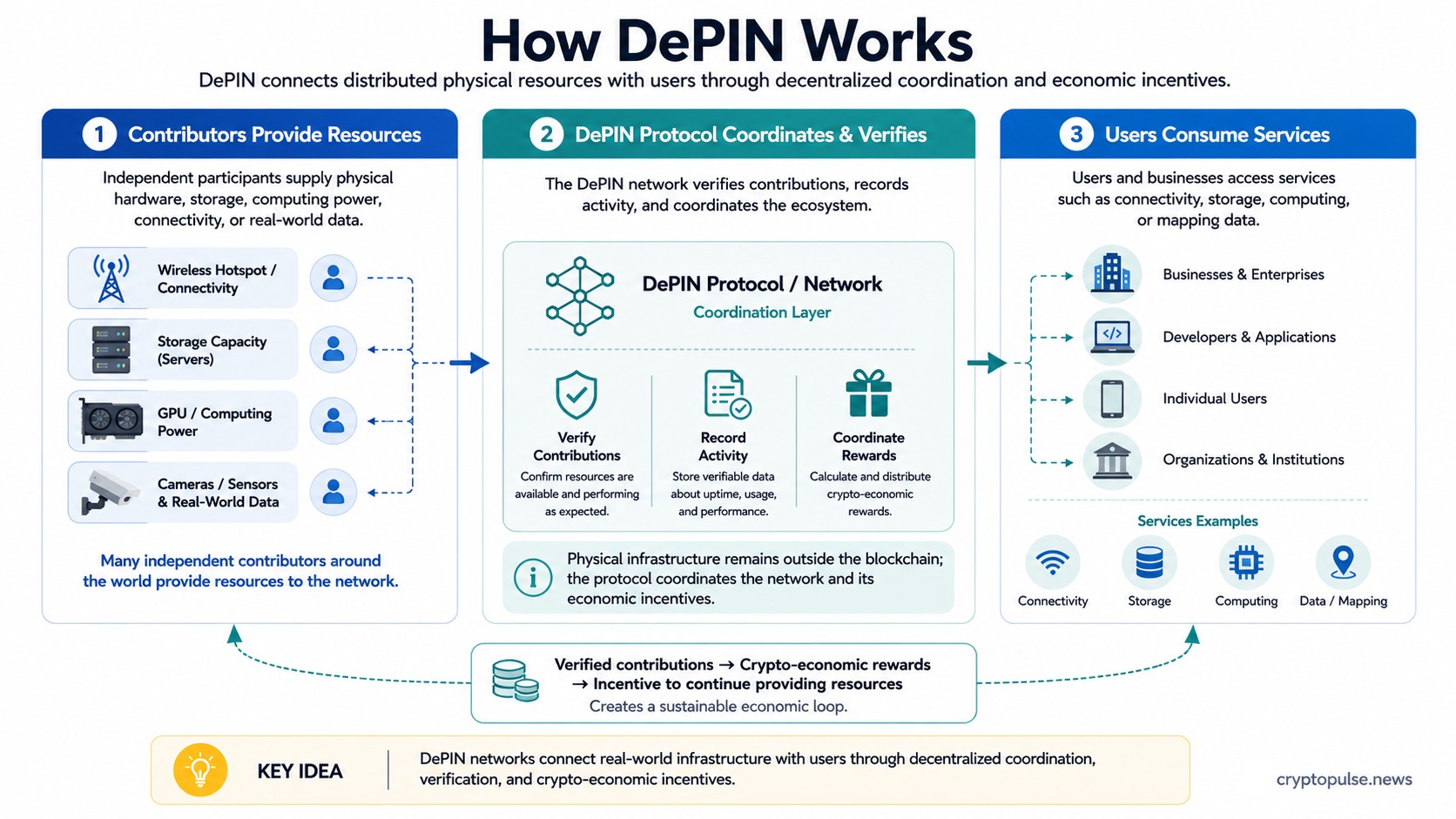
Although individual DePIN networks use different technologies and incentive systems, their basic operating model follows a similar pattern. Participants supply resources, the network verifies and coordinates those contributions, and users ultimately consume the resulting services.
Contributors Provide Physical Resources
The first layer is the infrastructure itself. Individuals, businesses, or specialized operators contribute physical resources to a network.
The resource can vary substantially depending on the project. A wireless DePIN may rely on hotspots or other networking equipment. A storage network can use servers with available disk capacity. A computing network can connect machines equipped with GPUs. A mapping network may depend on cameras and sensors installed in vehicles.
This model can allow infrastructure to be deployed by a much larger group than a traditional centralized operator could manage directly. A participant might contribute equipment they already own, purchase specialized hardware for the network, or operate infrastructure as a business.
However, the decentralized model does not remove the physical costs of infrastructure. Hardware, electricity, maintenance, connectivity, and physical deployment remain real-world requirements.
The Network Verifies Contributions and Coordinates Rewards
A DePIN protocol needs a way to determine whether participants are actually providing the resources they claim to provide. Otherwise, participants could potentially receive rewards without delivering useful infrastructure.
Networks therefore use different mechanisms to verify resource availability, activity, performance, or delivered data. The exact approach depends on the type of infrastructure. Storage networks, for example, can use cryptographic proofs to demonstrate that data is being retained, while wireless or mapping networks can use network activity and other forms of verification.
Once contributions have been verified, the protocol can calculate rewards according to its rules. These rewards often involve a native cryptocurrency token.
The important distinction is that the token is an economic mechanism, not the infrastructure itself. It can encourage participants to deploy equipment and provide resources, while blockchain records and protocol rules help coordinate those incentives.
This creates a feedback mechanism: useful contributions can attract rewards, while increasing network usage can create demand for the resources being supplied.
Users Pay for Infrastructure Services
A functioning DePIN network ultimately needs users on the other side of the system.
Users can include individuals, developers, businesses, applications, or other networks that need the infrastructure provided by participants. They might need wireless connectivity, data storage, GPU computing, mapping information, or another service.
The resulting model can be summarized simply:
Contributors provide resources → the protocol coordinates them → users consume the service.
This is important because a network can have a large amount of contributed infrastructure without necessarily having a sustainable business model. Token incentives can help create supply, but genuine demand is what gives that infrastructure an ongoing economic purpose.
For this reason, evaluating a DePIN network requires looking at more than its token price, number of contributors, or amount of hardware deployed. Actual usage, paying customers, service quality, and the economics of operating the infrastructure are equally important.
What Types of Infrastructure Can DePIN Support?
DePIN is a broad category rather than a single infrastructure technology. Existing networks demonstrate how the model can be applied to several different types of physical resources, from communications equipment to computing hardware and data-collection devices.
Wireless and Connectivity Networks
One major DePIN category involves decentralized wireless infrastructure. Participants can deploy networking equipment that provides connectivity in locations where users or other networks need coverage.
Wireless DePIN networks can support technologies such as Wi-Fi, cellular connectivity, and Internet of Things (IoT) communications. Instead of a single telecommunications operator deploying every access point, a decentralized network can coordinate infrastructure supplied by many independent operators.
The challenge is that wireless infrastructure remains highly physical: equipment needs suitable locations, power, connectivity, and regulatory compliance. The decentralized model changes who can contribute infrastructure and how participants are economically coordinated, rather than eliminating those requirements.
Storage and Computing
Another major category is distributed digital infrastructure built from physical hardware.
Decentralized storage networks allow independent operators to contribute disk capacity and store data for users. Computing-focused networks take a similar approach with CPUs or GPUs, allowing participants to supply processing capacity that can be used for workloads such as rendering, artificial intelligence, and other computational tasks.
These networks are particularly relevant as demand for data storage and computing resources increases. Their value depends on whether distributed infrastructure can provide users with reliable, competitive, and verifiable services, rather than simply accumulating hardware capacity.
Mapping, Sensors and Other Physical Resources
DePIN can also turn physical devices into distributed data-collection infrastructure.
Mapping networks, for example, can use contributor-operated cameras and sensors to collect road imagery, location information, and other real-world data. Other applications can involve environmental sensors, mobility infrastructure, energy resources, or specialized devices.
This category demonstrates that DePIN is not limited to traditional infrastructure such as storage or telecommunications. Any network that can coordinate distributed physical resources and turn their output into a useful service can potentially fit the broader DePIN model.
Real-World Examples of DePIN Networks
The DePIN sector includes many projects, but this explainer will focus on networks with actual infrastructure, continuing development, and identifiable real-world use cases.
Helium: Decentralized Wireless Infrastructure
Helium is one of the best-known examples of DePIN applied to wireless connectivity. Its ecosystem allows independent operators to deploy wireless infrastructure and participate in networks serving devices and users.
Helium’s model has evolved beyond simply rewarding people for installing hotspots. Its network has been used for carrier traffic and cellular offload, demonstrating how contributor-operated infrastructure can connect with existing telecommunications services. Helium’s operational status also continues to show active network and carrier-offload infrastructure in 2026.
The example illustrates an important DePIN principle: distributed infrastructure can complement existing centralized networks rather than necessarily replacing them outright.
Filecoin: Decentralized Storage
Filecoin applies the DePIN model to data storage. Independent storage providers contribute disk capacity, while the Filecoin protocol uses cryptographic mechanisms to verify that storage commitments are being maintained.
Filecoin has moved beyond simply accumulating storage capacity. In its 2026 network strategy, the ecosystem explicitly shifted its focus toward paid, on-chain storage deals, network profitability, and adoption by paying customers. The strategy also identifies AI-related data requirements as an important source of demand.
Filecoin Onchain Cloud went live on mainnet in March 2026, adding programmable storage and payment services around its decentralized infrastructure. At launch, it reported 49.41 TiB of data across 478 active datasets and 81 payer wallets connected through Filecoin Pay.
Filecoin therefore provides a useful example of an important evolution in DePIN: moving from incentivizing infrastructure supply toward building services that attract paying demand.
Render Network: Distributed GPU Computing
Render Network applies distributed infrastructure to GPU computing. The network connects GPU resources with users who need computing capacity, historically including workloads such as 3D rendering.
Its current infrastructure has expanded toward machine learning and artificial intelligence workloads. Render’s documentation describes support for machine-learning training, inference, fine-tuning, and generative AI imaging, with an API allowing external applications to access on-demand decentralized GPU computing.
This makes Render a useful example of how DePIN can connect independently supplied physical computing hardware with software-driven demand. Instead of building one centralized GPU cluster, the model aggregates computing resources distributed across network participants.
Hivemapper: Decentralized Mapping and Sensors
Hivemapper demonstrates another application of DePIN: collecting and processing real-world data through contributor-operated devices.
The project initially relied heavily on dashcams collecting street-level imagery for a map. Its network has since evolved. Under changes documented in May 2026, Hivemapper describes the network as a marketplace of sensors and compute, where devices operated by contributors can fulfill developer-requested work orders in exchange for HONEY rewards. Devices can now provide video, location and inertial data and perform on-device detections. They can also run developer-authored workloads at the edge.
This evolution is significant because it shows how a DePIN network can expand from collecting a single type of physical data into a broader marketplace for distributed sensing and computing resources.
What Are the Benefits of DePIN?
DePIN changes the traditional infrastructure model by combining distributed resource providers with software-based coordination and crypto-economic incentives. The potential benefits depend on whether this model can provide useful infrastructure efficiently, rather than simply attracting more participants.
Distributed Infrastructure Deployment
Traditional infrastructure often requires a company to make substantial upfront investments in equipment, facilities, networks, and maintenance. A DePIN network can instead aggregate infrastructure deployed by many independent participants.
This approach can be particularly useful when resources are geographically distributed or when existing hardware would otherwise remain underused. A network can potentially expand by adding contributors rather than requiring a single operator to finance every new deployment.
The model can also create more granular infrastructure. For example, a wireless network can potentially gain coverage from contributors in locations that may not justify a conventional large-scale deployment.
However, decentralization is not automatically more efficient. The infrastructure still has to be deployed, powered, maintained, and connected to users. The advantage comes when coordinating many contributors provides an economic or operational benefit over relying exclusively on centralized infrastructure.
Incentives for Infrastructure Contribution
A central feature of DePIN is the use of economic incentives to encourage participants to provide useful resources.
A contributor may spend money on a device, electricity, storage hardware, or computing equipment and receive network rewards in return. This can help a new network bootstrap its supply before it has enough customers to generate substantial service revenue.
Token incentives can therefore solve an important coordination problem: participants have a reason to invest in infrastructure that becomes more useful as the network grows.
The limitation is equally important. Rewards can create supply, but they cannot guarantee demand. If participants are paid to deploy hardware that customers do not need, the network can accumulate infrastructure without developing a sustainable business.
Open Participation and New Infrastructure Models
DePIN can also broaden who participates in infrastructure markets.
Instead of infrastructure being financed and operated exclusively by large companies, individuals, small businesses, and specialized operators can potentially become resource providers. The exact barriers vary by network: some require inexpensive consumer hardware, while others require significant capital and technical expertise.
This creates a marketplace-like model in which contributors can supply resources and users can consume them without every transaction being managed by a single infrastructure owner.
The broader significance is that DePIN applies blockchain’s coordination mechanisms to markets that have traditionally depended on centralized ownership. Its success, however, depends on whether distributed participation produces reliable services at competitive costs.
What Are the Risks and Challenges of DePIN?
DePIN combines crypto economics with physical infrastructure, so its risks extend beyond those normally associated with blockchain software. Hardware economics, service reliability, token volatility, demand, regulation, and geographic factors can all affect a network at the same time.
Hardware and Operational Costs
Physical infrastructure cannot be created by software alone. Contributors may need to purchase equipment, install it in suitable locations, pay for electricity and connectivity, and maintain it over time.
These costs can make the economics of a DePIN network very different from those of a conventional crypto protocol. A participant earning tokens must ultimately cover expenses that are usually denominated in fiat currency, including hardware and electricity.
Location can matter as well. A network may have thousands of devices but still lack useful coverage if too many are concentrated in the same places. In location-dependent networks, where infrastructure is deployed can be as important as how much infrastructure exists.
Token Economics and Sustainable Demand
Token incentives create one of DePIN’s biggest opportunities and one of its biggest risks.
A network may need to reward contributors before sufficient customer demand exists. This can help bootstrap infrastructure, but excessive emissions can also make the network dependent on continued token distribution.
A 2026 review of DePIN tokenomics identifies token-price volatility, incentive alignment, insufficient non-speculative demand, and regulatory uncertainty as key challenges. Providers face a particularly difficult problem because their costs can remain relatively stable while their token-denominated rewards fluctuate significantly.
The practical test is whether customer payments and genuine network usage can increasingly support the infrastructure, rather than token emissions doing all the work?
Verification, Centralization and Regulation
A decentralized network still needs reliable methods for verifying contributions. Without effective verification, participants may be able to exaggerate uptime, location, computing capacity, data quality, or other characteristics in order to receive rewards.
There is also a potential centralization problem within decentralized networks. Hardware manufacturers, large operators, infrastructure providers, foundations, developers, or a small group of major customers can become disproportionately important even when thousands of individual nodes exist.
Regulation adds another layer. DePIN can intersect with telecommunications, data protection, mapping, consumer protection, digital assets, and other physical-world rules, depending on the service and jurisdiction. A 2025 SEC Crypto Task Force submission specifically identified uncertainty around the treatment of digital assets used as DePIN incentives as a barrier to wider U.S. adoption.
DePIN vs. Traditional Infrastructure
DePIN does not simply replace centralized infrastructure with a decentralized equivalent. Instead, it changes how infrastructure can be financed, supplied, coordinated, and monetized.
In a traditional model, a company typically raises capital, purchases or builds infrastructure, controls its operation, and sells the resulting service to customers. In a DePIN model, infrastructure can instead be supplied by many independent participants, while a protocol coordinates contributions and distributes incentives.
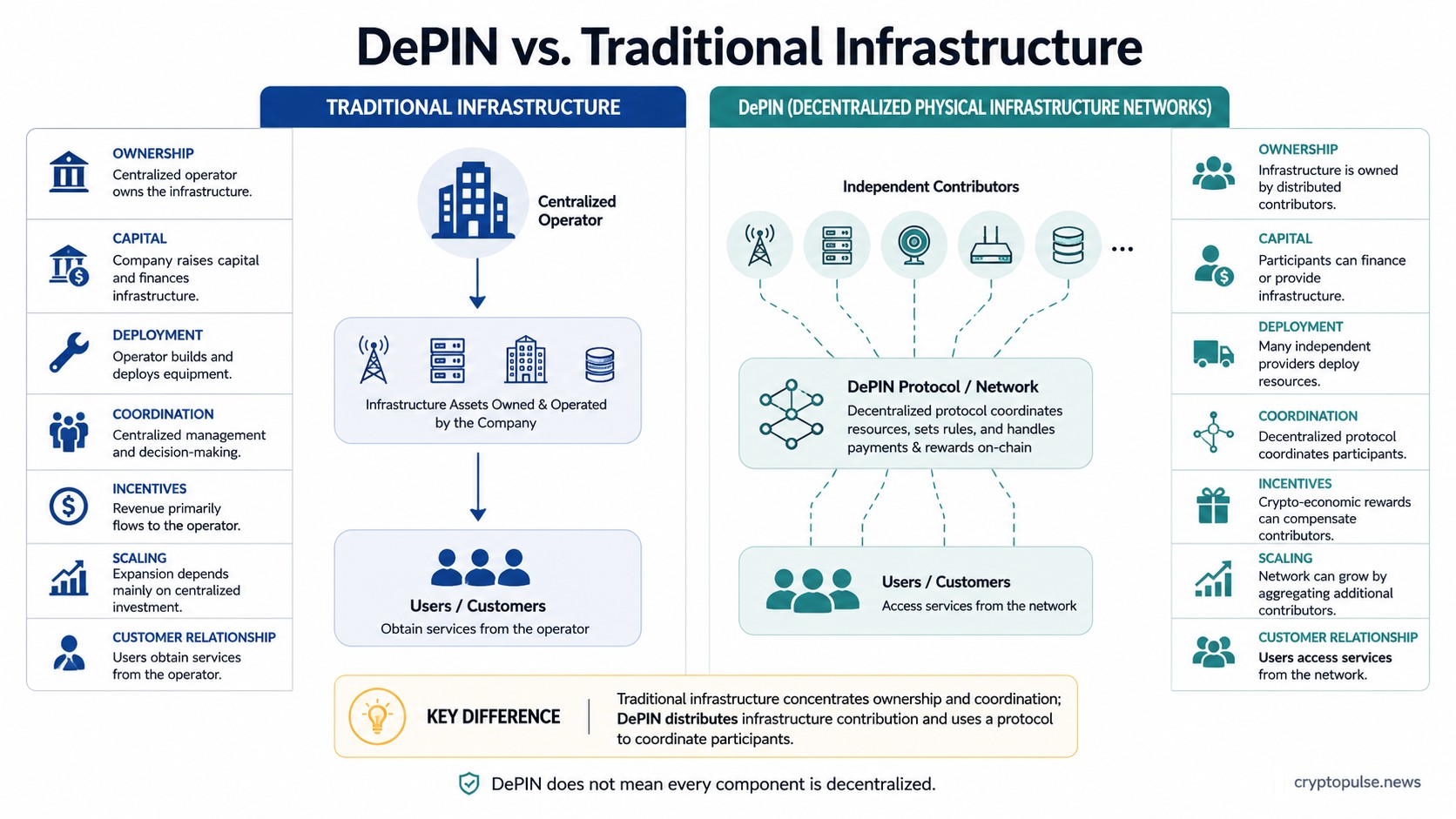
DePIN does not mean every part of the system is decentralized. Hardware manufacturers, internet providers, development teams, foundations, exchanges, and other centralized entities can still play important roles.
The key difference is that infrastructure supply and economic coordination can be distributed across multiple participants rather than controlled entirely by one operator.
Why Does DePIN Matter for Crypto and Web3?
DePIN is important to the broader crypto ecosystem because it gives blockchain technology a role in coordinating physical resources rather than only recording ownership of digital assets.
Traditional blockchain applications largely operate in digital environments. DePIN introduces an additional layer: people contribute physical hardware or real-world resources, the network verifies useful work, and blockchain-based mechanisms can coordinate rewards and payments.
This creates a connection between crypto-economic incentives and services that exist outside the blockchain. Wireless coverage, storage, computing power, and mapping data are tangible resources that users can consume regardless of whether they understand or care about blockchain technology.
DePIN also overlaps naturally with several fast-developing technology areas. Distributed computing networks can serve AI workloads, storage networks can support increasingly data-intensive applications, and sensor networks can produce data for mapping and other real-world services.
The more important question is whether decentralized coordination can organize useful physical resources into competitive markets.
That distinction matters. A DePIN network with many token holders but little service usage has limited evidence of real-world utility. A network with measurable infrastructure, paying customers, and sustainable provider economics represents a much stronger case for the model.
What Is the Future of DePIN?
The most useful way to assess DePIN’s future is to look at what operating networks are already building and where their economics are moving, rather than relying on speculative forecasts.
One clear development is a greater focus on paid usage and sustainable demand. Filecoin’s 2026 network strategy explicitly shifts attention toward paid on-chain storage deals, network profitability, and paying customers. Its strategy also identifies AI-related data needs as an important source of potential storage demand.
Computing is another area where DePIN is already expanding. Render’s current network supports GPU workloads related to machine learning, AI inference, training, fine-tuning, and generative applications, demonstrating an existing connection between distributed infrastructure and AI computing rather than a purely hypothetical one.
DePIN networks are also becoming more multifunctional. Hivemapper’s move toward a marketplace for sensors and compute shows how a mapping-focused DePIN network can expand into other distributed sensing and computing workloads.
These developments show a sector increasingly focused on measurable service usage, enterprise and developer demand, AI-related workloads, distributed data, and infrastructure that can generate revenue beyond token emissions.
That is a more concrete direction than simply adding more nodes: the long-term test is whether decentralized infrastructure becomes useful enough that customers are willing to pay for it.
Final Thoughts
DePIN combines physical infrastructure, decentralized coordination, and crypto-economic incentives into a model that can be applied to wireless connectivity, storage, computing, mapping, and other real-world resources.
Networks such as Helium, Filecoin, Render, and Hivemapper demonstrate that the concept has moved beyond theory into operating infrastructure and services. At the same time, DePIN does not eliminate the fundamental challenges of infrastructure: hardware costs, maintenance, verification, regulation, and reliable customer demand remain essential.
The most important measure of a DePIN network is therefore not simply how many devices it has or how valuable its token becomes. Its long-term viability depends on whether distributed infrastructure provides useful services that customers actually need and pay for. That distinction will remain central as the sector develops.
Frequently Asked Questions
A DePIN node is a device or computing resource that contributes infrastructure or services to a DePIN network. Depending on the network, it can be a wireless hotspot, storage server, GPU, camera, sensor, or other connected hardware.
Not always. Some DePIN networks require participants to operate dedicated hardware, while others allow contributors to provide existing computing, storage, bandwidth, data, or other resources; the requirements depend on the specific network.
DePIN networks can generate revenue when users or businesses pay for the infrastructure services they consume, such as storage, computing, connectivity, or data. That customer demand can support the network and provide an economic basis for compensating infrastructure contributors.
No. IoT (Internet of Things) connects and exchanges data between physical devices, while DePIN uses decentralized protocols and crypto-economic incentives to coordinate physical resources and infrastructure. A DePIN network can use IoT devices, but IoT itself does not require blockchain or token incentives.
Learn More with CryptoPulse.News
- What Is Blockchain and How Does It Work?
- What Is Web3 and How It Changes the Internet
- What Is DeFi? A Simple Guide to Decentralized Finance
- Top Blockchain Use Cases Beyond Cryptocurrency