How to Build and Track a Crypto Portfolio
Learn how to build a balanced crypto portfolio, choose assets carefully, track performance across wallets and exchanges, and manage risk with a consistent strategy.
A crypto portfolio is more than a list of coins you own. It is a collection of positions with different roles, risks, and target weights—and it needs to be tracked as a whole, even when assets are spread across exchanges, wallets, and decentralized finance platforms.
A sound portfolio management process starts before the first purchase: define your goals, set allocation limits, and understand why each asset belongs. Once you invest, track contributions separately from investment returns, monitor changes in allocation, and review your holdings regularly.
This guide walks through each step, from choosing assets and securing them to measuring performance and rebalancing.
Table of Contents
- Start With Your Goals, Time Horizon, and Risk Limits
- Set Your Portfolio Allocation and Position Limits
- Research Each Asset Before Adding It
- Choose Where to Buy and How to Store Your Assets
- Choose a Crypto Portfolio Tracker or Spreadsheet
- Track Portfolio Value, Returns, and Asset Allocation
- Review Your Portfolio and Rebalance With Rules
- Common Crypto Portfolio Tracking Mistakes to Avoid
- Final Thoughts: Build a Process, Not Just a Portfolio
- Frequently Asked Questions
1. Start With Your Goals, Time Horizon, and Risk Limits
Before choosing cryptocurrencies, determine what your portfolio is supposed to achieve and how much uncertainty you can realistically tolerate. These decisions influence which assets belong in the portfolio, how much capital to allocate, and how frequently to review your holdings.
Define your investment horizon. Are you building a portfolio for several years, accumulating assets gradually, or pursuing opportunities over shorter periods? A longer horizon may allow more time to withstand market fluctuations, but it does not guarantee recovery from losses or make a risky asset suitable for every investor.
Set a realistic capital limit. Consider your essential expenses, emergency savings, debt obligations, and other financial commitments before deciding how much to invest. The Commodity Futures Trading Commission’s guidance on virtual currency risks highlights the potential for sharp price swings, platform failures, cyberattacks, and fraud. Only put money at risk that you can afford to lose.

Next, assess your risk tolerance—how much uncertainty and potential loss you are willing to accept—and your risk capacity, meaning how much loss your financial circumstances could absorb without jeopardizing important needs. These are related but different considerations.
Finally, establish basic portfolio rules. Decide how you will add funds, what would justify selling a holding, how much exposure a single asset may receive, and when you will review your strategy.
2. Set Your Portfolio Allocation and Position Limits
Once your objectives are clear, decide how to distribute your capital across different assets. This process is called asset allocation: determining what proportion of your portfolio belongs to each holding or category.
A portfolio’s allocation can matter as much as the individual assets it contains. Even a project that performs well can create excessive risk if its position becomes too large relative to everything else.
Two principles can help you establish a manageable structure.
Separate Core Holdings From Higher-Risk Positions
Some investors distinguish between core holdings, which make up the central part of their portfolio, and smaller positions intended to provide exposure to less-established or more speculative projects.
For example, an investor might use Bitcoin and Ethereum as core holdings while limiting exposure to smaller altcoins. This is an organizational approach, not a guarantee that the core assets are safe or that the smaller holdings will outperform.
Diversification means spreading exposure across investments with meaningfully different risk drivers. Holding ten altcoins does not necessarily provide better diversification than holding three if all ten depend on similar market conditions, trading activity, or investor sentiment.
It is also worth distinguishing between holding several assets and diversifying beyond crypto altogether. A portfolio containing Bitcoin, Ethereum, and other cryptocurrencies remains exposed to the risks of the crypto market, even when its holdings differ.
Set Target Weights and Position Limits
Assign each holding a target weight, or the percentage of the portfolio you intend it to represent. You can also establish a maximum position size to prevent one investment from dominating your overall exposure.
Consider a hypothetical portfolio worth $10,000 with the following target allocation:
| Portfolio category | Target weight | Target value |
|---|---|---|
| Bitcoin | 50% | $5,000 |
| Ethereum | 25% | $2,500 |
| Other established crypto assets | 15% | $1,500 |
| Higher-risk speculative positions | 10% | $1,000 |
| Total | 100% | $10,000 |
This example illustrates how allocation works; it is not a recommended portfolio mix. Suitable weights depend on an individual’s circumstances, goals, and risk tolerance.
Position limits provide another useful safeguard. If a speculative token rises sharply and grows from 5% to 15% of a portfolio, the investor can recognize that the exposure has changed materially—even if the investment itself has performed well.
Target weights turn a vague investing strategy into something measurable. They also provide a reference point for future portfolio reviews and rebalancing decisions.
3. Research Each Asset Before Adding It
A target allocation defines how much you intend to invest in different assets, but you still need a method for deciding which cryptocurrencies deserve a place in the portfolio. A consistent research process can help distinguish projects with credible long-term potential from tokens driven primarily by hype.
Start by examining the project’s purpose and utility. What problem does it solve, who uses it, and why is its token necessary? A functioning network or popular application does not automatically mean its token will appreciate in value.
Next, evaluate the following factors:
- Tokenomics: Understand the total and circulating supply, issuance schedule, token distribution, and incentives that may affect demand. Scheduled token unlocks can introduce additional supply into the market.
- Adoption and activity: Look for evidence of real usage, network activity, developer participation, or demand for the services the project provides. Consider whether this activity is sustainable rather than driven by temporary incentives.
- Liquidity and market maturity: Assess trading volume, market depth, and the ease of buying or selling without significantly affecting the price.
- Security and competition: Investigate the project’s security history, governance structure, technical limitations, and competing solutions.
No single metric can establish that a cryptocurrency is a good investment. A promising technology may have weak token economics, while strong recent performance may reflect speculation rather than lasting demand.
For a more detailed evaluation framework, see How to Analyze Crypto Projects Before Investing.
Before purchasing, write down why the asset belongs in your portfolio and which developments would cause you to reconsider that decision. This creates a useful reference point for future reviews.
4. Choose Where to Buy and How to Store Your Assets
After selecting potential holdings, decide where to purchase them and how to keep them secure. Your portfolio may include assets on centralized exchanges, in personal wallets, or across several blockchain networks, so it is important to understand where everything is held.
Choose exchanges based on more than trading fees. Consider the platform’s reputation, security controls, liquidity, supported assets, withdrawal fees, and the availability of the services you need in your jurisdiction. Review the terms governing custody and withdrawals rather than assuming that deposited assets will always be immediately accessible.
You must also decide between exchange custody and self-custody.
With custodial storage, a third party holds the private keys associated with your crypto assets. With self-custody, you control those keys yourself, taking responsibility for protecting them and maintaining access.
As the SEC’s investor bulletin on crypto asset custody explains, crypto wallets generally store the private keys that provide access to assets recorded on a blockchain—not the assets themselves.
If you use a personal wallet, secure your recovery phrase and never share it with anyone. Losing access to your keys can mean losing access to your assets.
Finally, maintain a simple inventory showing which assets you hold, their quantities, and where they are stored. Include exchange accounts, wallet addresses, relevant blockchain networks, and any DeFi positions. This record will become the foundation of your tracking system in the next part of the guide.
5. Choose a Crypto Portfolio Tracker or Spreadsheet
With your assets selected and their storage locations documented, the next step is to create a reliable way to monitor everything in one place. The best tracking method is one that captures your complete portfolio accurately without requiring more maintenance than you can sustain.
Manual Tracking vs. Portfolio Tracker Apps
A spreadsheet offers a flexible, low-cost starting point. You can record each asset, quantity, purchase price, fees, current value, and target allocation. It also gives you control over how calculations are performed, although prices and transactions may need to be updated manually.
Dedicated crypto portfolio trackers can consolidate information from supported exchanges and wallets, display asset allocations, and calculate estimated profits and losses. Some also import transaction histories or track staking activity. However, features, supported networks, pricing, and calculation methods vary by service.
Popular options include CoinMarketCap Portfolio and CoinGecko Portfolio, which help users record holdings and monitor portfolio performance. For those who want to track investments across multiple platforms, Delta is another option. Features and supported integrations vary, so compare each tool’s capabilities, privacy practices, and pricing before choosing one. Regardless of the platform, verify imported balances and transactions rather than relying blindly on automated calculations.
Choose a method based on the complexity of your holdings. A simple spreadsheet may be sufficient for a portfolio with a few assets, while multiple exchanges and DeFi positions may justify automated tracking.
Connect Wallets and Exchanges Safely
Portfolio information can be collected through manual entries, transaction imports, public wallet addresses, or exchange API integrations. Each method has limitations: unsupported assets, missing historical prices, and incomplete transaction records can produce inaccurate balances or returns.
Never enter your seed phrase or private keys into a portfolio tracking service. When connecting an exchange account through an API, use read-only permissions wherever possible and disable trading and withdrawal permissions. Binance’s API key security guidance explains why applications should receive only the access they actually require.
After setting up your tracker, compare its reported balances with the actual balances in your wallets and exchange accounts. Correct discrepancies before relying on its performance figures.
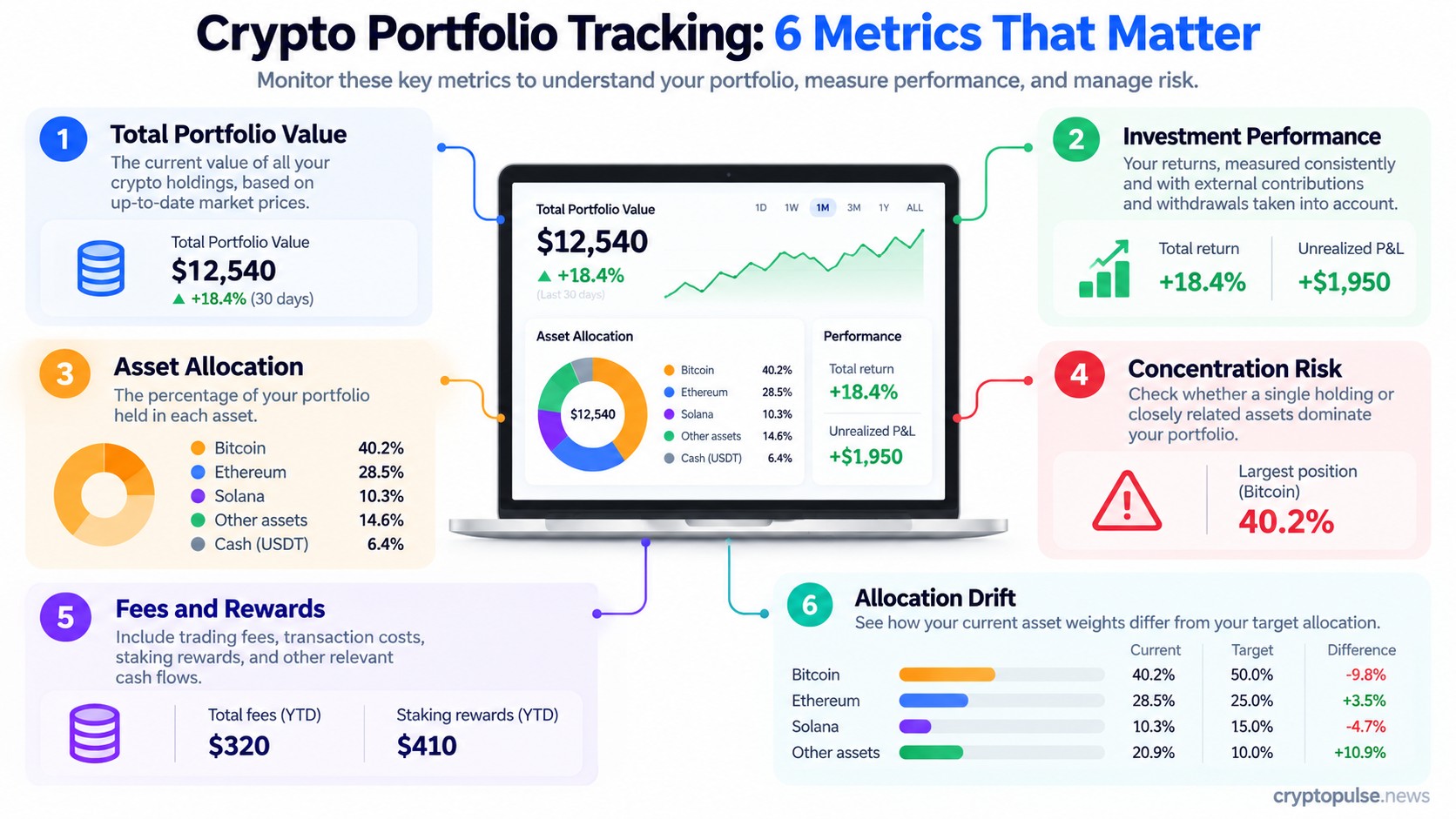
6. Track Portfolio Value, Returns, and Asset Allocation
A portfolio tracker becomes useful when it helps you understand not only what your assets are worth today, but also how your investments are performing and whether their distribution still matches your plan.
Three areas deserve particular attention: portfolio value and returns, performance comparisons, and portfolio composition.
Calculate Portfolio Value, Cost Basis, and Profit or Loss
Portfolio value is the combined current market value of all assets included in your portfolio, using consistent valuation prices and a common reporting currency, such as US dollars.
Cost basis is the recorded cost associated with acquiring an asset, determined using the applicable accounting method and adjusted where appropriate. Maintain reliable purchase records, including fees and transaction details.
Suppose you buy a cryptocurrency for $500 and its current market value rises to $600. Your position has an unrealized gain of $100, before fees and other adjustments. If you sell it, the resulting realized gain or loss is calculated using the relevant disposal proceeds and cost basis.
One important distinction: new deposits are not investment returns. If you transfer another $200 into your portfolio and leave it as cash, its total value rises from $600 to $800, but your investment gain remains $100.
Measure Returns and Compare Them With a Benchmark
Your dollar profit or loss does not always show how well your portfolio has performed, particularly when you add or withdraw money over time. Money-weighted return and time-weighted return are two common methods that answer different questions. Money-weighted return reflects the size and timing of your contributions and withdrawals, making it useful for understanding your personal investment experience. Time-weighted return reduces the influence of those cash flows, making it more suitable for evaluating investment performance independently of contribution timing.
Comparing performance with a relevant benchmark provides additional context. For a Bitcoin-focused portfolio, Bitcoin’s return may be a useful reference; a more diversified crypto portfolio may be better compared with a broad crypto-market index. Compare the same time period and use consistent return calculations. A benchmark helps put performance into perspective, but outperformance alone does not establish that a portfolio took less risk or followed a better strategy.
Monitor Allocation, Concentration, Fees, and Rewards
Tracking individual asset values is not enough. You also need to know how much each holding represents in the overall portfolio.
Asset allocation (%) = Current value of an asset ÷ Total portfolio value × 100
For example, if Bitcoin is worth $4,000 in a portfolio valued at $10,000, it represents 40% of the portfolio.
Review these percentages against your target allocation to identify growing concentration risks. Also account for trading fees, network transaction costs, staking rewards, and other relevant income or expenses. Missing transactions or duplicate records can distort both asset balances and calculated returns.
Keep a record of deposits, withdrawals, transfers between your own wallets, trades, and rewards. Moving assets between wallets you control is not the same as adding new capital or making an investment profit. Recording transfers correctly helps prevent double-counting and produces a more accurate picture of your portfolio.
7. Review Your Portfolio and Rebalance With Rules
Regular reviews help you determine whether your investments still serve their intended purpose. Instead of watching every price movement, establish a schedule and a set of conditions that will trigger a closer examination.
Establish a Consistent Review Schedule
A weekly or monthly review may be sufficient for many long-term investors, although the appropriate frequency depends on the strategy and complexity of the portfolio. Some investors may also review holdings after significant project developments, security incidents, or changes in their financial circumstances.
During each review, check total portfolio value, asset allocation, performance over a consistent period, transaction records, and concentration risk. Revisit the original reasons for holding each major asset and investigate whether any important assumptions have changed.
A simple record of review dates, observations, and decisions can be valuable. It allows you to distinguish deliberate strategic changes from reactions to temporary market sentiment.
The objective is not to predict every market move; it is to identify changes that matter to your portfolio.
Rebalance Deliberately, Not Emotionally
Rebalancing means adjusting holdings to bring the portfolio closer to its target allocation. It can become relevant when asset prices change enough to alter the intended distribution of risk.
For instance, imagine a hypothetical portfolio with a 50% target allocation to Bitcoin. After a strong rally, Bitcoin represents 62% of the portfolio. The investor might decide to sell part of the position or direct future contributions toward underweighted holdings.
Another approach is to establish predefined allocation thresholds—for example, reviewing an asset when its weight moves five percentage points away from its target. This is an illustrative rule, not a universally appropriate threshold.
Before making an adjustment, consider transaction costs, liquidity, applicable taxes, and the reasons behind the change. Rebalancing too frequently can generate unnecessary expenses, while rigidly selling an asset without reviewing new information can also be counterproductive.
Rebalance when your rules and circumstances justify it, rather than simply because an asset’s price has moved.
Common Crypto Portfolio Tracking Mistakes to Avoid
Even a well-structured portfolio can be difficult to manage when its records are incomplete or its performance is misunderstood. Several common mistakes are worth addressing early.
- Confusing deposits with returns: Track external contributions separately so that adding money does not appear to be investment growth.
- Double-counting transfers: Record transfers between your own wallets and exchanges correctly. Otherwise, the same holdings may appear twice.
- Ignoring fees and rewards: Include relevant transaction costs and staking income when calculating performance, while keeping the underlying records clear.
- Overlooking smaller accounts: Include holdings across supported exchanges, wallets, blockchain networks, and DeFi platforms to avoid an incomplete portfolio picture.
- Chasing recent winners: A sharp price increase may change an asset’s portfolio weight without improving its underlying investment case.
- Comparing inconsistent periods: Evaluate performance over clearly defined periods and use consistent valuation and return-calculation methods.
- Granting excessive tracker permissions: Avoid sharing private keys or seed phrases, and restrict exchange API access to the minimum necessary.
Accurate records and consistent methods matter more than a dashboard full of metrics. When figures look unusual, investigate missing transactions, valuation differences, and calculation settings before making investment decisions.
Final Thoughts: Build a Process, Not Just a Portfolio
Building a crypto portfolio is only the beginning. Long-term management requires a clear allocation strategy, careful asset research, secure storage, accurate records, and regular performance reviews.
Start with a process you can maintain. Define your goals and position limits, document every transaction, track returns separately from new contributions, and review your allocation according to predetermined rules. Use a spreadsheet or portfolio tracker that suits the complexity of your holdings, and verify its figures instead of assuming that every automated calculation is correct.
A well-managed portfolio is not necessarily the one with the most assets or the highest recent returns. It is one whose holdings, risks, and performance you understand well enough to make deliberate decisions.
Know what you own, understand why you own it, measure how it performs, and adjust your approach when the evidence and your objectives justify a change.
Frequently Asked Questions
A crypto portfolio records assets you own, their quantities, and often their purchase prices, allowing you to monitor your holdings and performance. A watchlist tracks cryptocurrencies you’re interested in without requiring you to own them.
Yes, several crypto portfolio trackers offer free access, while some charge for advanced features or integrations. You can also track holdings using a spreadsheet, although you may need to update prices and transactions manually.
Most standalone portfolio trackers are designed to monitor holdings rather than store funds or execute trades. Your assets remain in your exchange accounts or wallets unless you use a separate service that explicitly supports those functions.
A portfolio tracker can help organize transaction histories and estimate gains or losses, but its calculations may not satisfy all tax-reporting requirements. The rules depend on your jurisdiction, and you may need to verify transactions and apply the relevant tax treatment separately.
Learn More with CryptoPulse.News
- How to Manage Risk When Investing in Cryptocurrency
- How to Analyze Crypto Projects Before Investing
- How to Analyze the Crypto Market Using Key Indicators
- What Is Dollar-Cost Averaging (DCA) in Crypto