What Is Dollar-Cost Averaging (DCA) in Crypto
Learn how Dollar-Cost Averaging (DCA) helps crypto investors navigate market volatility by building positions gradually instead of relying on perfect market timing.
Cryptocurrency markets are known for their high volatility, with prices sometimes rising or falling by double-digit percentages within days or even hours. While experienced traders may attempt to profit from these movements, consistently buying at the “perfect” price is extremely difficult—even for professionals.
This is where Dollar-Cost Averaging (DCA) comes in. Rather than trying to predict market tops and bottoms, DCA focuses on consistency over timing. By investing the same amount of money on a regular schedule, investors gradually build their positions while reducing the emotional pressure that often leads to poor decisions.
This guide explains what Dollar-Cost Averaging is, how it works in cryptocurrency investing, its advantages and limitations, and when it may be a suitable strategy for long-term investors.
Table of Contents
- What Is Dollar-Cost Averaging?
- How Dollar-Cost Averaging Works in Crypto
- Benefits of Using DCA for Crypto Investing
- Risks and Limitations of DCA
- DCA vs Lump-Sum Investing
- Best Practices for Dollar-Cost Averaging in Crypto
- Common Mistakes to Avoid
- Frequently Asked Questions (FAQ)
What Is Dollar-Cost Averaging?
Dollar-Cost Averaging (DCA) is an investment strategy where a person invests a fixed amount of money at regular intervals, regardless of whether an asset’s price is rising, falling, or moving sideways. Instead of making a single large purchase, the investment is spread over time, resulting in different purchase prices and an average cost per unit.
Although the strategy is widely used across traditional financial markets, it has become especially popular in cryptocurrency because of the sector’s frequent price swings. Rather than worrying about buying Bitcoin or another digital asset at exactly the right moment, investors simply follow a predetermined schedule.
For example, instead of investing $1,200 in Bitcoin all at once, an investor could purchase $100 worth of Bitcoin every month for one year. Some months the price will be higher, resulting in fewer coins purchased, while other months the price will be lower, allowing the same investment to buy more cryptocurrency.

The primary objective of DCA is not to maximize short-term profits, but to promote disciplined investing while reducing emotional decision-making during periods of market volatility.
How Dollar-Cost Averaging Works in Crypto
The mechanics of DCA are simple, but understanding why the strategy works can help investors apply it more effectively. Rather than reacting to daily price movements, a DCA plan follows predetermined rules that remain unchanged regardless of market sentiment.
The Basic Process
A typical DCA strategy begins by choosing three fixed variables: the amount to invest, the cryptocurrency to purchase, and the investment schedule. For example, an investor might decide to buy $100 of Bitcoin every two weeks or $250 of Ethereum on the first day of each month.
Once these rules are established, purchases continue automatically or manually according to the schedule. The investment amount never changes based on price movements. When prices fall, the same amount buys more cryptocurrency. When prices rise, it buys less. Over time, this naturally produces an average purchase price rather than relying on a single market entry.
Many major cryptocurrency exchanges now offer recurring purchase features, allowing investors to automate the entire process and remove the temptation to constantly adjust their strategy based on headlines or short-term market volatility.
Example of DCA in Action
Imagine an investor decides to purchase $100 worth of Bitcoin on the first day of every month regardless of market conditions. During some months Bitcoin trades at higher prices, while in others it experiences significant corrections. Because the investment amount remains fixed, the number of bitcoins purchased changes each month.
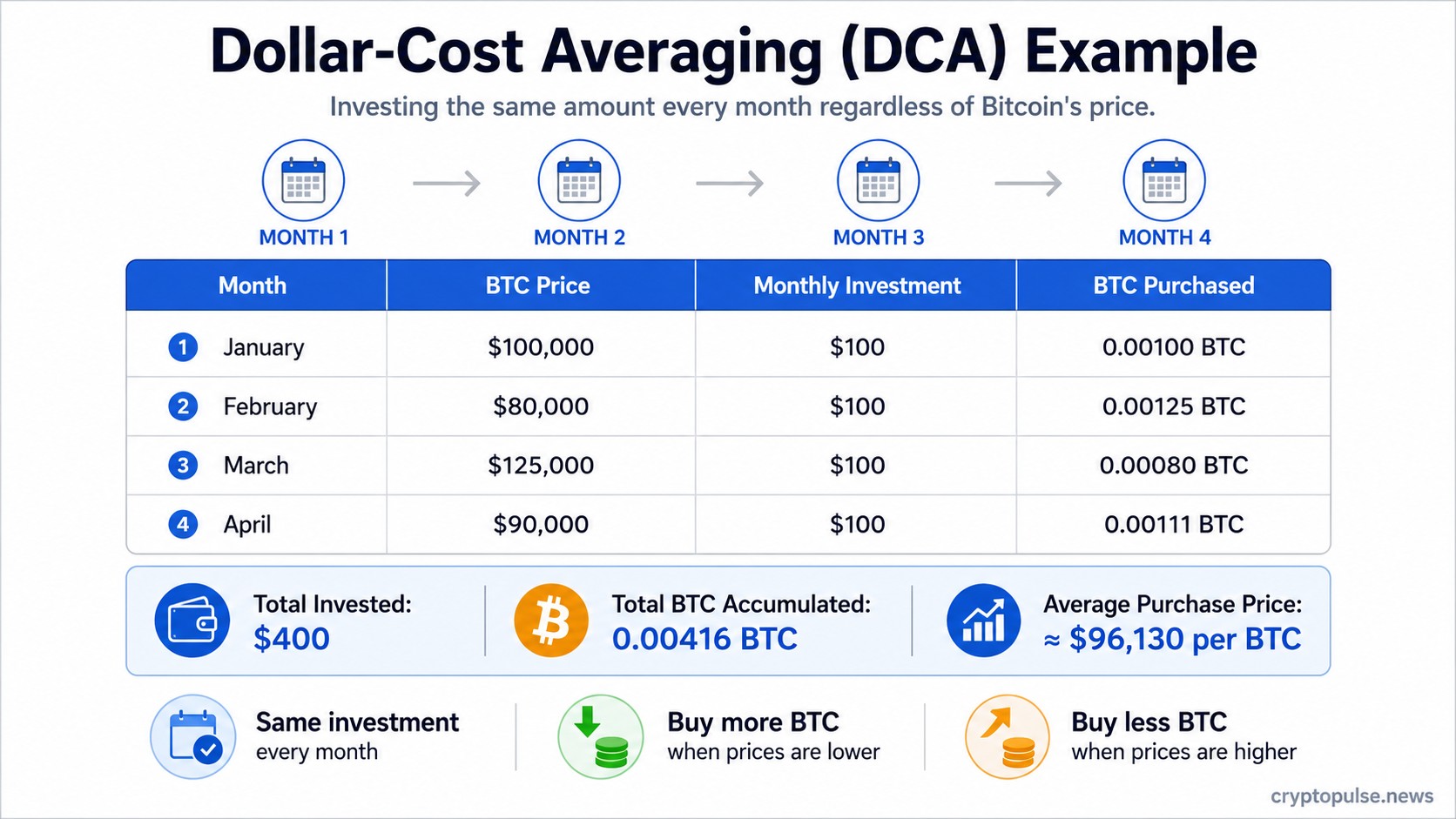
By following the same investment schedule regardless of market conditions, the investor gradually builds a Bitcoin position across different price levels. After several purchases, the investment reflects an average acquisition cost rather than a single entry price. This demonstrates one of the core principles of DCA: consistency replaces market prediction, helping investors avoid the pressure of making one perfect investment decision.
Benefits of Using DCA for Crypto Investing
Dollar-Cost Averaging has remained popular for decades because it addresses some of the biggest psychological and practical challenges investors face. While it does not guarantee higher returns, it can make long-term investing easier to maintain.
Reduces Emotional Decision-Making
One of the biggest advantages of DCA is that it helps reduce the impact of fear and greed, two emotions that frequently influence investment decisions. During sharp market declines, many investors hesitate to buy because they worry prices will continue falling. Conversely, during strong rallies, excitement and FOMO (Fear of Missing Out) often encourage people to buy near local highs.
A predefined investment schedule removes much of this emotional uncertainty. Instead of reacting to market headlines or social media sentiment, investors simply follow their existing plan. This disciplined approach can help reduce impulsive buying and selling decisions that often hurt long-term performance.
Encourages Long-Term Discipline
Successful investing often depends more on consistency than prediction. By investing regularly over months or years, DCA encourages investors to focus on long-term accumulation rather than short-term price fluctuations.
This mindset is particularly valuable in cryptocurrency markets, where temporary corrections of 20–50% have historically occurred even during broader bull markets. Investors following a DCA strategy are generally less concerned with daily volatility because they understand that each scheduled purchase is only one step within a much longer investment journey.
Makes Investing Easier to Automate
Another major advantage is convenience. Most leading cryptocurrency exchanges allow users to schedule automatic recurring purchases, eliminating the need to manually place orders every week or month.
Automation offers two key benefits. First, it helps maintain consistency even during busy periods. Second, it reduces the temptation to delay purchases while waiting for what appears to be a “better” entry point. Over time, this systematic approach can help investors remain committed to their investment plan regardless of changing market conditions.
Risks and Limitations of DCA
Although Dollar-Cost Averaging is often considered a lower-stress investment strategy, it is not a guarantee of profits. Like any investment approach, it has limitations that investors should understand before relying on it.
DCA Does Not Eliminate Investment Risk
A common misconception is that DCA protects investors from losses. In reality, it only changes how investments are made, not whether an asset ultimately gains or loses value.
If a cryptocurrency experiences a prolonged decline because of weak fundamentals, security failures, or reduced adoption, investing regularly will not prevent losses. DCA should therefore be applied primarily to assets that investors have researched and believe have long-term potential, rather than simply purchasing any cryptocurrency on a fixed schedule.
It May Underperform Lump-Sum Investing
Historical studies of traditional financial markets have shown that lump-sum investing often produces higher returns than DCA when markets trend upward over long periods. This is because more capital enters the market earlier and has more time to benefit from price appreciation.
However, lump-sum investing also exposes the investor to the risk of buying immediately before a major correction. DCA sacrifices some potential upside in exchange for lower timing risk, making it attractive for investors who prefer a more gradual approach or receive income regularly instead of having a large amount to invest all at once.
DCA vs Lump-Sum Investing
Both Dollar-Cost Averaging and lump-sum investing are legitimate investment strategies, but they suit different financial situations and risk tolerances. While lump-sum investing involves investing all available capital at once, DCA spreads investments over time. Neither approach is universally better—the right choice depends on factors such as market conditions, personal confidence, and the source of investment funds.
When Lump-Sum Investing May Perform Better
Lump-sum investing has historically outperformed DCA in many long-term rising markets, largely because the money enters the market immediately and has more time to appreciate. For example, an investor who purchased Bitcoin before a sustained bull market with a single investment would generally achieve higher returns than someone who gradually entered the market over several months.
However, this strategy requires confidence that the investment is being made at a reasonable valuation. If prices fall sharply shortly after investing, the entire portfolio is exposed to the decline from day one. For many investors, this creates significant psychological pressure and may lead to emotional decisions during periods of volatility.
When DCA May Be the Better Choice
DCA is often better suited to investors who receive regular income, are new to cryptocurrency, or simply prefer a more disciplined approach. Instead of trying to identify the perfect market entry, they invest consistently while gradually building their position over time.
The strategy may also be appropriate during periods of high uncertainty, when market direction is unclear and volatility remains elevated. While DCA does not eliminate losses, it reduces the likelihood of investing an entire portfolio immediately before a significant correction. For many long-term investors, the reduced emotional stress can be just as valuable as the investment strategy itself.
Best Practices for Dollar-Cost Averaging in Crypto
A DCA strategy is most effective when supported by clear rules and realistic expectations. The following practices can help investors maintain consistency while avoiding common pitfalls.
Choose a Consistent Investment Schedule
The exact schedule is less important than maintaining consistency. Some investors prefer weekly purchases, while others invest every two weeks or once a month. The best choice often depends on personal income patterns and budgeting preferences.
Changing the investment schedule based on market headlines defeats one of DCA’s core purposes. By sticking to predetermined intervals, investors remove much of the uncertainty associated with deciding when to buy.
Focus on Long-Term Goals
Dollar-Cost Averaging is designed for long-term accumulation, not short-term speculation. Investors should avoid judging the success of their strategy after only a few weeks or months, particularly during volatile market conditions.
Instead, focus on broader financial objectives such as building exposure to established cryptocurrencies over several years. Long investment horizons also allow investors to benefit from compound market growth if the chosen assets appreciate over time.
Review Your Strategy Without Constantly Changing It
Although DCA is largely automated, it should not be completely ignored. Investors should periodically review whether their financial situation, investment goals, or chosen assets have changed.
However, reviewing a strategy is different from reacting to every market movement. Frequently increasing, decreasing, or skipping scheduled purchases because of short-term price changes introduces emotion back into the process and reduces one of DCA’s biggest advantages—its consistency.
Common Mistakes to Avoid
Dollar-Cost Averaging is simple in theory, but investors can still make mistakes that reduce its effectiveness. Understanding common pitfails can help keep the strategy aligned with its original purpose.
Chasing the Market Instead of Following the Plan
Some investors abandon their fixed investment schedule whenever prices rise rapidly, purchasing larger amounts out of excitement or delaying purchases while waiting for prices to fall. Both behaviors undermine the discipline that makes DCA effective.
A successful DCA strategy depends on following predetermined rules rather than reacting to market sentiment. While no strategy removes uncertainty, consistency helps reduce emotional decisions over time.
Giving Up During Market Downturns
Market corrections are often the moment when investors feel least comfortable continuing their DCA plan. Ironically, these periods are also when the fixed investment amount purchases more cryptocurrency.
Stopping investments during downturns while only buying during bull markets can significantly reduce the long-term benefits of Dollar-Cost Averaging. Investors should ensure they only commit funds they can comfortably invest for an extended period, allowing the strategy to continue through different market cycles.
Ignoring Fees and Asset Quality
Frequent purchases can become less efficient if trading fees are high or if the investment amounts are very small. Before setting up a recurring purchase plan, compare exchange fees and minimum order sizes to ensure that transaction costs do not consume a meaningful portion of each investment.
Equally important is selecting high-quality assets. DCA is an investment method—not a guarantee that every cryptocurrency will succeed. Conducting thorough research before investing remains essential, regardless of how purchases are scheduled.
Conclusion
Dollar-Cost Averaging has become one of the most widely used long-term investment strategies because it emphasizes discipline, consistency, and risk management rather than market prediction. By investing a fixed amount at regular intervals, investors can reduce the emotional pressure of deciding when to enter the market while gradually building exposure to cryptocurrencies over time.
Although DCA cannot eliminate investment risk or guarantee positive returns, it offers a practical approach for many beginners and long-term investors who want to navigate crypto’s volatility more confidently. Combined with careful research, realistic expectations, and sound risk management, Dollar-Cost Averaging can form an important part of a thoughtful cryptocurrency investment strategy.
Frequently Asked Questions
Yes. Dollar-Cost Averaging is often considered one of the most beginner-friendly investment strategies because it removes the pressure of trying to buy at the perfect time. By investing a fixed amount regularly, new investors can build experience while reducing emotional decision-making.
There is no universally best schedule. Many investors choose weekly, biweekly, or monthly purchases based on their income and budget. The most important factor is maintaining a consistent investment schedule over the long term rather than choosing a specific interval.
DCA is generally considered more appropriate for established cryptocurrencies with strong long-term adoption, such as Bitcoin and Ethereum. Regardless of the asset, investors should research fundamentals and understand the risks before committing to a recurring investment strategy.
Yes. Most major cryptocurrency exchanges offer recurring buy or automatic purchase features that allow investors to schedule regular purchases. Automation helps maintain consistency and reduces the temptation to change an investment plan based on short-term market movements.
Learn More with CryptoPulse.News
- How to Buy Your First Cryptocurrency
- How to Manage Risk When Investing in Cryptocurrency
- Best Cryptocurrency Wallets for Beginners
- What is Bitcoin and Why It Matters Today