How to Bridge Crypto Between Blockchains Safely
Crypto bridges let users move assets between blockchain networks, but cross-chain transfers require extra care to avoid costly mistakes and security risks.
Blockchains do not naturally share the same accounts, assets, or transaction history. Crypto held on Ethereum, for example, cannot simply appear on another network because both chains maintain independent ledgers. Blockchain bridges solve this interoperability problem by creating routes for assets and, in some cases, data to move across networks.
Bridging has become a practical part of navigating a multi-chain crypto ecosystem, whether someone wants to access a decentralized application (dApp), move funds to a lower-cost network, or use an asset elsewhere. This guide breaks down what happens during a cross-chain transfer, how to complete one step by step, and what to check before putting funds at risk.
Table of Contents
- What Does Bridging Crypto Mean?
- Why Do People Bridge Crypto?
- How Do Crypto Bridges Work?
- How to Bridge Crypto Between Blockchains
- Popular Crypto Bridges and Aggregators
- How Much Does Bridging Cost and How Long Does It Take?
- What Are the Risks of Bridging Crypto?
- How to Bridge Crypto Safely
- Final Thoughts
- Frequently Asked Questions
What Does Bridging Crypto Mean?
Bridging crypto means transferring the value or representation of a crypto asset from one blockchain network to another through cross-chain infrastructure. The network where the transaction begins is usually called the source chain, while the network receiving the asset is the destination chain.
For example, someone holding ETH on Ethereum may want to use those funds on Arbitrum, a Layer 2 network built to scale Ethereum. A compatible bridge can facilitate the move from Ethereum to Arbitrum so the user can access applications and services available there.
This differs from an ordinary wallet transfer. Sending ETH from one Ethereum address to another keeps the entire transaction on Ethereum. A cross-chain bridge must coordinate activity between two separate blockchain environments.

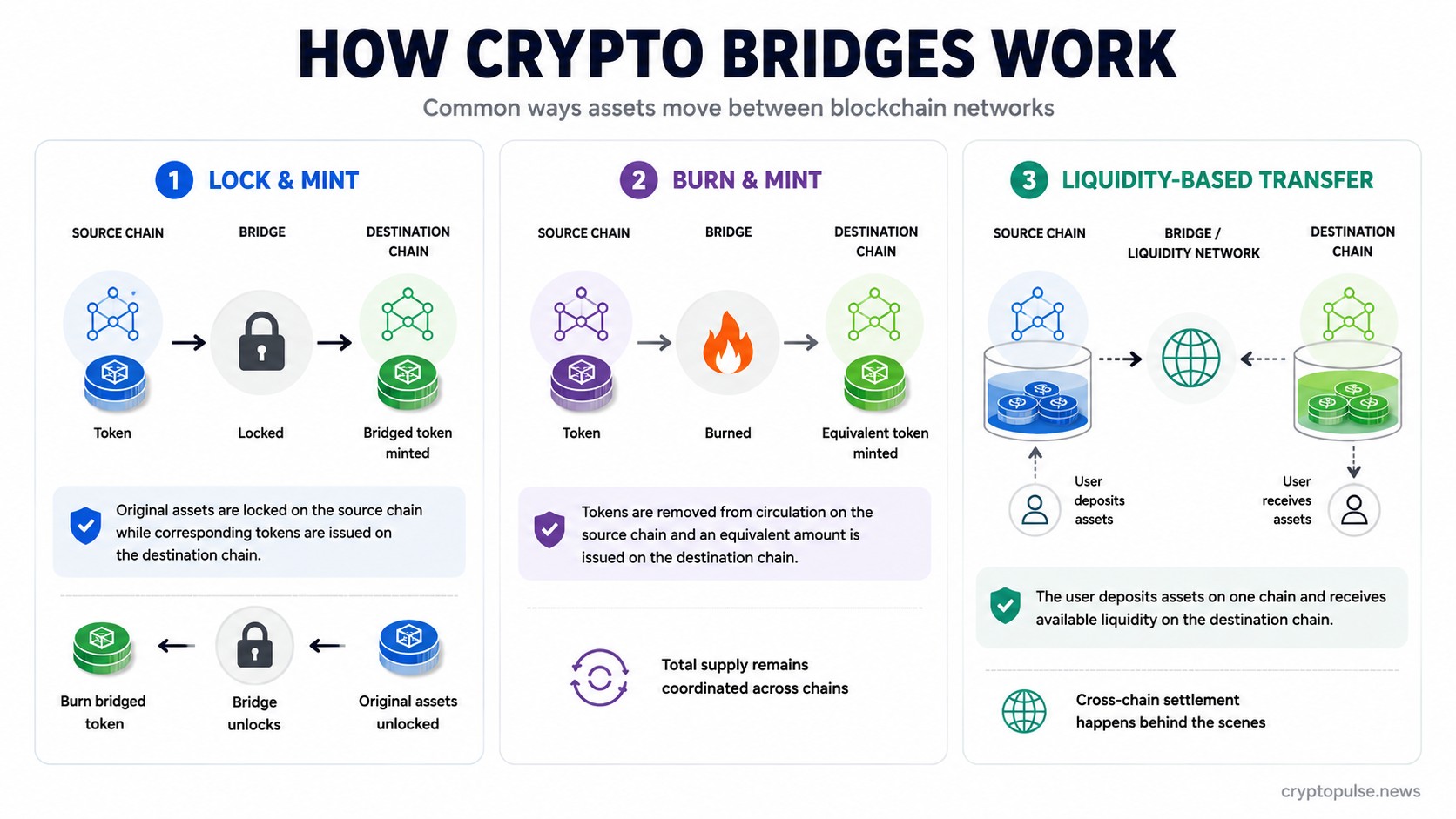
The asset does not necessarily travel between chains in the literal sense. Depending on the bridge design, tokens can be locked, burned, minted, released, or exchanged using liquidity on another network. Ethereum’s bridge documentation identifies lock-and-mint, burn-and-mint, and swap-based mechanisms as major approaches to cross-chain asset transfers.
Why Do People Bridge Crypto?
The main reason to bridge crypto is simple: different blockchain networks offer access to different applications, assets, liquidity, and user experiences. A wallet may contain the right asset but on the wrong network for what its owner wants to do.
Consider a user who holds a stablecoin on Ethereum but wants to use funds on BNB Smart Chain (BSC). A bridge can provide a route between the two networks, provided that the selected asset and route are supported. BNB Chain’s current bridge interface, for example, connects users with cross-chain routes between Ethereum and BNB Smart Chain through external bridge providers.
People may bridge assets to interact with DeFi protocols, use a dApp deployed on another chain, access liquidity elsewhere, or move to a network whose transaction costs better suit a particular activity. Developers also use cross-chain infrastructure to make applications available across multiple blockchain ecosystems.
Bridging therefore does more than move balances around. It helps overcome one of blockchain’s fundamental limitations: a network can have a thriving ecosystem while remaining technically isolated from other chains unless some form of interoperability connects them.
How Do Crypto Bridges Work?
There is no single technical design used by every crypto bridge. Some rely on smart contracts that lock assets, others change token supply across networks, and some use existing liquidity to complete transfers.
For beginners, the important point is that a bridge coordinates a transaction on the source chain with a corresponding action on the destination chain. The exact mechanism determines what happens to the original asset and what the user ultimately receives.
Lock and Mint
In a lock-and-mint bridge, tokens deposited on the source blockchain are locked in a smart contract or another custody mechanism. The bridge then creates, or mints, a corresponding representation of those assets on the destination blockchain.
Imagine that 100 units of a token are locked on Chain A. The bridge may issue 100 corresponding bridged tokens on Chain B. The original tokens remain locked rather than existing freely on both networks at once.
When the user later bridges back, the corresponding tokens on Chain B can be removed from circulation and the original assets released on Chain A.
This mechanism also explains why users sometimes encounter wrapped or bridged versions of familiar crypto assets. The token on the destination network may represent an asset secured or held elsewhere rather than being the original native asset itself.
Burn and Mint
Burn-and-mint removes tokens from circulation on one network and issues an equivalent amount on another. Instead of keeping the original assets locked indefinitely, the protocol coordinates the token’s supply across supported blockchains.
Suppose a cross-chain asset has 1,000 tokens circulating on Chain A. If a user bridges 100 of them to Chain B, those 100 can be burned on Chain A before 100 are minted on Chain B. The overall supply remains unchanged even though its distribution between networks has shifted.
This model is particularly relevant to assets designed from the outset to operate across multiple chains.
For users, however, the underlying mechanism may be largely invisible. What matters is verifying that the destination token is the asset they expect to receive, rather than assuming every token with the same ticker or name is interchangeable.
Liquidity-Based Transfers
Some bridges take a different approach by using liquidity already available on the destination network. Instead of waiting for an asset to be locked and a new representation minted for every transfer, liquidity providers or cross-chain protocols can supply the corresponding asset on the other side.
In simplified terms, a user deposits an asset on Chain A and receives an equivalent asset from available liquidity on Chain B. The protocol handles the accounting or settlement needed to keep the system balanced.
This approach can make the experience feel closer to a cross-chain exchange than physically “moving” a token. Ethereum’s documentation categorizes liquidity networks and atomic-swap-based systems among the mechanisms used for cross-chain asset transfers.
The distinction matters because different bridge designs introduce different assumptions around liquidity, security, speed, and trust. A smooth interface does not mean every bridge is doing the same thing underneath.
How to Bridge Crypto Between Blockchains
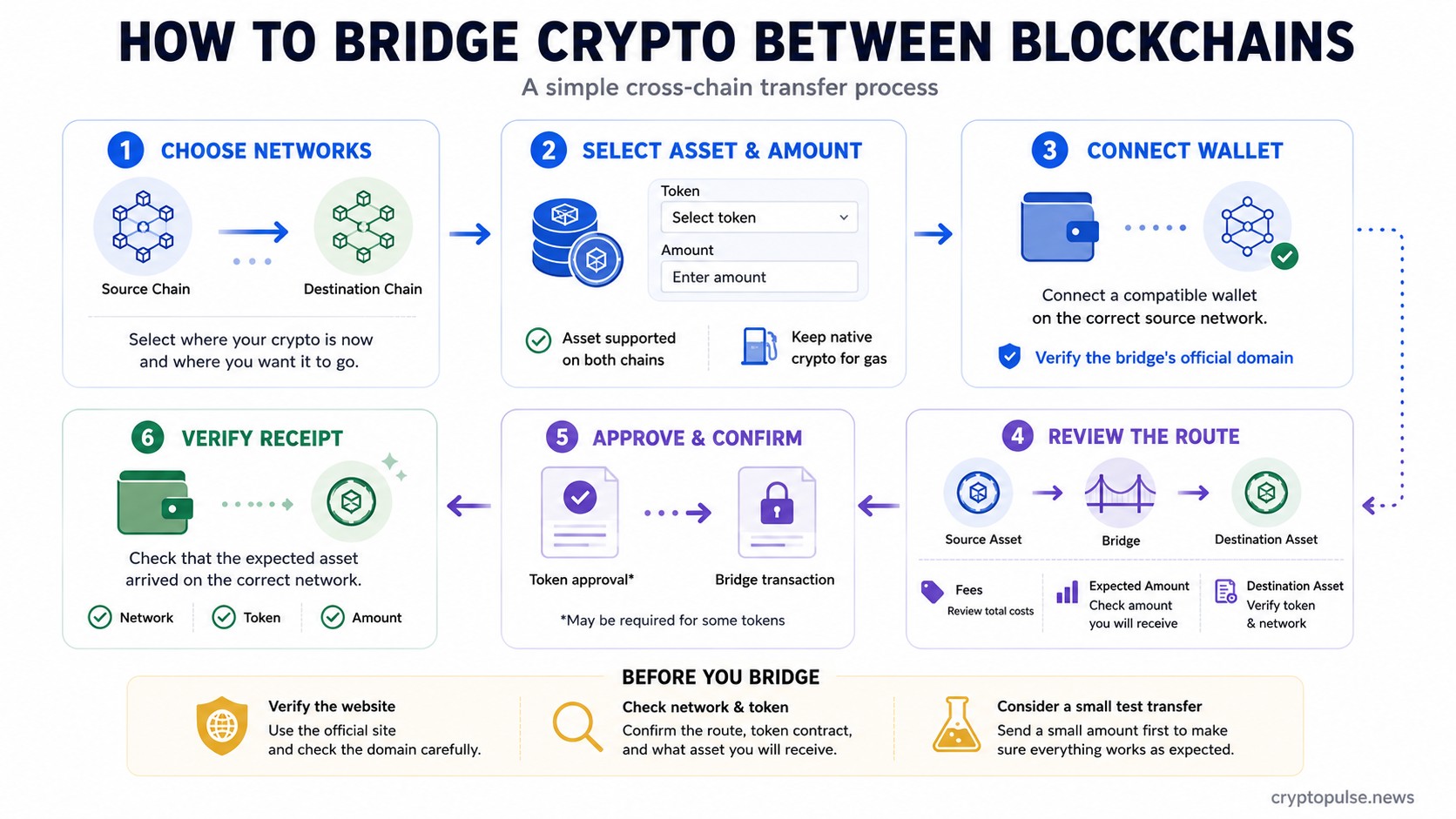
Although individual bridge interfaces differ, the basic user workflow is remarkably consistent. You select where the funds currently exist, where you want them to go, which asset to transfer, and then authorize the required blockchain transactions.
To make the process easier to follow, consider a hypothetical transfer involving a stablecoin from Ethereum to BNB Smart Chain. The example illustrates the general workflow rather than instructions for any particular bridge. Actual token and route support should always be verified before initiating a transfer.
Step 1: Choose the Source and Destination Networks
First, identify the blockchain where your crypto currently exists and the network where you need it.
In our example, Ethereum is the source chain and BNB Smart Chain is the destination chain. This distinction is critical: reversing the networks tells the bridge to route funds in the opposite direction.
Before proceeding, confirm that the service supports the desired network pair. A bridge supporting both Ethereum and BNB Smart Chain does not automatically support every possible token between them. Available routes depend on the infrastructure and liquidity provided for the specific asset.
Step 2: Choose the Asset and Amount
Next, select the cryptocurrency you want to bridge and enter the amount.
This is where users should pay close attention to token identity and destination support. Stablecoins provide a useful example because assets with familiar names or tickers may exist in different forms across networks. Never assume that selecting “USDC,” for instance, guarantees the same underlying token representation on every route.
You should also avoid transferring the entire wallet balance when the source network requires its native currency for transaction fees. An Ethereum transaction normally requires ETH for gas, even when the asset being bridged is a stablecoin or another ERC-20 token.
Step 3: Connect Your Wallet
A bridge generally needs a compatible self-custody wallet to request and authorize transactions. Connecting the wallet allows the application to see the relevant address and interact with the selected source network.
Connecting a wallet by itself is not the same as sending funds, but subsequent approval or transaction requests can grant permissions or move assets. Read each wallet prompt rather than automatically confirming it.
This is also the point where verifying the bridge’s website becomes especially important. Phishing sites can imitate legitimate bridge interfaces in an attempt to obtain malicious token approvals or signatures. Use the project’s official website and check the domain carefully before connecting a wallet.
Step 4: Review the Route and Fees
Before approving anything, review the transaction details presented by the bridge. Depending on the service, this can include the selected route, estimated network costs, protocol fees, expected destination amount, and the asset that will be received.
Some interfaces work as bridge aggregators, meaning they search routes offered by several underlying providers rather than operating every route themselves. BNB Chain’s bridge, for example, currently describes itself as an aggregator that displays routes supplied by external cross-chain providers.
The cheapest displayed route is not automatically the best choice. Check the networks, token contracts where appropriate, destination asset, and expected amount before comparing speed or cost.
Step 5: Approve and Confirm the Transaction
For some tokens, the wallet may first request an approval, which gives a smart contract permission to interact with a specified amount of the token. The actual bridge transaction is then submitted separately.
After confirmation on the source blockchain, the bridge coordinates the corresponding transfer or settlement on the destination network. Completion may not be instantaneous because the process can depend on blockchain confirmations and the bridge’s underlying design.
Once the transaction is complete, verify the destination wallet balance and make sure the expected asset arrived on the correct network. Do not assume a transaction has failed simply because the token does not immediately appear in a wallet interface; in some cases, the correct token contract or network must first be visible in the wallet.
Popular Crypto Bridges and Aggregators
Users can choose between dedicated cross-chain protocols, bridge aggregators, and ecosystem-specific interfaces. They may look similar from a user’s perspective, but the infrastructure handling a transfer can differ significantly, so a familiar interface should never replace checking the actual route.
Across Protocol is an example of an intent-based cross-chain bridge. Instead of requiring the user to wait for the entire underlying settlement process, independent relayers can provide the requested assets on the destination chain and receive reimbursement later. This separates the user’s transfer from final settlement.
deBridge provides cross-chain transfers through its deBridge Liquidity Network (DLN). Its design uses on-demand liquidity rather than maintaining shared liquidity pools, allowing market participants to fulfill cross-chain orders.
Another approach is an ecosystem interface such as the BNB Chain Bridge. Rather than operating every underlying route itself, it acts as an aggregator that can display routes from external providers. Its documentation lists providers including Stargate, Celer, deBridge, Meson, LayerZero, and Mayan.
These are examples rather than recommendations. Supported networks, assets, and routes can change, so users should verify current compatibility on official sources before transferring funds.
How Much Does Bridging Cost and How Long Does It Take?
There is no universal price or completion time for bridging crypto. The total cost depends on the source blockchain, bridge design, selected route, asset, and current network conditions.
A cross-chain transaction may involve a source-network gas fee, a bridge or protocol fee, and costs associated with providing or routing liquidity. Some designs may also require additional transactions, such as approving a token before it can interact with the bridge contract. Depending on the route, the amount received can therefore be slightly lower than the amount sent.
Timing varies for similar reasons. A bridge may need to wait for sufficient blockchain confirmations, while liquidity-based and intent-based systems can provide destination assets before the underlying cross-chain settlement is finished. Across, for example, uses relayers that front their own capital on the destination network before later settlement.
For users, the practical rule is straightforward: review the estimated amount received, fees, and route before confirming instead of assuming that every bridge transfer costs or performs the same.
What Are the Risks of Bridging Crypto?
Bridges solve an important interoperability problem, but they also introduce components beyond the source and destination blockchains. That additional complexity creates risks that do not exist in a simple transfer within one network.
The specific risk depends partly on how the bridge works. A protocol holding assets in smart contracts faces different assumptions from an intent-based system using relayers or a service relying on external validators. Users also face risks unrelated to the bridge architecture itself, including phishing and transaction mistakes.
Smart Contract and Bridge Risk
Cross-chain protocols can rely on smart contracts, validators, relayers, liquidity providers, or combinations of these components to coordinate activity between networks. A vulnerability or failure in critical infrastructure can therefore put bridged funds at risk even if the underlying blockchains continue operating normally.
Lock-and-mint designs illustrate the issue clearly. If substantial assets are locked on one chain to back tokens issued elsewhere, the contracts or custody mechanism securing those assets become particularly important.
Security models also vary between protocols. A bridge being decentralized or non-custodial does not make it risk-free. Users should consider how transfers are verified and whether the protocol has clear documentation, security information, and a meaningful operating history rather than judging safety from interface design alone.
Fake Bridges and Phishing
Not every bridging risk comes from the underlying protocol. A convincing fake website can imitate a legitimate bridge and trick users into signing malicious transactions or granting token permissions.
This makes the point at which a wallet is connected especially sensitive. Users should avoid blindly following bridge links from unsolicited messages, social-media replies, or unfamiliar advertisements. Instead, find the project’s official source and verify the domain before connecting.
Wallet prompts deserve the same attention. A request to sign a message, approve token spending, or submit a transaction can have very different consequences. Never treat repeated wallet confirmations as routine pop-ups that can safely be clicked through without reading them.
If a website unexpectedly requests permissions unrelated to the intended bridge transaction, stopping and verifying the request is safer than proceeding.
User and Network Errors
Cross-chain transactions also create opportunities for ordinary mistakes. Users can select the wrong destination network, choose an unsupported token route, misunderstand which version of an asset they will receive, or leave themselves without enough native currency to pay gas.
Token identity is particularly important. Two assets displaying the same ticker are not necessarily the same token, and bridged or wrapped representations may have different contract addresses and security assumptions.
Another common source of confusion is the destination wallet balance. The transfer may have completed successfully even though the wallet interface does not immediately display the received token.
Before assuming funds are lost, users can verify the transaction through the appropriate blockchain explorer and confirm that the wallet is viewing the correct network and token contract. Cross-chain transfers should be checked on both sides of the route, not only through the bridge interface.
How to Bridge Crypto Safely
No bridge can make a cross-chain transaction completely risk-free. However, a few checks before signing a transaction can prevent many avoidable losses, especially those caused by phishing, unsupported routes, and user error.
Start by reaching the bridge through its official website and confirming the domain before connecting a wallet. Verify that the exact source network, destination network, and asset are supported. If the destination asset is wrapped, bridged, or otherwise different from the original token, understand what you will receive and whether it can be used for your intended purpose.
Next, review the expected output and all wallet requests. Keep enough of the source network’s native currency available for gas, and avoid granting permissions that are broader than necessary when the wallet or application provides a choice.
For a significant transfer, consider sending a small test amount first. It adds another transaction and potentially another fee, but it can confirm that the address, network, asset, and route behave as expected before more funds are committed.
Finally, remember that popularity is not a security guarantee. Prioritize a bridge’s security model, documentation, route transparency, and your own verification over simply choosing the fastest or cheapest option.
Final Thoughts
Blockchain bridges make it possible to use crypto across ecosystems that would otherwise remain largely isolated. They can connect users with applications, liquidity, and services on other networks without requiring every blockchain to operate as one system.
That flexibility comes with additional complexity. A safe cross-chain transfer starts with understanding the source and destination networks, confirming the exact asset being received, reviewing the route, and verifying every wallet request before signing.
The interface may reduce bridging to a few clicks, but the transaction underneath can involve smart contracts, liquidity providers, relayers, validators, or other infrastructure. Understanding those basics makes bridging considerably less confusing—and helps users navigate an increasingly multi-chain crypto ecosystem with greater confidence.
Frequently Asked Questions
No. Bridging typically moves an asset or its representation from one blockchain to another, while swapping exchanges one crypto asset for another. Some cross-chain services combine bridging and swapping into a single transaction route, which can make the distinction less obvious.
Yes, many bridges support transfers in both directions, allowing assets to be moved back to their original network. However, users should verify that the return route and specific asset are supported before initiating the transaction.
A failed or delayed bridge transaction does not necessarily mean the funds are lost. The outcome depends on the bridge and where the transaction failed, so users should check the source and destination blockchain explorers and follow the bridge provider’s recovery or support instructions.
It depends on the jurisdiction and what happens to the asset during the bridge transaction. A transfer of the same beneficial asset may be treated differently from a route that swaps or converts it into another token, so users should check local tax rules or consult a qualified tax professional.
Learn More with CryptoPulse.News
- What Is Blockchain Technology and How It Works
- What Is Layer 2 and Its Role in the Future of Blockchain
- What Is DeFi? A Simple Guide to Decentralized Finance
- How to Store Cryptocurrency Securely: A Beginner’s Guide
- 10 Common Cryptocurrency Mistakes Beginners Should Avoid