
Ark Invest: 35% of Bitcoin Supply Faces Quantum Risk
A new report by Ark Invest and Unchained suggests that roughly one-third of Bitcoin’s supply could theoretically be exposed to future quantum computing attacks, though researchers stress the threat remains long-term.
The rapid development of quantum computing technology has reignited debate over the long-term security of Bitcoin’s cryptography, with a new report suggesting that a significant share of the network’s supply could eventually face risk if breakthroughs occur.
According to a March 11 white paper published by Ark Invest in collaboration with Bitcoin financial services firm Unchained, approximately 34.6% of the total Bitcoin supply could theoretically be vulnerable to quantum attacks if quantum computers become capable of breaking the elliptic curve cryptography (ECC) that protects Bitcoin wallets.
However, the report emphasizes that around 65.4% of the Bitcoin supply is currently considered safe from such threats under present technological conditions.
Researchers argue that even if quantum computing capabilities improve substantially, the development timeline is likely to unfold gradually, providing the Bitcoin ecosystem with years of warning and preparation before any real security crisis emerges.
How Much Bitcoin Could Be Vulnerable?
The report estimates that the potentially exposed portion of Bitcoin stems largely from older address formats and address reuse, which reveal public keys and therefore become theoretically susceptible if cryptographic protections are broken.

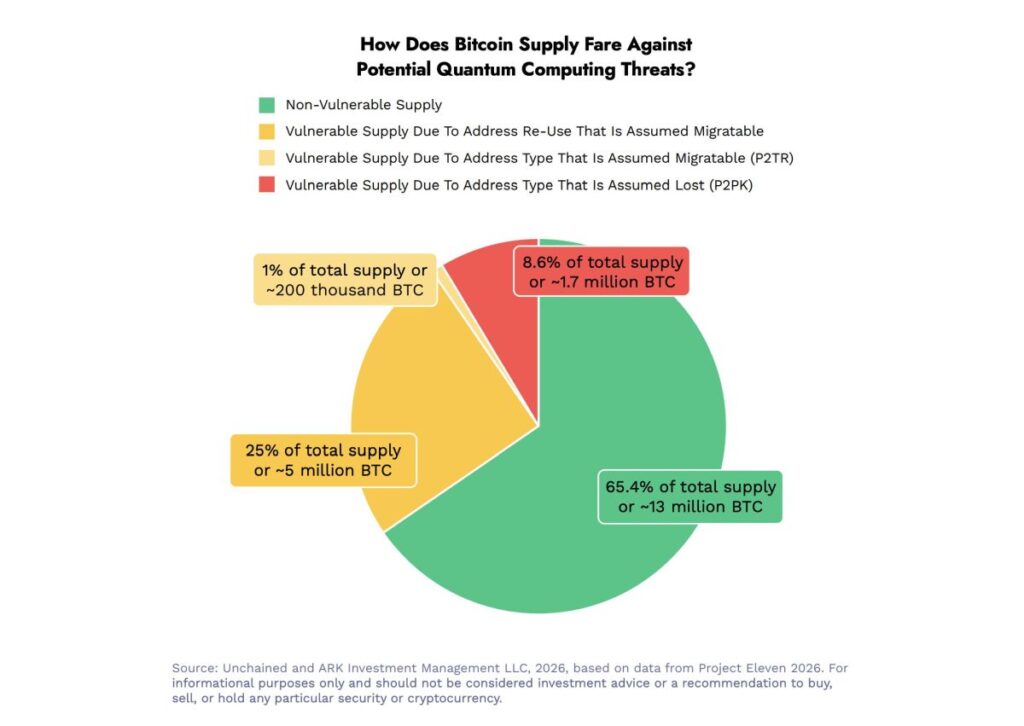
The vulnerable supply includes:
- 5 million BTC (about 25% of the total supply) associated with address reuse, meaning coins could potentially be migrated to safer addresses.
- 1.7 million BTC (8.6%) stored in Pay-to-Public-Key (P2PK) addresses, one of Bitcoin’s earliest transaction formats that directly exposed public keys on-chain.
- Around 200,000 BTC (about 1%) linked to Pay-to-Taproot (P2TR) addresses that could also potentially be migrated.
If a quantum computer were capable of breaking Bitcoin’s 256-bit elliptic curve cryptography, attackers could theoretically derive private keys from exposed public keys and access those funds.
According to the report, achieving this would require around 2,330 logical qubits along with tens of millions to billions of quantum operations, far beyond current capabilities.
Other Estimates Suggest Lower Exposure
Ark Invest’s projections are notably higher than some other recent analyses.
A February study by CoinShares concluded that the realistically vulnerable portion of Bitcoin was approximately 10,200 BTC, representing only 0.05% of the total supply, even though legacy address formats technically create a larger theoretical exposure.
The discrepancy highlights the uncertainty surrounding how much of Bitcoin’s supply could actually be targeted if quantum breakthroughs occur.
The Ark report takes a broader approach, including coins that could be migrated but are currently held in potentially vulnerable address structures.
Quantum Computing Progress Still in Early Stages
Despite growing concerns, the report stresses that quantum computing remains far from posing an immediate threat to Bitcoin.
Today’s quantum machines operate with limited qubits and significant error rates, meaning they are not capable of attacking modern cryptographic systems.
Ark researchers describe quantum risk as a “long-term” issue, noting that the technology will likely evolve through several stages before reaching the capability needed to challenge Bitcoin’s encryption.
The report outlines a five-stage development model:
Stage 0 — Early Quantum Machines
Quantum computers exist but are not commercially useful and lack the capability to threaten cryptographic systems.
Stage 1 — Commercial Applications
Quantum computers begin to show practical use in areas such as chemistry and materials science, while cryptographic applications remain out of reach.
Stage 2 — Breaking Weak Cryptography
Quantum machines become capable of breaking weaker or outdated encryption systems, but not modern elliptic curve cryptography.
Stage 3 — Breaking Bitcoin Keys
Quantum computers could theoretically break elliptic curve cryptography used in Bitcoin, though the process would take a long time, exposing vulnerable addresses.
Stage 4 — Rapid Key Breaking
Quantum attacks become faster than Bitcoin’s 10-minute block time, requiring major protocol-level upgrades to maintain network security.
The report indicates that Stage 3 would mark the first real risk for Bitcoin wallets, while Stage 4 would require network-wide upgrades.
Major Quantum Milestones Expected in the Coming Decade
Industry investment in quantum computing continues to accelerate.
Chicago-based PsiQuantum is currently developing a facility expected to house one million physical qubits, a milestone researchers believe could mark a major leap in quantum capability.
The company has raised $1 billion from funds linked to BlackRock to support the project, which is expected to be completed around 2027.
Even so, many experts believe it may take until the mid-2030s before quantum machines can realistically break a public key used in Bitcoin.
The Ark report cites consensus targets from major technology companies including Google, IBM, and Microsoft, which are all actively pursuing large-scale quantum systems.
Bitcoin May Eventually Need Quantum-Safe Cryptography
Although the threat is distant, the report argues that Bitcoin will ultimately need to adopt quantum-resistant security measures.
This would involve introducing post-quantum cryptography (PQC) to the network, potentially through new address formats and upgraded signature schemes.
Potential cryptographic approaches mentioned in the report include:
- ML-DSA, a lattice-based signature scheme
- SLH-DSA, a hash-based signature algorithm
Ark researchers say these emerging standards demonstrate the growing maturity of post-quantum cryptography, but integrating them into Bitcoin would not be simple.
Because Bitcoin operates under decentralized governance, any protocol change requires widespread agreement among miners, developers, and node operators—likely through a soft fork upgrade.
Preparing Bitcoin for a Post-Quantum Future
Rather than viewing quantum computing as an imminent threat, the report suggests that the next several years should be used to strengthen Bitcoin’s resilience before the technology matures.
Key steps could include:
- Migrating funds from vulnerable addresses to newer formats
- Developing quantum-safe wallet standards
- Researching protocol upgrades for post-quantum cryptography
- Educating investors about the realistic timeline of quantum risks
Ultimately, the researchers argue that the slow evolution of quantum technology gives the Bitcoin ecosystem a valuable advantage: time.
By addressing vulnerabilities gradually and coordinating governance decisions, the network could transition toward quantum-resistant infrastructure long before the technology becomes powerful enough to threaten its core security model.